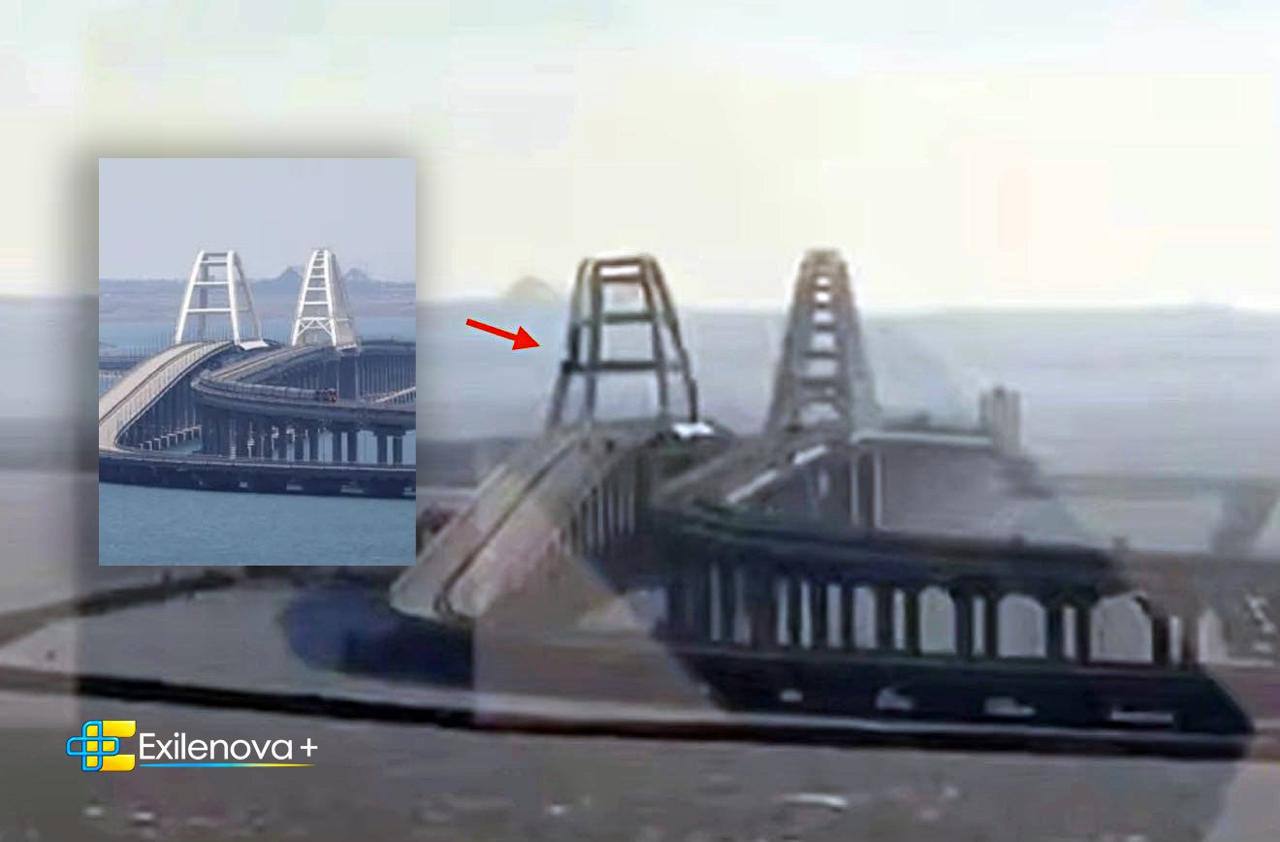
In the pre-dawn hours of November 17, 2026, Ukrainian defense forces executed a precision missile strike on the Crimean Bridge, marking the second such attack within 48 hours. The assault utilized the newly developed Ukrainian cruise missile, the FP-5 “Flamingo,” a product of the private defense company Fire Point. The strike resulted in the collapse of a key arch span on the road section of the bridge and caused critical damage to the railway tracks. Movement of vehicles and trains across the vital crossing has been completely halted, and navigation through the Kerch Strait has been officially suspended by occupying authorities.
Real-Time Video and Response to Attacks on Kyiv Bridges
Technological advancements were a hallmark of this operation, with the FP-5 “Flamingo” missile’s onboard electro-optical camera providing real-time footage of its flight. These visuals, now publicly available, show the missile’s high-precision guidance system targeting the most vulnerable engineering point of the structure – the navigational arch.
This strike is seen as a direct and sovereign response by Ukraine to persistent Russian attempts to destroy bridges over the Dnipro River in Kyiv. The deployment of an indigenous long-range cruise missile circumvents any political restrictions previously imposed by Western partners regarding the use of weaponry on strategically important targets within temporarily occupied territories.

Cascading Effect: Blocking the Kerch-Yenikalye Canal and the Caspian
Mykhailo Gonchar, President of the Center for Global Studies “Strategy XXI,” emphasizes that the collapse of the arch span has triggered a large-scale cascading effect extending far beyond the Crimean Peninsula.
- Navigational Waterway Blockage: Although the Kerch Strait is 4.5 kilometers wide at its narrowest point, its depth does not exceed 3-5 meters. The sole passage for large vessels is the artificial Kerch-Yenikalye Canal, only 120 meters wide, which is now obstructed by debris from the collapsed arch.
- Isolation of the Azov, Don, Volga, and Caspian Seas: Ships designed for “river-sea” transport, carrying refined oil products from refineries along the Middle Volga, Kama, and Don rivers, as well as export grain, are now caught in a prolonged logjam. Russian Railways would be unable to reroute these cargo flows to other ports.
- Blockade of Russian Naval Fleets: Patrol boats and small missile ships of the Black Sea and Caspian Fleets have lost the ability to maneuver through inland waterways between Novorossiysk and Kaspiysk via the Volga-Don Canal.

Operational Blockade of Crimea and the Factor of Russian Troops
Political scientist and analyst Vadym Denysenko highlights four key military-political consequences of the bridge’s destruction:
- Effective Logistical Blockade of the Peninsula: With the absence of ferry services and the halt of railway traffic, the only remaining supply route to Crimea is the vulnerable land corridor, often referred to as the “road of death.” This will inevitably lead to a severe deficit of fuel and ammunition.
- Sacred and Symbolic Defeat: Despite Kremlin attempts to downplay the object’s media significance, the physical destruction of the structure shatters the myth of invulnerable Russian air defense.
- Information Blackout for the Region: Following a pattern seen in operations in Kursk or blackouts in Belgorod, Russian propaganda will likely remove Crimea and Sevastopol from the federal information space.
- Disruption of Russian Army Reinforcement: The severed artery makes it impossible to quickly redeploy reserves to bolster the offensive actions of the Russian “Dnieper” group of forces.

Matrix of Cascading Consequences from the FP-5 ‘Flamingo’ Missile Strike
The table below summarizes the military, economic, and infrastructural impact of the repeated strike on the Kerch Bridge as of November 17, 2026.
| Sphere of Impact | Physical Result of Strike | Strategic Consequence for Russia |
| Railway and Road Communication | Arch span collapse, track destruction | Complete traffic halt; Crimea becomes a logistical island |
| Maritime Logistics and Exports | Blockage of the 120m Kerch-Yenikalye Canal fairway | Halt of “river-sea” tankers with oil products from Volga/Don and grain exports |
| Russian Naval Forces | Inability to pass under the destroyed arch | Disruption of connection between the Black Sea Fleet and the Caspian Flotilla |
| “Dnieper” Group of Forces | Overload of the land corridor via Azov region | Disruption of ammunition and fuel supplies, impossibility of escalating offensive actions in the south |
HiTech Expert Take
The deployment of the FP-5 “Flamingo” cruise missile by Ukrainian company Fire Point, coupled with real-time flight broadcasting, signifies the advancement of private Ukrainian missile development to the strategic operations level. In the context of “Middle Strike” results in October, which saw the destruction of 19 air defense/electronic warfare assets, and the launch of grant competitions for missiles and radar systems under Brave1, the breakthrough of dense Russian air defenses near Kerch demonstrates the high anti-jamming capabilities of domestic guidance systems.
Simultaneously, Vadym Denysenko rightly points out the challenge posed by limitations in satellite communication channels (Starlink/Starshield), which complicate continuous fire control of the land corridor along the “Novorossiya” highway. Therefore, the implementation of sovereign communication systems, such as the powerful “GRIM” LTE modem (1.5W) from Militech Group with a range of up to 45 km, and the scaling of domestic fiber-optic UAVs, become critically important tools for finally severing enemy land logistics in the Azov region.