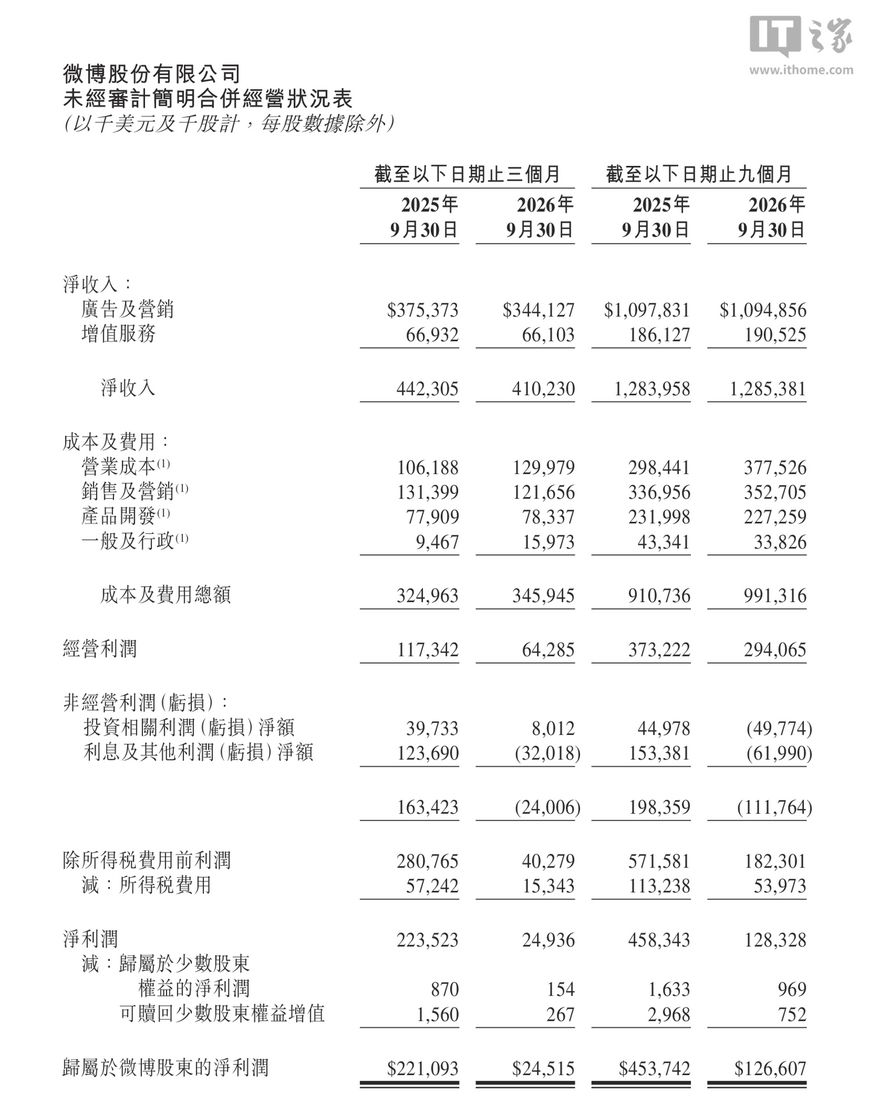
Weibo Corporation, a leading social media platform in China, has released its financial report for the third quarter of fiscal year 2026, revealing a significant downturn in its net profit. For the period spanning July to September 2026, the company reported a net profit attributable to shareholders of $24.515 million, a steep decline of 88.91% compared to the same period last year.
Key Financial Highlights for Q3 FY2026
Weibo’s total revenue for the third quarter stood at $410 million, marking a 7% decrease year-over-year. The primary revenue streams, advertising and marketing services, saw a decline of 8% to $344 million. Value-added services contributed $66.103 million, down 1% from the previous year.
The net profit attributable to Weibo shareholders was $24.515 million, a stark contrast to the $221 million reported in Q3 FY2025. On a non-GAAP basis, net profit attributable to shareholders was $14.348 million. Basic and diluted earnings per share both stood at $0.10.
The company reported operating cash outflow of $10.2 million for the quarter. Capital expenditures were $1.9 million, with depreciation and amortization totaling $15.6 million.
Year-to-Date Performance
Looking at the first three quarters of FY2026, Weibo’s cumulative net revenue reached $1.285 billion, down from $1.671 billion in the same period last year. Cumulative net profit attributable to shareholders was $127 million, a considerable drop from $454 million in the prior year. Non-GAAP net profit attributable to shareholders for the nine-month period was $209 million.
As of September 30, 2026, Weibo’s cash, cash equivalents, and short-term investments totaled $2.31 billion, indicating a strong liquidity position.
User Base and Operational Metrics
Despite the financial challenges, Weibo maintained a substantial user base. As of the end of September 2026, the platform had 551 million monthly active users (MAUs) and 254 million average daily active users (DAUs).
Factors Affecting Profitability
The decline in profitability can be attributed to several factors. On the revenue side, advertising demand showed divergence, with reduced spending from sectors like e-commerce, online gaming, and beauty. Advertising revenue from Alibaba also decreased by 33% compared to a high base in the previous year. On the cost side, increased advertising production costs, combined with significant decreases in investment-related gains and net interest income compared to the previous year, led to a contraction in the overall operating profit margin, which fell from 27% to 16% year-over-year.
Future Outlook and Strategic Focus
Weibo’s management remains committed to strengthening its information feed products, expanding the video creator ecosystem, and leveraging AI capabilities to enhance advertising effectiveness and cross-industry penetration. These initiatives are aimed at solidifying the platform’s long-term competitiveness.
The company is characterized as a mature internet stock with a low valuation, ample cash reserves, and a history of high shareholder returns through dividends. However, near-term performance will depend on the recovery pace of the advertising industry and the platform’s ability to drive revenue growth through increased user activity.
Analysts note that Weibo’s Q3 results were below market expectations, with both revenue and net profit falling short of consensus forecasts. Investors will be closely monitoring the company’s ability to navigate the current economic climate and execute its strategic priorities.