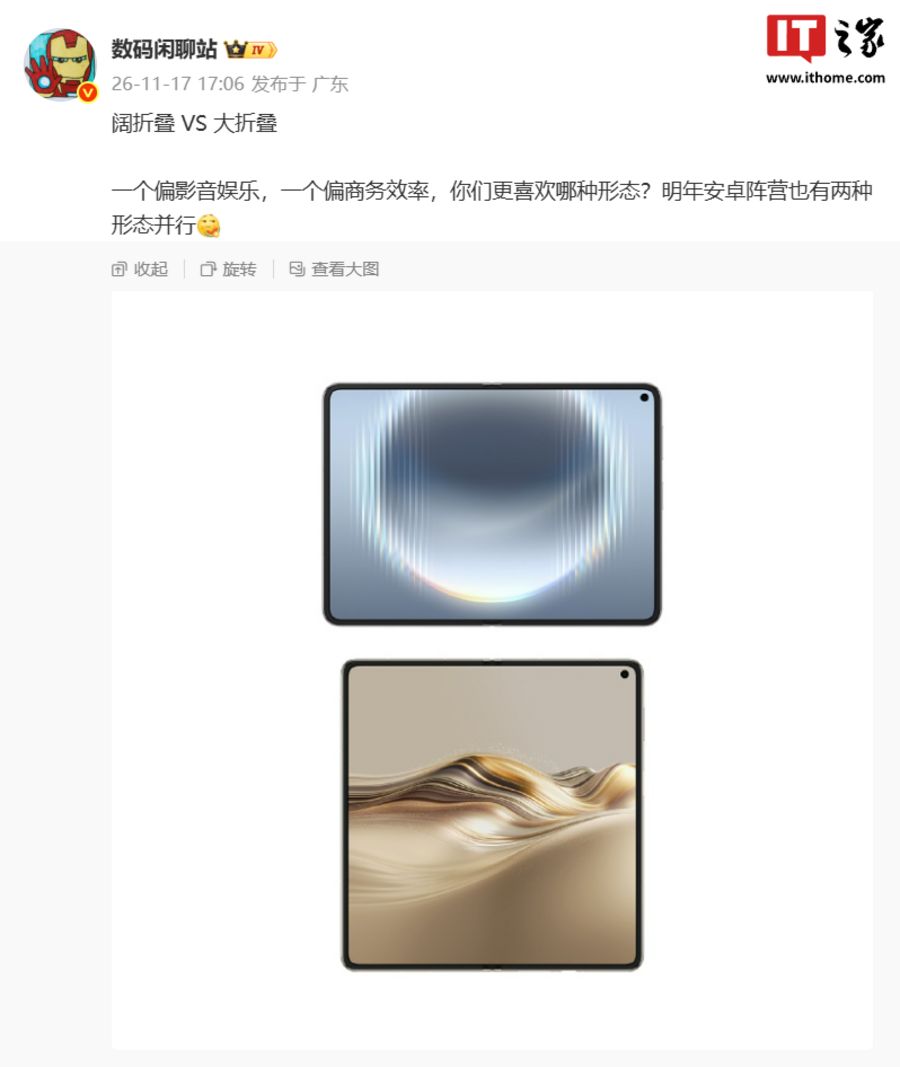
The foldable smartphone market is poised for a significant evolution, with two distinct form factors set to dominate the Android landscape next year: the ‘wide fold’ and the ‘large fold’. This divergence in design promises to cater to different user needs and preferences, from productivity to immersive entertainment.
Defining the Foldable Forms
Industry observers and leakers are highlighting a clear split in the upcoming foldable phone designs. The ‘large fold’ refers to the more traditional, squarer aspect ratio of its inner display, often close to a 1:1 proportion. This form factor offers ample internal space, creating opportunities for more robust component integration. Manufacturers can potentially pack in larger batteries, enhanced cooling systems, and more advanced camera modules. This also translates to a better user experience for multitasking and productivity-oriented tasks, making it a strong contender for mobile work environments.
In contrast, the ‘wide fold’ is characterized by a more elongated inner display, typically with an aspect ratio closer to the $\sqrt{2}$:1 proportion. This newer design trend, exemplified by devices from leading manufacturers, aims to provide a more immersive viewing experience. The wider screen is ideal for consuming media like videos and games, offering a tablet-like feel that enhances engagement. While potentially offering less internal space for high-end components compared to its larger counterpart, the wide fold’s novel design and media-centric advantages are already proving popular.
Market Trends and Projections
Several major players have already embraced the wide fold form factor. Huawei, a pioneer in this space, has reported significant success, with its wide fold smartphones exceeding 3.21 million units shipped by October of this year. This indicates a strong market reception for the innovative design.
Looking ahead, market research firm Omdia forecasts a substantial growth trajectory for the global foldable smartphone display market. Their October 21st report projects that shipments of AMOLED displays for foldable smartphones will reach 29 million units by 2026, marking a significant 44% year-over-year increase.
Furthermore, Omdia’s analysis suggests that displays for wide fold phones will constitute 44% of the total foldable panel shipments in 2026. This share is expected to climb even higher, surpassing 60% by 2027, as more Chinese manufacturers enter and expand within this segment. Analyst Brian Huh noted the positive market response, stating that the wide screen foldable format has “initially gained consumer recognition.”
The Future Landscape
The concurrent development of both wide and large foldable phone designs indicates a maturing foldable market that is segmenting to meet diverse consumer demands. This dual-pronged approach by Android manufacturers is expected to drive further innovation in screen technology, hinge mechanisms, and software optimization. As foldable phones move beyond niche products to mainstream options, the choice between a productivity-focused large fold and an entertainment-centric wide fold will likely become a key differentiator for consumers navigating the next generation of mobile devices.