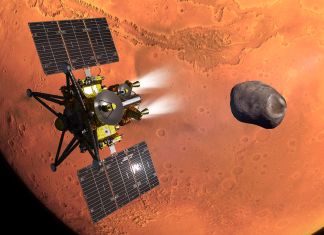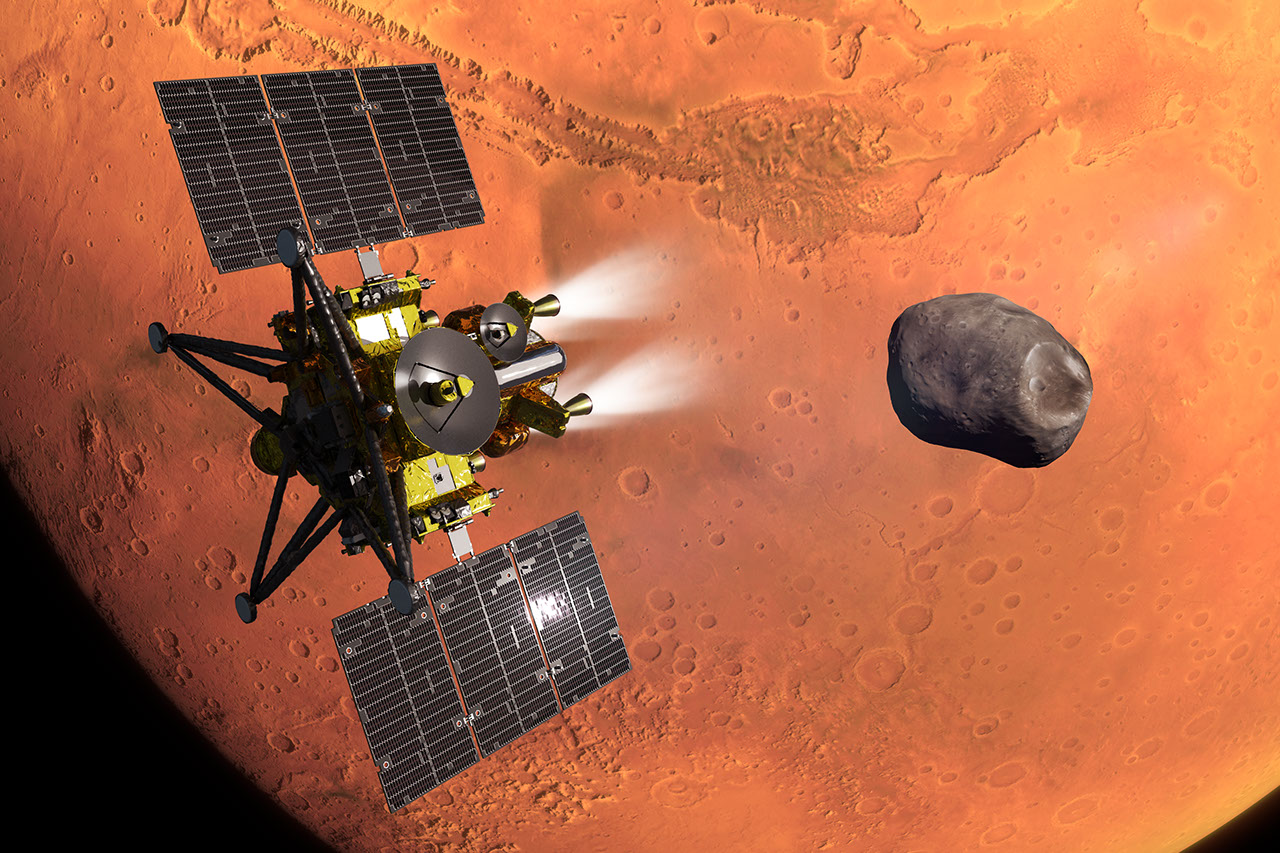
The U.S. National Aeronautics and Space Administration (NASA) will play a pivotal role in Japan’s MMX (Martian Moons eXploration) mission, an ambitious endeavor aimed at deepening our understanding of Mars’s moons, Phobos and Deimos. This collaboration marks a significant step in the exploration of the Red Planet and promises to expand our knowledge of the solar system’s history.
Mission Objectives: From Moons to Earth
The primary goal of the MMX mission is to meticulously study and determine the origin of Mars’s moons, Phobos and Deimos. A key feature of the mission is its plan to return soil samples from Phobos to Earth for subsequent analysis. This undertaking represents the next phase in the long history of robotic exploration of Mars.
The MMX spacecraft is slated for launch from the Tanegashima Space Center in Japan on October 19, 2026. “The samples returned by MMX will provide scientific breakthroughs in the exploration of the Mars system for generations to come, especially as NASA prepares to send the first humans to Mars,” stated Nicky Fox, associate administrator of NASA’s Science Mission Directorate. “The partnership between NASA and JAXA (Japan Aerospace Exploration Agency) for sample curation is extremely valuable, and I am proud that NASA Science will support the MMX sample curation and share a portion of these samples for research, continuing to expand humanity’s understanding of the universe for the benefit of all.”
NASA’s Contribution: Instruments and Support
NASA’s significant contributions to the MMX mission include:
- Development of the MEGANE (Mars-moon Exploration with Gamma rays and Neutrons) instrument, a spectrometer designed to help determine Phobos’s chemical composition.
- Provision of a technology demonstration, the P-Sampler (Pneumatic Sampler), a system for collecting surface samples from the moon.
- Support for communication and navigation through the Deep Space Network.
- Funding for American scientists working as part of the MMX science team.
The origin of Phobos and Deimos has long been a subject of scientific debate. One theory suggests they are remnants of a powerful collision with Mars that ejected material into orbit around the planet. Another hypothesis posits that they are asteroids captured by Mars’s gravity billions of years ago. Unraveling these questions will offer crucial insights into the early formation of inner planets, including Earth, and the processes by which they acquired water and organic compounds.
MEGANE and P-Sampler: Tools for Discovery
The MEGANE spectrometer, named after the Japanese word for “glasses,” will enable scientists to “see” Phobos’s composition by measuring neutrons and gamma rays emitted from its surface, providing critical data about its origin. The P-Sampler system, attached to one of the spacecraft’s lander legs, is designed to collect a surface sample from Phobos. It utilizes short bursts of high-pressure nitrogen, complementing the Japanese C-Sampler, which will gather samples from deeper soil layers.
NASA will receive and curate approximately 15% of the total collected samples at the Johnson Space Center in Houston, making them available for research for decades. Scientific collaboration is a vital component of NASA’s contribution, with American researchers working alongside international colleagues to unlock the history of Phobos and gain new data on the evolution of the Martian system.
The MMX spacecraft is expected to arrive at Mars in August 2027. Following detailed study of Phobos, sample collection is planned for no earlier than December 2028, with the return to Earth scheduled for 2031.