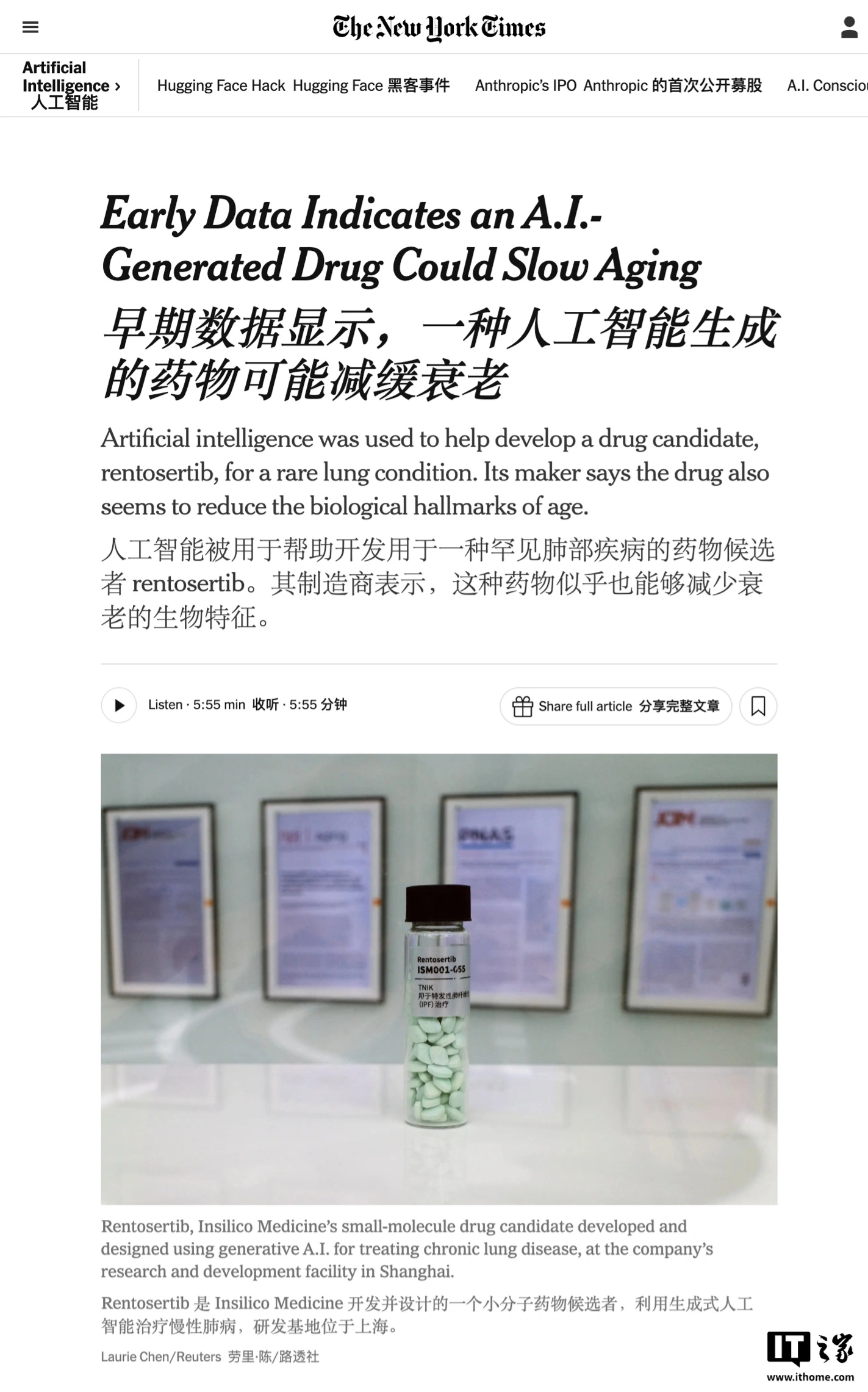
In a significant stride for AI-driven healthcare, Insilico Medicine has revealed that its AI-discovered drug, Rentosertib, not only shows promise in treating chronic lung disease but may also possess the remarkable ability to slow down the aging process. This revelation emerges from data gathered during a clinical trial, marking a potential milestone for AI’s integration into medical advancements.
AI’s Leap into Longevity Research
The drug, Rentosertib, was developed with the assistance of artificial intelligence, which played a crucial role in designing its molecular structure. A new study published in Nature Biotechnology indicates that after treatment with Rentosertib, patients exhibited a decrease in age-related biomarkers, as measured by six different “aging clocks.” These sophisticated AI tools are designed to predict an individual’s risk of illness and mortality by estimating overall bodily aging rates, and even pinpointing the aging speed of individual organs relative to the rest of the body.
While the scientific community continues to debate the precise utility of aging clocks, this clinical trial underscores the growing potential of AI in medicine, extending its reach from short-term disease treatment to the complex realm of longevity research. The trial’s findings suggest that AI’s capabilities in healthcare are rapidly evolving.
From Lung Disease to the Fountain of Youth?
Insilico Medicine, founded in 2014 by mathematician, physicist, and biotech expert Alex Zhavoronkov, has been at the forefront of applying AI to drug discovery for over a decade. The company utilizes deep learning, similar to the technology powering systems like ChatGPT, to analyze vast datasets. These datasets include patient health records, blood test results detailing protein conditions, and extensive academic literature on protein functions. The goal is to identify specific proteins implicated in diseases.
Subsequently, a second AI system is employed to analyze data on protein structures and their interactions with other molecules. This system then generates novel molecules designed to bind to specific drug targets and neutralize their effects. Zhavoronkov likens this process to “scanning a lock and generating a key that fits it.”
Rentosertib was created through this advanced methodology. It was initially targeted at idiopathic pulmonary fibrosis (IPF), a chronic condition sometimes referred to as “the Alzheimer’s of the lungs.” In IPF, lung tissue thickens and scars, progressively impairing the lungs’ ability to oxygenate the blood, and can be fatal within years.
Last year, Insilico Medicine’s clinical trial demonstrated that Rentosertib could significantly increase the volume of air patients with IPF could inhale. However, treating lung disease was only part of the trial’s scope. Zhavoronkov revealed that the company also envisioned Rentosertib as a drug that could potentially extend overall lifespan.
Aging Clocks and Promising, Yet Preliminary, Results
Beyond assessing IPF treatment efficacy, researchers utilized six different aging clocks to measure patients’ biological age markers before and after taking the drug. The trial involved 43 patients. These systems, which primarily assess age based on the functional status of cells, tissues, and organs, indicated a notable decrease in the patients’ predicted age. Despite employing diverse methodologies, all six aging clocks registered a reduction in predicted age after patients underwent 12 weeks of continuous treatment.
Vadim Gladyshev, a professor at Harvard Medical School and a developer of one of the aging clocks, commented, “This is the first very strong study that shows that predicted biological age can be reduced.” However, he, along with others, emphasizes that the research is far from conclusive.
“This drug looks very promising. But we don’t have a decisive trial yet that allows us to make a final judgment.” – Eric Topol, Cardiologist and author of “Deep Medicine” and “The Patient Will See You Now.” (While this quote is attributed to Topol in the original context, it’s important to note that the direct quote provided in the source text pertains to the potential of the drug, not specifically the aging aspect.)
Limitations include the small sample size of the trial and the inherent variability in the reliability of aging clocks themselves. Crucially, Rentosertib has not been tested on healthy individuals. As the clinical trial exclusively recruited patients with IPF, the observed effects might be specific to this particular patient group.
The Road Ahead
Despite these caveats, experts acknowledge the significance of Insilico Medicine’s work. Evelyn Bischof, a professor of medicine at Tel Aviv University specializing in longevity research, suggested that these methods could serve as a blueprint for future longevity studies, indicating that similar approaches will likely be adopted in upcoming trials.
While Rentosertib is still years away from potential regulatory approval, even for its intended use in treating IPF, its apparent anti-aging effects, uncovered during the trial, open a new frontier in the quest for extending human healthspan. The journey from AI-generated molecule to a potential longevity drug highlights the transformative power of artificial intelligence in medicine.