OpenAI has announced a significant step forward in developing a non-perturbative definition of the Standard Model of particle physics. This achievement, realized with their advanced GPT-6 Astra model, paves the way for a deeper understanding of the universe’s fundamental interactions.
The Challenge of Non-Perturbative Definitions
The Standard Model is an exceptionally successful theory, describing known elementary particles and three of the four fundamental forces: strong, weak, and electromagnetic. Its success lies in the remarkable agreement between theoretical calculations and experimental data across a wide range of energies. However, after more than half a century, the theory faces a fundamental challenge: the lack of a non-perturbative definition that doesn’t rely on treating interactions as minor corrections.
The traditional approach, known as perturbation theory, is effective when interactions are weak. Yet, many crucial phenomena, such as the mass of the proton, necessitate methods that account for interactions from the outset. For these cases, discretizing spacetime into a lattice is employed, enabling a rigorous non-perturbative definition of the theory and facilitating computational calculations.
The Chirality Hurdle
Applying the lattice approach to the entire Standard Model is complicated by its chiral nature. Chiral theories differ from their mirror images due to their distinct treatment of left-handed and right-handed particles (fermions). Unlike the strong and electromagnetic forces, the weak interaction selectively affects left-handed fermions, making direct lattice implementation problematic. This often leads to the emergence of “extra” right-handed partners, known as “doublers,” which distort the theory’s intended meaning.
An Analogy with Light and Mirrors
The problem of fermion “doubling” on a lattice is analogous to the behavior of light. A standard mirror, when reflecting left-circularly polarized light, converts it into right-circularly polarized light. To avoid this, specialized “chiral mirrors” are used that preserve the original polarization. A similar approach, based on the concept of “overlap fermions,” was developed decades ago, but the precise definition of the phase for such particles on a lattice remained an open question.
GPT-6 Astra’s Novel Approach
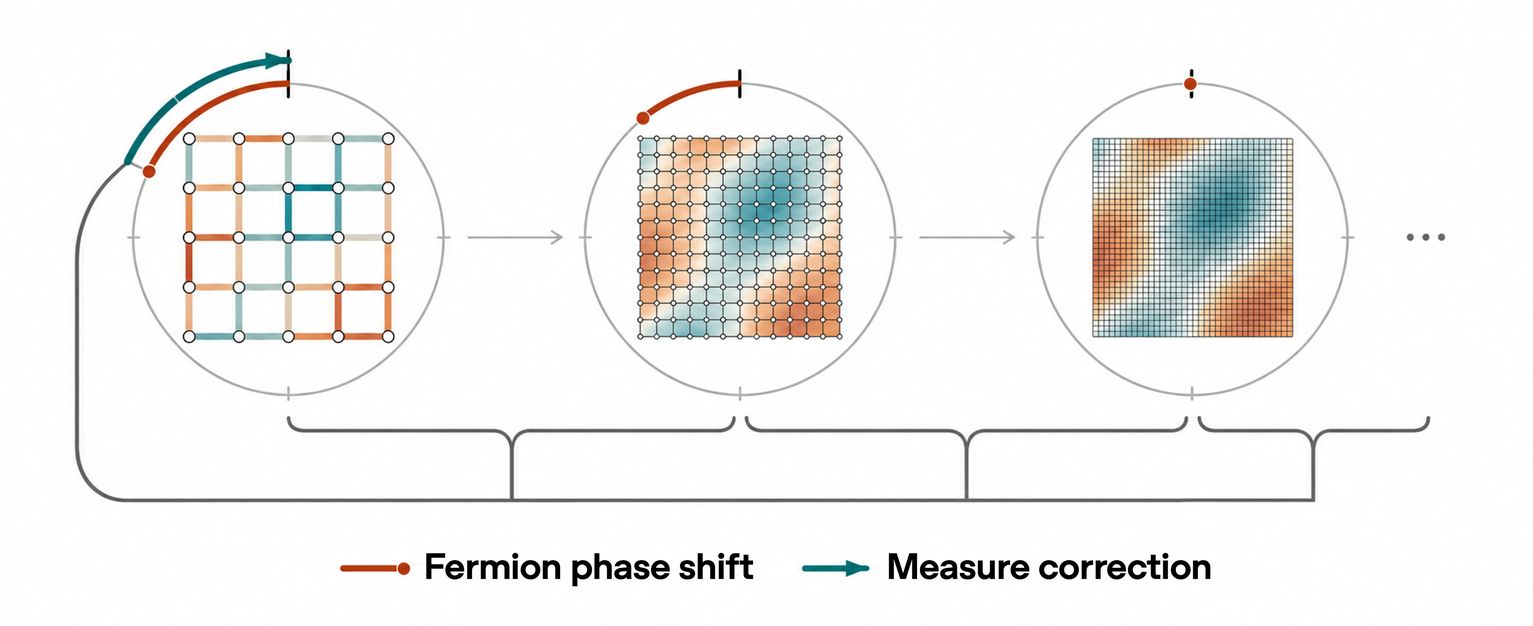
OpenAI’s research, conducted using GPT-6 Astra, proposes a new method for phase determination. The idea involves representing interaction fields on an initial lattice and then on a sequence of progressively finer lattices. Comparing the allowed fermion states on adjacent lattices allows for phase correction with small field variations. Summing these corrections yields a rule for phase definition on the initial lattice.
“Developing this refinement strategy into a proof required multiple rounds of working with Astra and discussions with external experts. GPT-6 Astra was instrumental in transforming the refinement idea into a working construct. It proposed the correct way to transfer a given set of interaction fields to finer lattices, showed that comparisons on finer lattices would converge to a defined answer, and took the lead in developing the detailed proof,” the announcement stated.
Future Prospects
This work represents a candidate non-perturbative lattice definition of the Standard Model, potentially resolving an issue that has remained open for over fifty years. Further research is needed to verify all the desired properties of this construction and its practical application in simulations. The question of defining the interacting theory in continuous spacetime also remains, a challenge OpenAI recently addressed with a proof of existence for Yang-Mills theory.
These advancements offer hope for new progress in understanding the Standard Model.