Baidu, a leading artificial intelligence company, has announced its financial results for the third quarter of its 2026 fiscal year (ending September 30, 2026). The company reported a significant turnaround in its net profit, moving from a loss in the previous year to a profit of 1.395 billion yuan. This marks a key moment in Baidu’s ongoing AI transformation.
Financial Highlights for Q3 2026
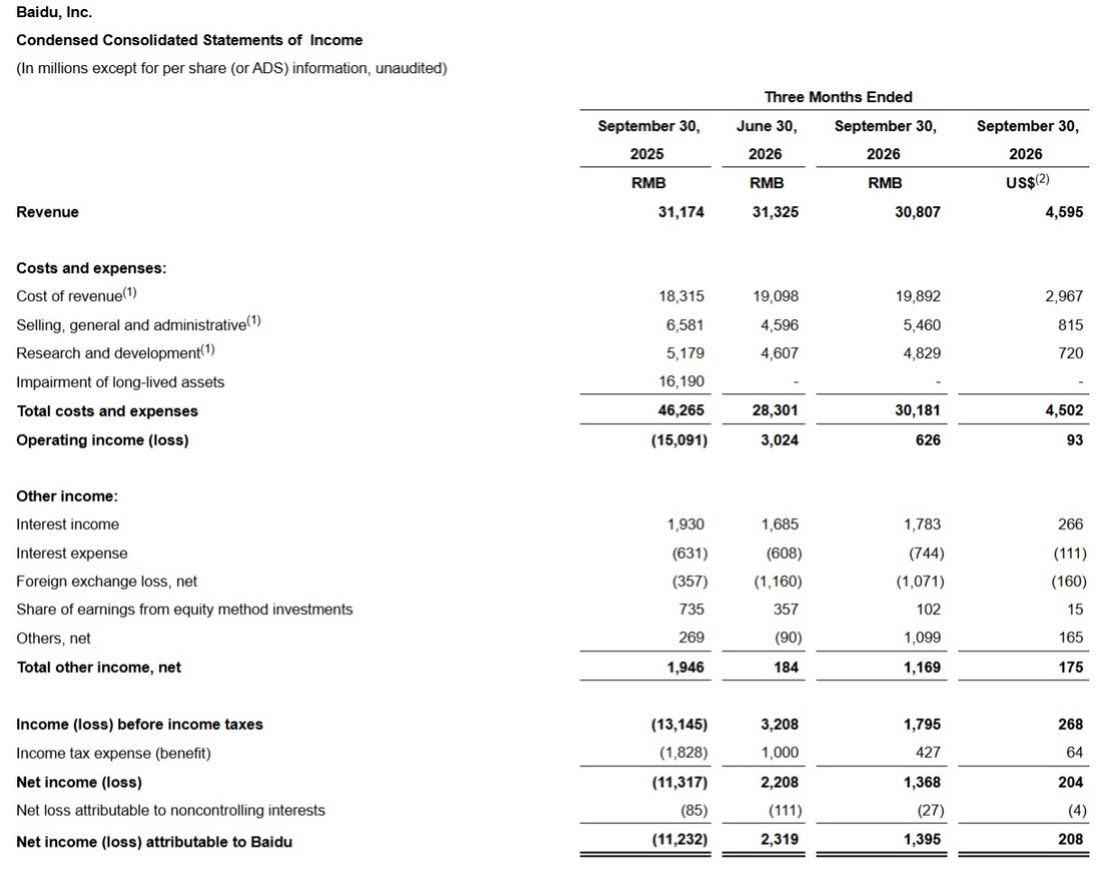
In the third quarter, Baidu’s total revenue reached 30.807 billion yuan, a slight decrease of 1% year-over-year and 2% quarter-over-quarter. However, the company’s net profit attributable to shareholders surged, turning profitable year-over-year and reaching 1.395 billion yuan. This compares to a net loss in the same period last year. On a sequential basis, net profit saw a decrease of 39.84%.
Key financial metrics also showed positive trends:
- Operating income: 30.807 billion yuan (down 1% YoY, down 2% QoQ).
- Net profit attributable to shareholders: 1.395 billion yuan (year-over-year turnaround to profit).
- Net profit (Non-GAAP): 2.395 billion yuan, with a Non-GAAP net margin of 8%.
- Operating cash flow: 2.778 billion yuan, an impressive increase of 121.18% year-over-year.
- Basic earnings per share: 0.57 yuan (year-over-year turnaround to profit).
- Diluted earnings per share: 0.54 yuan (year-over-year turnaround to profit).
- Adjusted EBITDA: 4.493 billion yuan, with an Adjusted EBITDA margin of 15%.
Baidu’s core business revenue was 24.973 billion yuan, showing a 1% year-over-year increase and a 1% quarter-over-quarter decrease. iQIYI, the company’s video streaming platform, generated 6.007 billion yuan in revenue, a decrease of 10% year-over-year and 4% quarter-over-quarter.
AI Business: The Core Growth Engine
Baidu’s strategic pivot towards AI continues to yield significant results, with AI-driven businesses becoming the core pillar of its growth. The company’s AI Cloud Infrastructure (AI Cloud Infra) revenue experienced a remarkable surge, reaching 8.2 trillion yuan, up 94% year-over-year and 11% quarter-over-quarter. Notably, GPU cloud revenue grew by 191% year-over-year and 43% quarter-over-quarter, while the Qianfan MaaS platform saw external customer token usage increase by a staggering 1159%.
AI Applications revenue remained stable year-over-year at 2.6 trillion yuan, with a 1% quarter-over-quarter increase. The penetration rate of AI for Wenku and Map DAUs (Daily Active Users) also improved by 60.7% year-over-year.
AI-native marketing services, which are undergoing a strategic contraction during the AI search transformation, saw a revenue of 2.4 trillion yuan, down 15% year-over-year and 7% quarter-over-quarter. Despite this, AI-driven businesses now constitute 53% of Baidu’s general business revenue, a significant increase from 39% in the same period last year and 50% in the previous quarter.
Cost, Expenses, and Profitability
Operating costs for the quarter were 19.892 billion yuan, up 9% year-over-year and 4% quarter-over-quarter. This rise is primarily attributed to increased costs in cloud services and traffic acquisition, partially offset by a decrease in content costs.
Sales, general, and administrative expenses amounted to 5.46 billion yuan, a decrease of 17% year-over-year but an increase of 19% quarter-over-quarter, indicating continued improvements in operational efficiency.
Research and development expenses remained robust at 4.829 billion yuan, down 7% year-over-year but up 5% quarter-over-quarter, reflecting Baidu’s sustained high-intensity investment in AI.
Autonomous Driving and Shareholder Returns
Baidu’s autonomous driving service, Apollo Go, is expanding its footprint globally. It is now operating fully driverless services in 30 cities worldwide. Shenzhen saw a remarkable approximate 170% increase in fully driverless order volume quarter-over-quarter. International markets, including Dubai, London, and Hong Kong, are also experiencing continuous expansion. Cumulatively, Apollo Go has driven over 390 million kilometers.
In terms of shareholder returns, Baidu has returned $373 million to shareholders through stock repurchases in 2026. Furthermore, the company has announced its first-ever common stock dividend policy and expects to complete its initial dividend payment by the end of 2026.
Investment Value Outlook
This quarter’s performance highlights Baidu’s successful transition towards an AI-driven business model, with its AI Cloud Infrastructure business showing rapid growth and driving general business revenue back into positive year-over-year growth, even as traditional online advertising faces pressure. While gross margin saw a year-over-year decline of approximately 5.82 percentage points due to the cost structure of the cloud business, the short-term profitability quality warrants continued observation.
The company’s substantial cash reserves, coupled with its new share repurchase and dividend policies, and the accelerating commercialization of Apollo Go, position Baidu’s long-term AI ecosystem value for potential re-evaluation. The report suggests a steady recovery rhythm for Baidu during its AI transformation period.