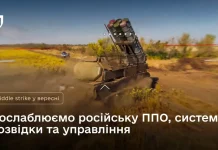
In July 2026, Ukraine’s defense forces continued a systematic, high‑precision campaign targeting the Russian operational rear, air‑defense elements, and critical logistics routes of occupation troops. For middle‑depth strikes they employed jam‑resistant FPV drones on fiber‑optic links, heavy night bombers, Ukrainian‑produced missiles, and guided aerial munitions.
The main effort focused on isolating the theater of operations in Donetsk, Luhansk, Kherson, and Zaporizhzhia, while also destroying military infrastructure on the temporarily occupied Crimean peninsula.

Isolation of the Battleground: Destruction of Bridges, Overpasses, and Ferries
A key objective of the summer campaign was to sever the transport arteries Russia uses to move ammunition, fuel, and fresh reserves. Throughout July, middle‑strike assets hit 14 railway and road bridges, as well as vital overpasses and pontoon ferries.
- Donetsk Oblast: road bridges over the Malyi Kalchyk and Kalka rivers (near Granitnoye), the Gruzky Yalanchik (near Huselnikove), the Kalmius (near Staromayivka), and facilities close to Novoekonomichne and Vyselky.
- Luhansk Oblast: railway bridges over the Teplaya (Nizhnеteple) and Severnyy Donets (Stanytsia Luhanska) rivers, plus a railway overpass near Dovzhansky.
- Russian‑occupied Crimea: railway bridges over the Krasnohvardiiskyi Canal near Rozdol’ne and Ichki, plus the strategic ‘Syvash’ rail bridge near Chongar.
- Kherson and Zaporizhzhia Oblasts: the automobile bridge over the Henichesk Strait and the bridge near Prymorske.
- Russian border: an automobile bridge near Kozyn in Kursk Oblast.

Blinding the Dome: Destruction of Air Defense Systems, Radar, and Long‑Range EW
Systematically disabling the enemy’s air‑defense and electronic‑warfare assets opened corridors for follow‑on strikes by Ukrainian aviation, cruise‑missile launches, and long‑range UAV Deep Strike operations.
| Target category | Specific nomenclature and location | Operational‑tactical effect | ||
|---|---|---|---|---|
| Surface‑to‑air missile systems (SAMS) | S‑400 (Kerch), Buk (Zelenopillya), Pantsir‑S2 (Simferopol) | Breached the ballistic and air‑defense umbrella over Crimea and the south. | ||
| Radar stations | Nebo‑U (Kerch), Bussol‑S (Khory), detection radar (Olenivka) | Total loss of Russian reconnaissance capability in the Black Sea. | ||
| EW/ER complexes | Ground‑based EW complex “Murmansk‑BN” (Fiolent), “Pole‑21” (Luhansk region) | Neutralized jamming of KH‑signals over thousands of kilometres. | ||
| EW munitions stockpiles | Stock of electronic‑warfare equipment (Novodaryivka) | Disrupted supply of trench‑level EW for occupier infantry. |
Liquidation of UAV Infrastructure, Airfields, and Command Centers
July saw massive strikes on Russian UAV bases, operator training sites, and relay stations used to enforce logistics lockdowns on Ukrainian front‑line areas.
- UAV command points and warehouses: destroyed over 10 drone control hubs in Zaporizhzhia, Donetsk, Sumy, and Bryansk oblasts of Russia, plus a UAV warehouse near Chervonopopivka in Luhansk region.
- Communication relays: hit ground relays for “Geran’/Gerbera” UAVs near Chornomorsky and Zaliznyy Port, plus “Orion” drone relays at the Dzhankoy airbase.
- Strikes on Crimean airfields: at Saky airfield, at least seven Su‑30, Su‑30SM, and Su‑24 aircraft destroyed or damaged; at Gvardeyskoye airfield, two hangars loaded with Shahed drones and aviation materiel were demolished.
- Maritime and command infrastructure: struck the FSB coordination center in Kherson Oblast (hosting ~100 occupiers and 70 pieces of equipment), hit the Project 10410 patrol boat “Svetlyak” in Kerch, and damaged boat bases in Mezhevoye.
Depleting Fuel Arsenal and Logistical Starvation
As part of the middle‑strike campaign, Ukrainian forces delivered precision blows to critical fuel‑storage facilities. Targets included the strategic TES‑Terminal‑1 oil depot in Kerch, a fuel base in Shakhtyrska, facilities of Chornomornaftogaz, a fuel echelon near Tokmak, and a Russian tanker in the Black Sea basin.
The destruction of huge complexes such as Murmansk‑BN and TES‑Terminal‑1, combined with the demolition of railway bridges, creates a cumulative debilitating effect on the Russian grouping. Occupants lose fuel autonomy, maneuver flexibility, and coordination, setting the stage for further Ukrainian offensive and defensive operations.
Xpert Take
The July middle‑strike campaign demonstrates the potency of Ukraine’s sovereign GovTech procurement model. Scaling orders to $1 billion via the eBali program on the Brave1 marketplace enabled frontline brigades to acquire jam‑resistant FPV drones and middle‑strike munitions within seven days, directly addressing urgent gaps in radar and bridge destruction capabilities.
Combining internal contracting through the State Defense Order (DOT) with preferential financing of the defense industrial complex (10 bn ₴) created an uninterrupted pipeline of high‑precision weapons for the Armed Forces. This integrated approach not only sustains the current tempo of operations but also signals to global defense investors that Ukraine’s wartime innovation ecosystem can deliver scalable, cost‑effective solutions for modern high‑intensity conflict.