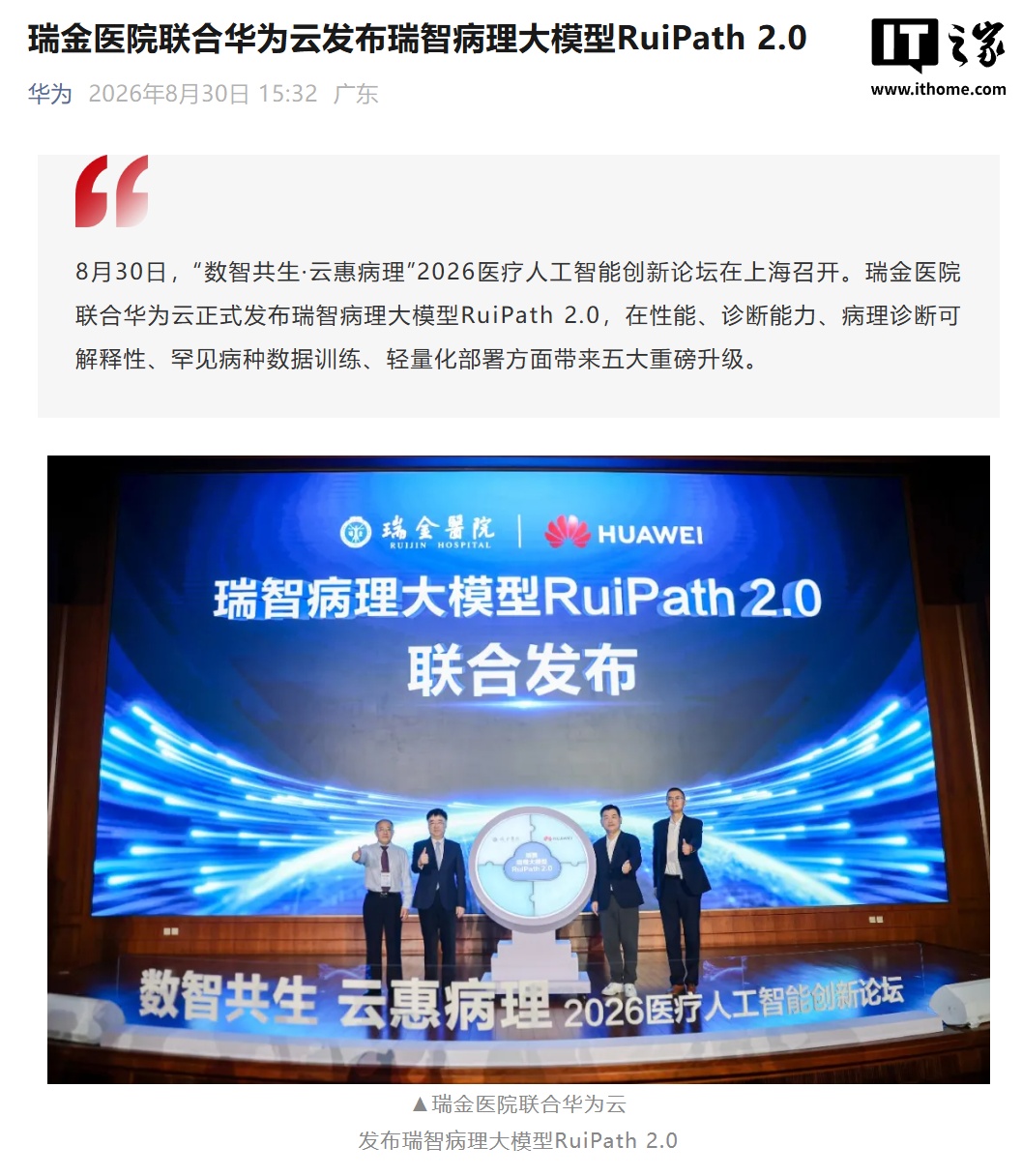
Shanghai, China – August 30, 2024 – Ruijin Hospital, in collaboration with Huawei Cloud, has officially unveiled RuiPath 2.0, an advanced artificial intelligence pathology model. This latest iteration brings significant upgrades in performance, diagnostic capabilities, interpretability, rare disease data training, and lightweight deployment.
RuiPath 2.0: A Leap Forward in AI Pathology
The new RuiPath 2.0 model boasts a 7 billion parameter scale, significantly enhancing its ability to analyze pathological images. It now covers 19 common types of cancer and expands its diagnostic tasks to 205 items, making it the most comprehensive model of its kind in the industry. This extensive coverage aims to support over 90% of the daily diagnostic scenarios faced by pathologists.
A key advancement in RuiPath 2.0 is its enhanced interpretability. The model is now capable of providing precise, traceable explanations for its diagnoses across various dimensions, including histological subtype, invasion depth, and mitotic count. This feature ensures that AI-driven diagnoses are transparent and can be verified by medical professionals.
Addressing Rare Diseases and Achieving SOTA Performance
Addressing the challenge of data scarcity for rare diseases, Huawei Cloud and Ruijin Hospital have developed a multimodal generative model. This approach synthesizes training data, significantly improving the model’s accuracy for less common conditions. Notably, in diagnosing the presence or absence of lymphoma, the model achieved an impressive accuracy rate of 96.48%.
The foundational RuiPath 2.0 model has demonstrated superior performance, achieving State-of-the-Art (SOTA) levels in 42 out of 59 downstream diagnostic tasks. This performance surpasses that of leading overseas pathology foundation models, marking a significant milestone for Chinese AI in healthcare.
Democratizing AI Pathology with Edge Deployment
In parallel with the advanced cloud-based model, Huawei Cloud and Ruijin Hospital also introduced a lightweight version: RuiPath 2.0 Edge. This specialized model, with approximately 2 million parameters, is designed for direct deployment on standard hospital PCs. It works in synergy with the cloud-based system to deliver results within minutes, substantially lowering the barrier to adoption for hospitals seeking to integrate AI into their pathology workflows.
This dual approach – a powerful cloud model and an accessible edge version – underscores the commitment of both Ruijin Hospital and Huawei Cloud to advancing the field of digital pathology and making cutting-edge AI tools more widely available to medical institutions.