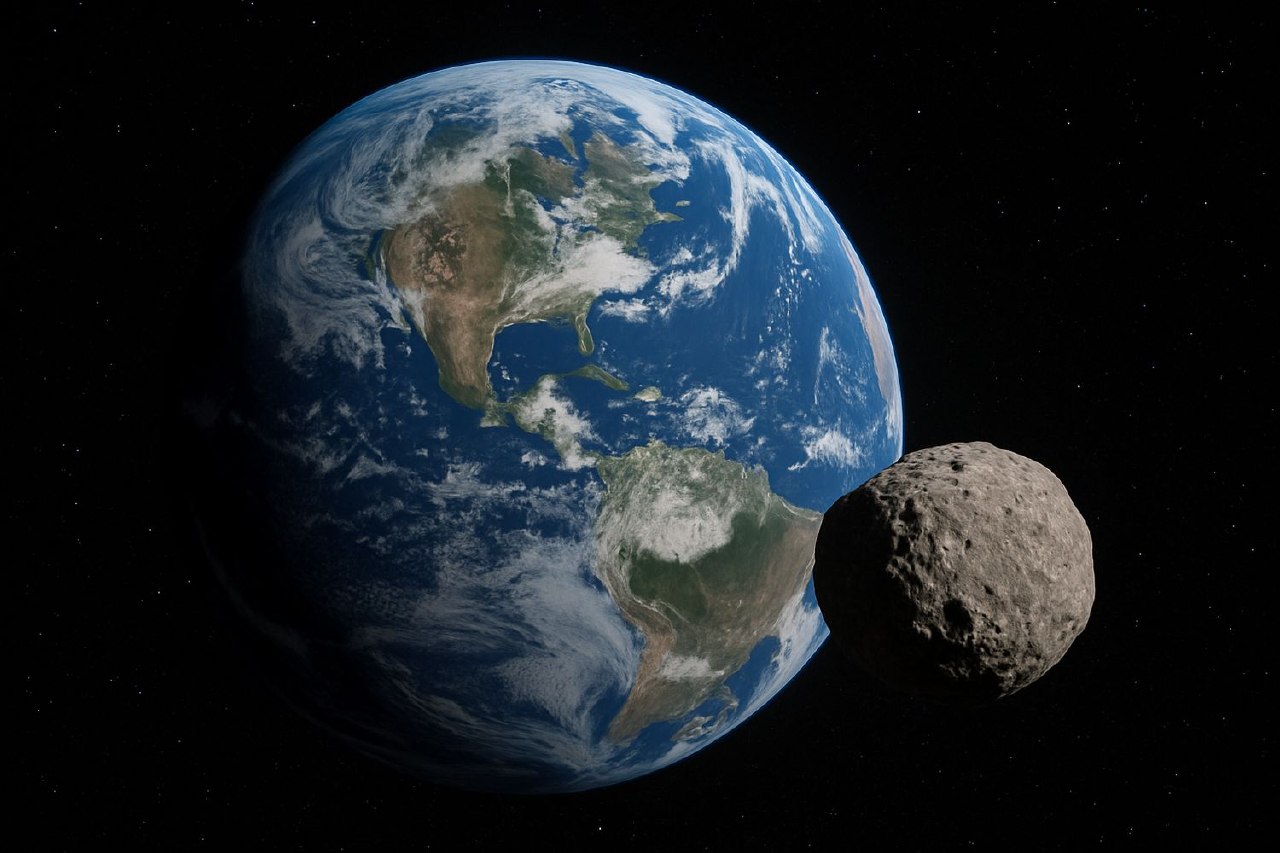
Astronomers have detected a new, temporary satellite of Earth—the celestial object 2026 QQ8—which has approached our planet closely enough to be captured by its gravitational pull. This ‘mini-moon,’ measuring approximately 2 meters in diameter, will orbit Earth for several months before continuing its journey through the Solar System. Its visit is expected to last until early 2027.
A Temporary Visitor in Orbit
The cosmic rock, designated 2026 QQ8, was first observed in August 2026, though it effectively entered Earth’s orbit in April 2026. The International Astronomical Union’s Minor Planet Center officially announced the discovery on October 29. Scientists estimate that 2026 QQ8 orbits the Sun in about 359 days, nearly equivalent to one Earth year.
While this asteroid passes close to Earth roughly once a decade, its current trajectory brought it sufficiently near to be temporarily ensnared by our planet’s gravity. At its closest approach during this encounter, it will be approximately 568,000 kilometers away, which is about 177,000 kilometers farther than the average distance to our permanent satellite, the Moon.
Tiny Size, Safe Passage
Despite its temporary ‘satellite’ status, 2026 QQ8 is an exceptionally small object. Its diameter is estimated to be only about 2 meters. This means that even if it were to impact Earth, it would most likely burn up completely in the atmosphere without reaching the surface. This is not the first time Earth has captured similar transient objects.
Research from the past year suggests that up to six such ‘mini-moons’ can orbit our planet simultaneously. The average size of these temporary satellites, according to modeling, is around 75 centimeters, with an average orbital duration of about nine months. However, 2026 QQ8 is larger than this average. Scientists hypothesize that if Earth’s gravity were to capture an asteroid around 3 meters in diameter, it could remain in orbit for a decade or even twenty years.
Source: space.com