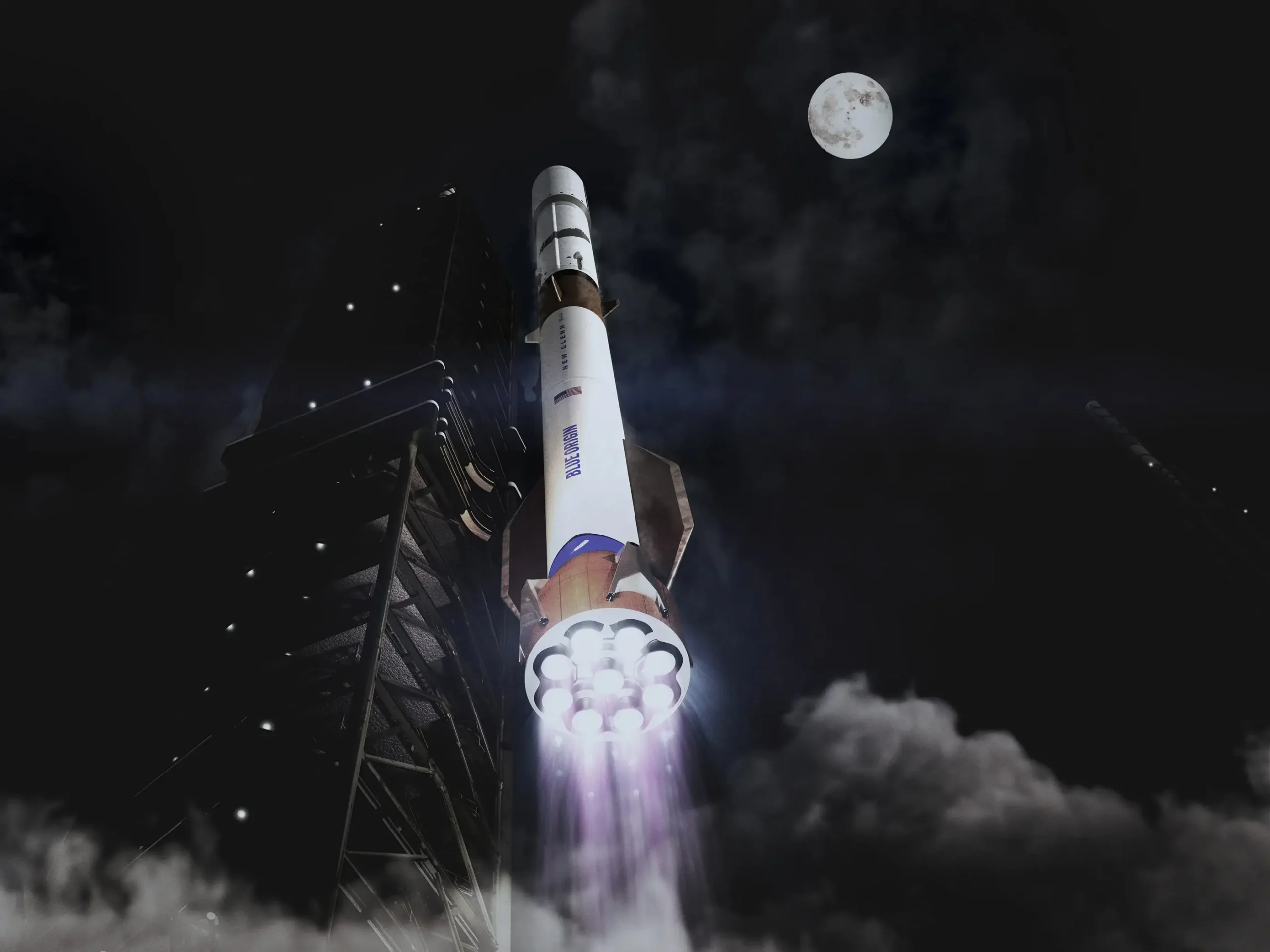
American space company Blue Origin, founded by Jeff Bezos, has announced significant upgrades to its powerful New Glenn rocket. The company is developing a third stage for the rocket and a new engine, innovations expected to greatly expand its capabilities. These advancements will enable New Glenn to deploy satellites directly into geostationary orbit (GEO) and undertake complex missions to the Moon and deep space.
GS3: A New Stage for New Challenges
The new third stage, dubbed GS3, is designed to boost the flexibility and efficiency of the New Glenn rocket. “This stage expands New Glenn’s capabilities,” the company stated. GS3 will facilitate direct deployment of satellite constellations into geostationary orbit, as well as support scientific and exploration missions to the Moon and distant space that require the delivery of substantial payload mass.
- Standard New Glenn version (7×2): Height – 98 meters, payload capacity to Geostationary Transfer Orbit (GTO) – 13 tons, to Low Earth Orbit (LEO) – 45 tons.
- Super Heavy version (9×4): Height – 122 meters, payload capacity to GTO – 14 tons, to LEO – 70 tons.
Currently, New Glenn is a two-stage rocket. Its first stage is powered by seven BE-4 engines, and the second stage by two BE-3U engines. The rocket has successfully completed three flights. However, a mission in April of this year ended unsuccessfully when the BlueBird 7 spacecraft was placed into the wrong orbit and lost. Following this, an incident occurred on the launch pad in May during engine testing.
Northstar: The Engine of the Future
While working to restore its launch pad, Blue Origin has also been developing the new third stage. The GS3 will be equipped with a single BE-7 engine, which the company originally designed for the Blue Moon lunar lander. Although these landers do not require a New Glenn launch with GS3, the third stage will be capable of supporting extended operations around the Moon, delivering significant cargo mass to the Trans-Lunar Injection (TLI) point, thereby conserving fuel.
The company has also announced a new engine for the rocket’s first stage, named Northstar. This engine, like the BE-4, operates on liquid oxygen and methane (methalox) but is designed to be more powerful and simpler to manufacture. Northstar reduces mass by 30% and parts count by 50%, while increasing thrust from 640,000 to 715,000 pounds. The production of the new engine takes less than a day.