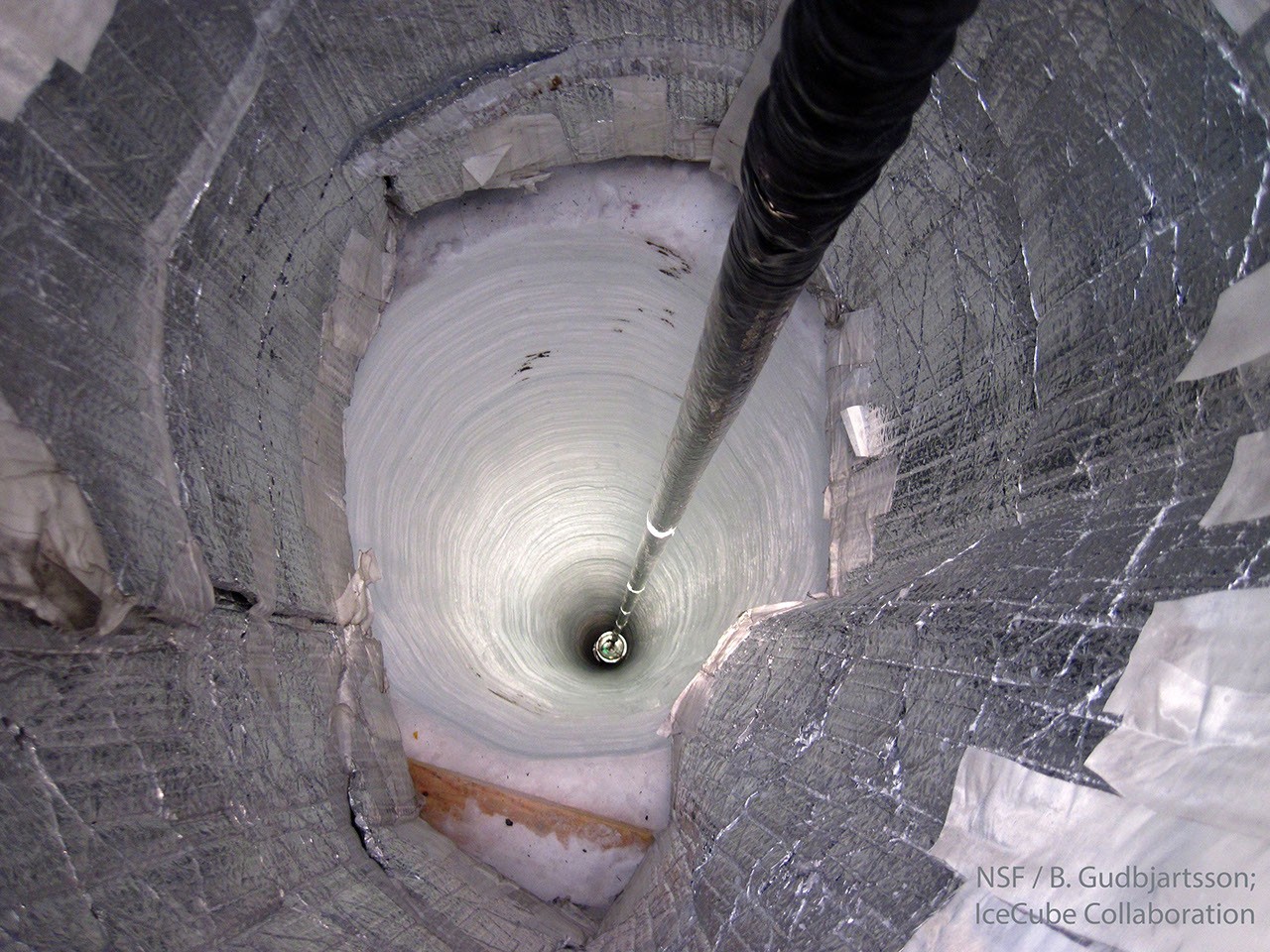
In the Earth’s coldest and most remote corner, near the South Pole, a unique scientific operation is underway. Astronomers are utilizing over a hundred boreholes melted into the ice, forming the world’s largest cosmic observatory dedicated to hunting neutrinos – the elusive subatomic particles born from the most powerful cosmic events. This cutting-edge technology is opening new frontiers in our understanding of the universe.
An Icy Trap for Cosmic Visitors
The initiative, known as the IceCube Neutrino Observatory, involves lowering long strings of basketball-sized detectors into vertical ice boreholes. Once filled with water, the holes rapidly refreeze, creating an ice matrix that acts as a sensitive instrument for registering faint blue light. This light is emitted when high-energy cosmic neutrinos, having traveled billions of light-years, collide with ice molecules, releasing secondary particles.
IceCube has already successfully detected thousands of these cosmic messengers, providing invaluable information about extreme phenomena in the universe, such as supernova explosions, active galactic nuclei, and explosive processes associated with black holes.
Recognition for Groundbreaking Discoveries
This week, IceCube’s achievements were recognized at the highest level: one of the founders of the IceCube collaboration will receive the Nobel Prize in Physics for their revolutionary contributions. This underscores the significance of the observatory’s work and its role in advancing our comprehension of cosmic phenomena. Constructed in 2010, IceCube has become the largest neutrino detector in the world, showcasing humanity’s ambition and success in exploring the smallest particles and the grandest cosmic mysteries.
Source: NASA