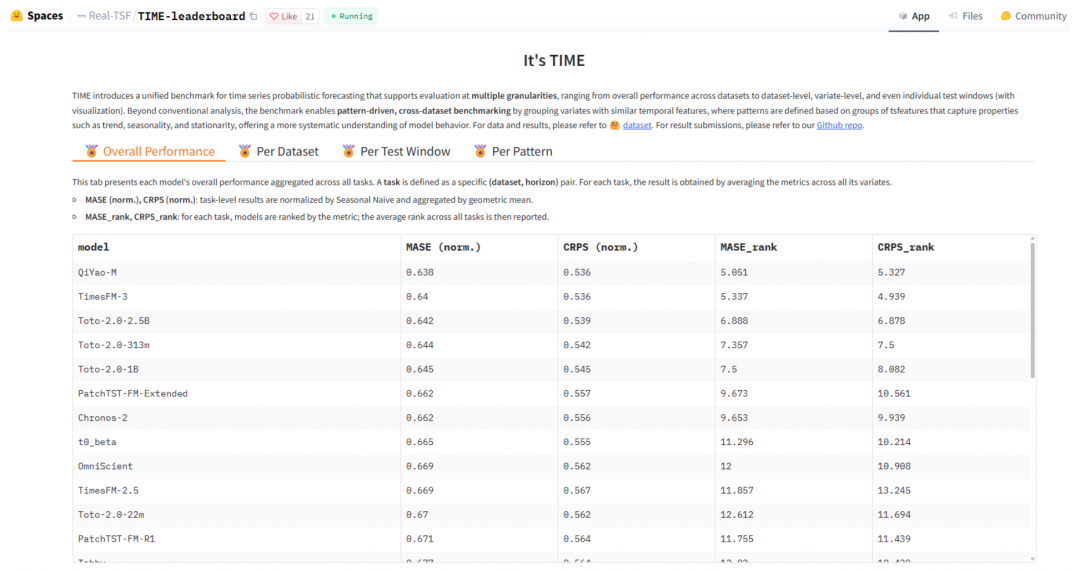
A joint research effort between Huawei and East China Normal University has achieved a significant breakthrough in time-series forecasting with their novel pre-trained model. This advanced model, developed using Huawei’s Ascend AI computing platform, has successfully secured the top positions on two prestigious international authoritative time-series evaluation leaderboards: TIME-leaderboard and GIFT-Eval (Pretrained category).
A New Benchmark in Time-Series Forecasting
Time-series fundamental models are considered a cornerstone technology for empowering core scenarios such as weather forecasting, energy dispatch, industrial operations, and financial analysis. They represent a critical pathway in AI foundational research and industrial application. The joint team, comprising members from Huawei Cloud’s Industry Large Model team, the 2012 Application Scenario Innovation Lab, and the ‘Little Q’ assault team, alongside researchers from East China Normal University, has leveraged the Huawei Ascend ecosystem to deeply optimize the model’s training and inference capabilities.
The result is a universally applicable time-series foundation model that boasts high precision, robust performance, broad generalizability, and ease of engineering. This achievement signifies a monumental leap for domestic time-series foundational models, officially positioning them in the global top tier and marking a transition from following to leading the field.
Versatile Applications and Future Potential
According to Huawei Cloud, the newly developed model, codenamed ‘Qiyue’, has demonstrated exceptional performance on the TIME-leaderboard and GIFT-Eval, where many top-tier models compete. This success indicates that China’s foundational time-series models have officially entered the global forefront, achieving a breakthrough from following to surpassing established benchmarks.
The ‘Qiyue’ model offers remarkable versatility. It can be directly applied to various zero-shot time-series prediction tasks, adapting seamlessly to critical scenarios like power grid load forecasting, industrial equipment anomaly detection, and financial trend analysis. Furthermore, it supports cost-effective fine-tuning, enabling rapid adaptation to the customized needs of different vertical industries. This dual capability ensures that the model balances computational efficiency with high-fidelity predictive power and emphasizes strong intellectual property for the autonomously developed model.
This collaboration underscores the power of academic-industry partnerships in pushing the boundaries of AI research. By combining Huawei’s robust AI infrastructure and industry insights with East China Normal University’s academic rigor and expertise, the team has created a foundational model with significant implications for numerous sectors reliant on accurate time-series predictions.
Implications for Key Industries
The potential applications of this advanced time-series model are vast. In the energy sector, accurate load forecasting can lead to more efficient grid management and reduced waste. For industrial operations, early detection of anomalies in equipment performance through time-series analysis can prevent costly downtime and maintenance issues. Financial institutions can leverage such models for more sophisticated market trend predictions and risk assessments.
The model’s ability to perform well in zero-shot scenarios and its adaptability through fine-tuning make it a highly practical tool for businesses. This means organizations can potentially deploy advanced AI forecasting capabilities with less initial investment in data preparation and model customization, accelerating the adoption of AI in time-sensitive decision-making processes.
The success of the ‘Qiyue’ model on international benchmarks not only highlights the advancement of AI research within China but also contributes valuable foundational technology to the global AI community. This development is expected to spur further innovation in time-series analysis and its applications across a wide range of scientific and industrial domains.