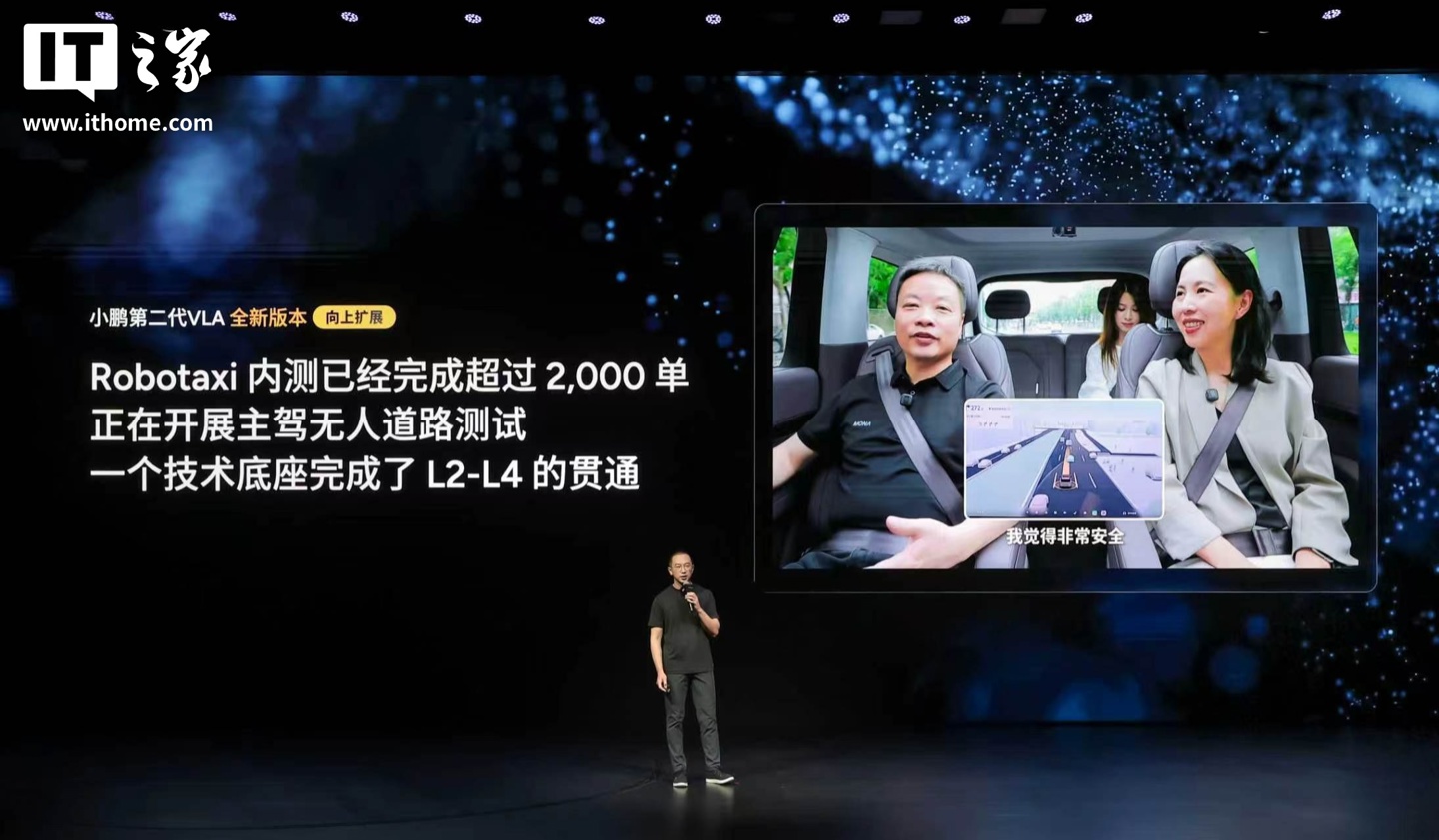
XPeng Motors has announced a significant milestone in its autonomous driving development, with its second-generation VLA (Vision, Language, and Action) system powering Robotaxis to begin key road verification for driverless operation. The company revealed that these Robotaxis recently obtained the necessary remote testing qualifications from the city of Guangzhou, allowing them to conduct tests on designated Level 1, 2, and 3 roads without a safety driver in the driver’s seat.
This achievement marks XPeng’s official entry into the critical phase of driverless road validation. The company stated that the new version of the VLA system is designed to be highly adaptable, capable of reaching Level 4 autonomy while also being compatible with a wider range of mass-produced vehicles. Furthermore, it aims for global generalization, suggesting its potential application beyond current operational areas.
Physical World AI Foundation
XPeng emphasized that the true value of its AI foundation for the physical world lies not just in excelling at single tasks. Instead, the focus is on migrating and reusing learned capabilities from real-world scenarios across more tasks and more instances. This approach aims to propel its ‘Physical AI’ from singular product capabilities towards more generalized abilities.
Unified Technology and Enhanced Capabilities
The second-generation VLA is built upon a unified technological base, enabling a seamless progression of capabilities from Level 2 to Level 4 autonomous driving. This integrated approach further pushes the boundaries towards higher-order autonomous driving functionalities.
During the event, XPeng shared insights into its technical advancements. Through ‘learning-based Token compression and distillation training,’ the company has achieved high-quality visual understanding using fewer effective tokens, without compromising input information or model capacity. This innovation allows for the deployment of the second-generation VLA’s foundational model capabilities onto platforms with lower computing power.
Consequently, the distilled Turing VLA 2.0 Lite version also benefits from enhanced capabilities as the foundational model grows stronger. This strategic development not only refines the performance of their autonomous driving systems but also makes them more accessible for integration into a broader range of vehicles.
The commencement of these driverless road tests in Guangzhou represents a crucial step for XPeng in demonstrating the safety and reliability of its autonomous driving technology in complex urban environments. As the company continues to refine its VLA system and expand its testing, the prospect of widespread commercial Robotaxi deployment moves closer to reality.