The global DRAM market experienced an extraordinary surge in the third quarter of 2026, with revenues approaching $200 billion. According to Counterpoint Research’s ‘Global Memory Market Tracker,’ this represents a staggering 369% year-over-year increase, nearly quintupling the revenue from the same period in 2025. The report highlights that this unprecedented growth was primarily fueled by significant price hikes rather than a substantial increase in shipment volumes.
Price Surge Drives DRAM Supercycle
Counterpoint Research analysts emphasize that the dramatic revenue jump was predominantly driven by escalating prices, with DRAM shipment volumes growing by only about 4% quarter-over-quarter. The average price per gigabit (Gb) reached an impressive $1.90 during the quarter.
Jeongku Choi, Senior Analyst at Counterpoint Research, commented, “This boom is a price-driven supercycle, not a volume-driven one. Artificial intelligence (AI) has transformed memory from a commodity into a high-value, scarce resource. Buyers are now prioritizing securing supply over negotiating prices. With prices continuously rising, memory manufacturers are set to achieve new profitability records in the next quarter.”
Market Share Dynamics
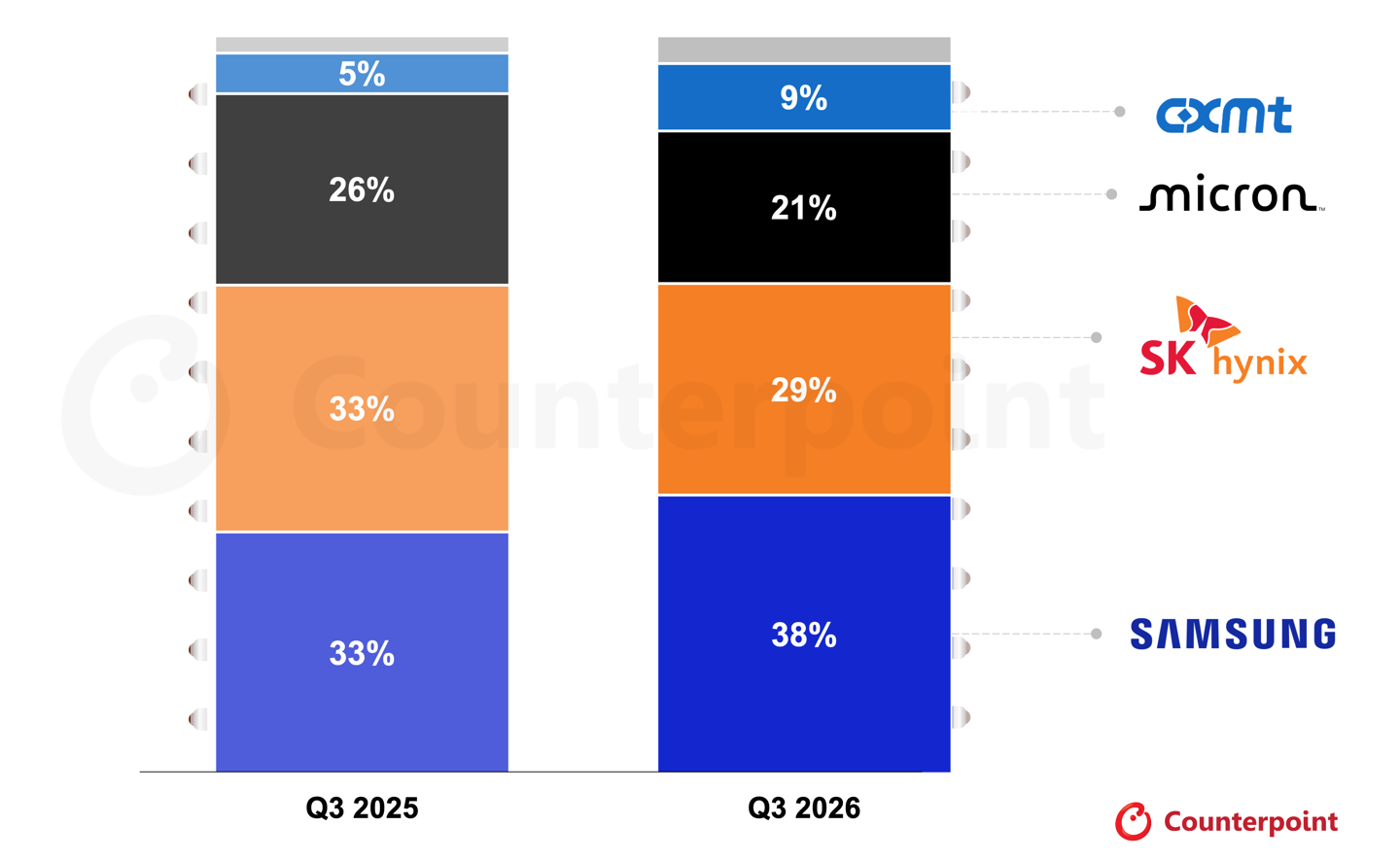
Samsung Electronics maintained its leading position in the DRAM market, holding a 38% market share. SK Hynix demonstrated robust performance, with revenues increasing by over 40% compared to the previous quarter. This growth significantly narrowed the gap with Samsung and allowed SK Hynix to reclaim some lost market share.
Micron also reported strong results, driven by increased demand for AI data center memory, although its growth rate lagged behind Samsung and SK Hynix. Meanwhile, China-based manufacturer CXMT (Changxin Memory Technologies) saw a slight dip in its market share, decreasing from 10% in Q2 to 9% in Q3. Competition for CXMT is expected to intensify, particularly with competitors launching premium High Bandwidth Memory (HBM4) products starting in the fourth quarter.
Product Structure and Emerging Trends
While revenues from High Bandwidth Memory (HBM) nearly doubled, its overall share of the total DRAM revenue saw a slight decrease. This was due to traditional DRAM products experiencing even faster revenue growth.
“As new generations of HBM emerge, the competitive landscape among manufacturers is evolving,” noted MS Hwang, Research Director at Counterpoint Research. “SK Hynix previously dominated the HBM3E market, but Samsung’s HBM4 has received positive customer feedback. Samsung is expected to lead in HBM market share next year.”
The increased demand for traditional DRAM is also linked to shifts in AI infrastructure. Brady Wang, Associate Director at Counterpoint Research, explained that AI agents are stimulating demand for conventional memory.
Counterpoint Research’s AI cloud computing tracking data reveals a shift in the GPU-to-CPU ratio from 4:1 to 2:1, moving closer to 1:1. For instance, in Nvidia Vera Rubin racks, each CPU socket is now equipped with 1.5 TB of DRAM, nearly tripling the capacity of the previous generation.
Wang added that average selling prices for DDR and LPDDR have hit historical highs, with revenues for these products surging 500% and nearly 400% year-over-year, respectively. The increasing adoption of server CPUs is expected to sustain the demand for traditional DRAM, potentially driving average prices per gigabit even higher next year while exerting pressure on the peripheral device market.
Future Outlook
MS Hwang summarized the outlook: “Memory prices are expected to remain elevated next year. HBM prices, which previously lagged, are now catching up to traditional DRAM. Long-term supply agreements (LTAs) are supporting these prices. Furthermore, new fabs from major manufacturers are not expected to come online until 2028, suggesting that supply shortages will likely persist. While short-term profitability may vary for different companies due to LTA conditions, the long-term growth trajectory for all is positive.”
“Massive demand has driven historical growth in average selling prices for DDR and LPDDR, with revenues increasing 500% and nearly 400% year-over-year respectively. We are observing significant growth in memory consumption tied to server CPUs, which will lead to further increases in the average price per gigabit next year, while simultaneously creating pressure on the end-market,” he concluded.