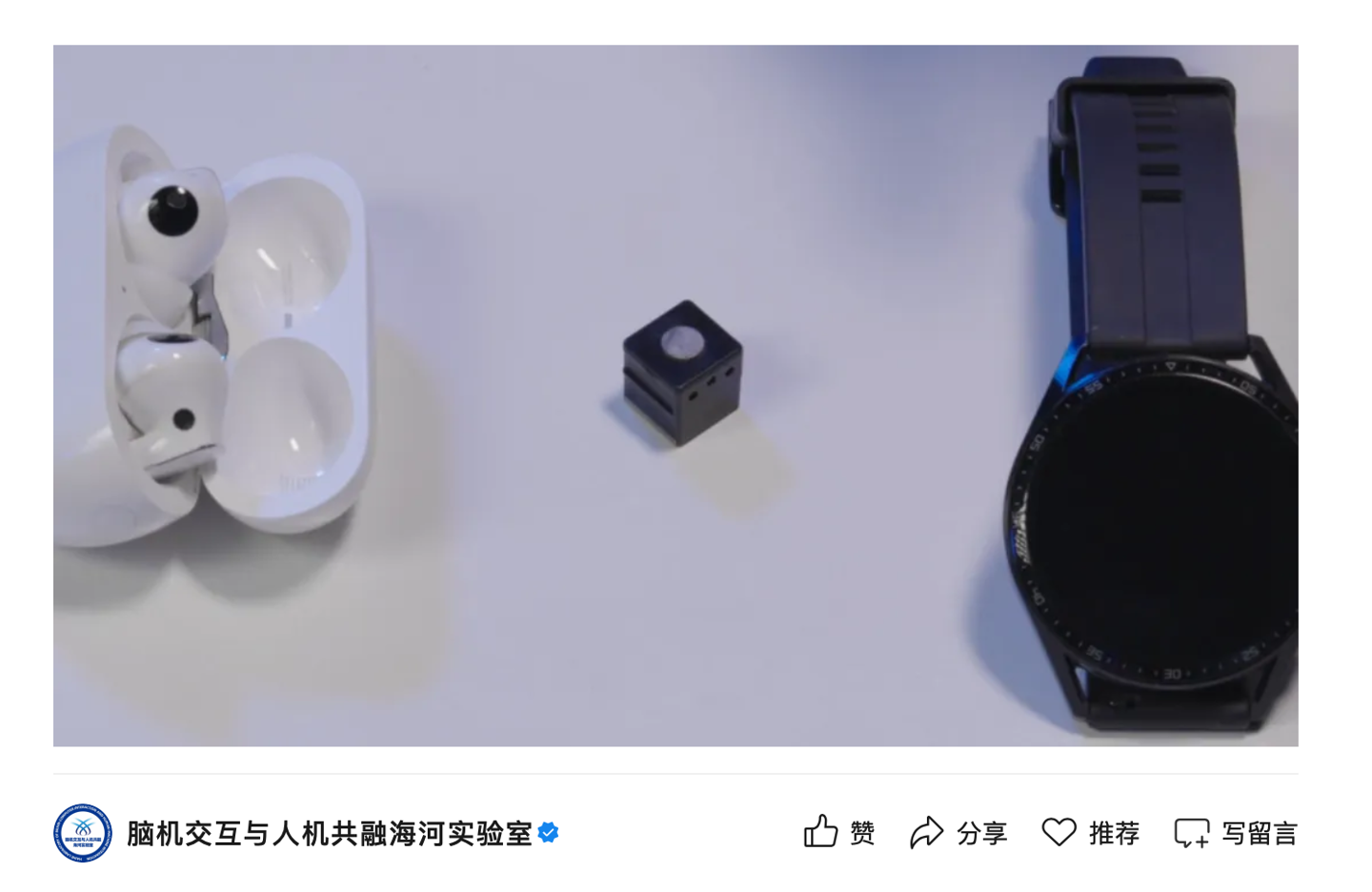
Tianjin University’s Haihe Laboratory for Brain-Computer Interaction and Human-Machine Integration, in collaboration with Shenggong Diting (Tianjin) Technology Co., Ltd., has unveiled a groundbreaking non-invasive brain-computer interface (BCI) system. Dubbed ‘Shenggong · Xumi · Naolifang,’ this system weighs a mere 3 grams and has a volume of less than 2 cubic centimeters, making it the world’s smallest and lightest integrated BCI system to date.
Revolutionary Design for Seamless Integration
Unlike traditional non-invasive BCI devices that often come in the form of bulky caps, helmets, or headbands, the ‘Shenggong · Xumi · Naolifang’ system ingeniously integrates electrodes, circuitry, and a battery into an extremely compact unit. Its innovative design allows it to be affixed to the scalp, hidden discreetly within hair, offering a near-imperceptible wearing experience due to its negligible weight. This breakthrough opens up significant possibilities for widespread adoption across various sectors, including healthcare, consumer electronics, and industrial applications.
High Performance and Medical Compliance
The system’s core performance metrics meet the stringent requirements of the Chinese national standard GB 9706.226-2021 for medical electrical equipment. This ensures that it can accurately and reliably capture even faint brainwave signals. Operating at a high sampling rate of 1000Hz, the ‘Shenggong · Xumi · Naolifang’ boasts a battery life of 8 to 10 hours, making it suitable for extended continuous BCI tasks. This level of performance is crucial for applications requiring precise and uninterrupted data acquisition.
Applications in Specialized Fields
Leveraging this advanced BCI technology, the research team, in conjunction with guidance from departments involved in special operations and emergency management, has been actively collaborating with leading enterprises and academic institutions. Their joint efforts focus on developing critical technologies and practical applications for constructing brain-computer interface and smart wearable safety management models specifically for personnel engaged in high-risk or specialized operations. This includes exploring how BCIs can enhance safety, performance, and management in demanding environments.
The Future of Non-Invasive BCIs
The development of ‘Shenggong · Xumi · Naolifang’ represents a significant leap forward in non-invasive BCI technology. By overcoming the limitations of size, weight, and comfort associated with previous generations of devices, this new system paves the way for more natural and intuitive human-machine interaction. Its potential applications are vast, ranging from advanced medical diagnostics and rehabilitation to enhanced human-computer interaction in gaming, virtual reality, and professional training. The team’s commitment to integrating the system into specialized fields like emergency management underscores its potential to address real-world challenges and improve safety and efficiency in critical operations.