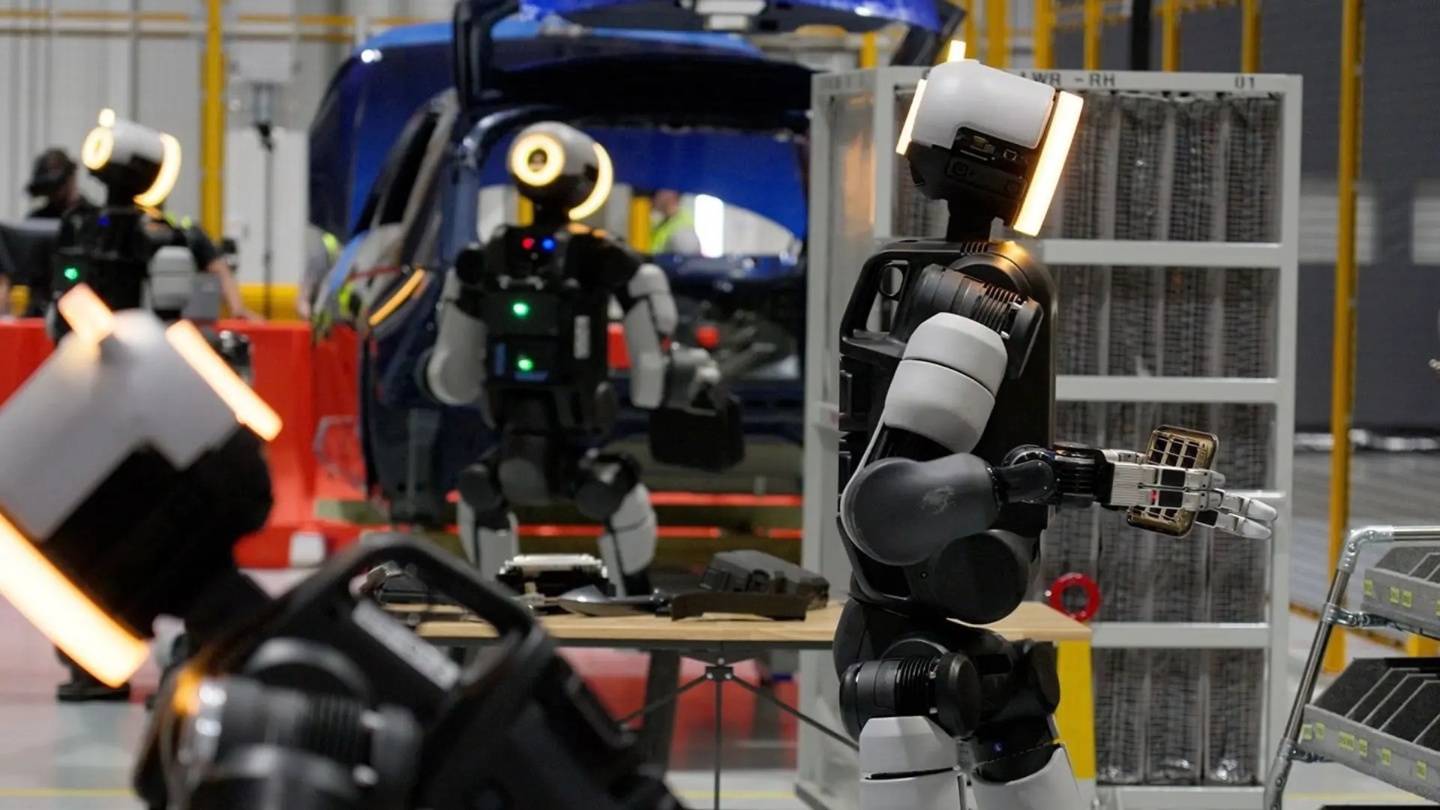
Hyundai Motor Group is set to significantly expand its use of advanced robotics, announcing plans to deploy 25,000 Boston Dynamics Atlas humanoid robots across its global manufacturing facilities in the coming years. This ambitious initiative is supported by the establishment of a new U.S. factory with an annual production capacity of 30,000 robots.
Metaplant Application Center Opens Doors
Boston Dynamics recently inaugurated its Robot Metaplant Application Center (RMAC) at Hyundai Motor Group’s Metaplant America site near Savannah, Georgia. This facility will serve as a crucial hub for testing and training the Atlas robot, facilitating its integration directly into Hyundai’s automotive manufacturing processes. Currently, Atlas robots are undergoing training at RMAC, with operators controlling them remotely.
Zack Jackowski, Chief Product and Technology Officer at Boston Dynamics, stated, “We are pioneering physical AI at an enterprise scale with Hyundai Motor Group. We have established a clear strategy to optimize Atlas’s supply chain, production, testing, and deployment capabilities. RMAC strengthens our shared vision of robots amplifying human potential by making work safer and more efficient.”
Phased Deployment and Future Expansion
The strategic rollout of Atlas robots is slated to begin in 2028 at the Metaplant in Georgia, initially focusing on component sorting. By 2030, the goal is to expand its application to component assembly, a timeline echoed in Boston Dynamics’ official press release.
Beyond automotive manufacturing, Boston Dynamics is exploring Atlas’s application in other industries starting next year. Potential sectors include aerospace, semiconductors, logistics, food and beverage, and life sciences. Discussions are already underway with existing customers of Boston Dynamics’ Spot and Stretch robots to extend Atlas training into these diverse fields.
Atlas Robot Capabilities and Next Steps
The production version of Atlas, unveiled at CES 2026, boasts impressive specifications: 56 degrees of freedom, fully rotating joints, an arm span of up to 2.3 meters, and a lifting capacity of 50 kilograms. It can operate in temperatures ranging from -20℃ to 40℃ and can autonomously navigate to charging stations to swap batteries when low on power. The robot has a continuous payload capacity of 30 kilograms and a battery life of approximately 4 hours per charge.
Looking ahead, Boston Dynamics plans to relocate RMAC to a new, significantly larger building within the same industrial park in 2027, approximately ten times the current size. This expansion underscores the growing importance of the Atlas program and its potential for widespread adoption.
Addressing Workforce Concerns
As workplace automation advances, concerns about job displacement have arisen. The Kia labor union has called for the establishment of a dedicated body to protect workers’ rights in the age of AI. However, Hyundai Motor Vice Chairman Jang Jae-hoon has addressed these worries, emphasizing that the operation, training, and maintenance of robot clusters will continue to require human employees, ensuring ongoing employment needs.
This collaboration between Hyundai Motor Group and Boston Dynamics marks a significant leap forward in the practical application of advanced AI and robotics within large-scale industrial settings, promising to reshape manufacturing and potentially other sectors in the years to come.