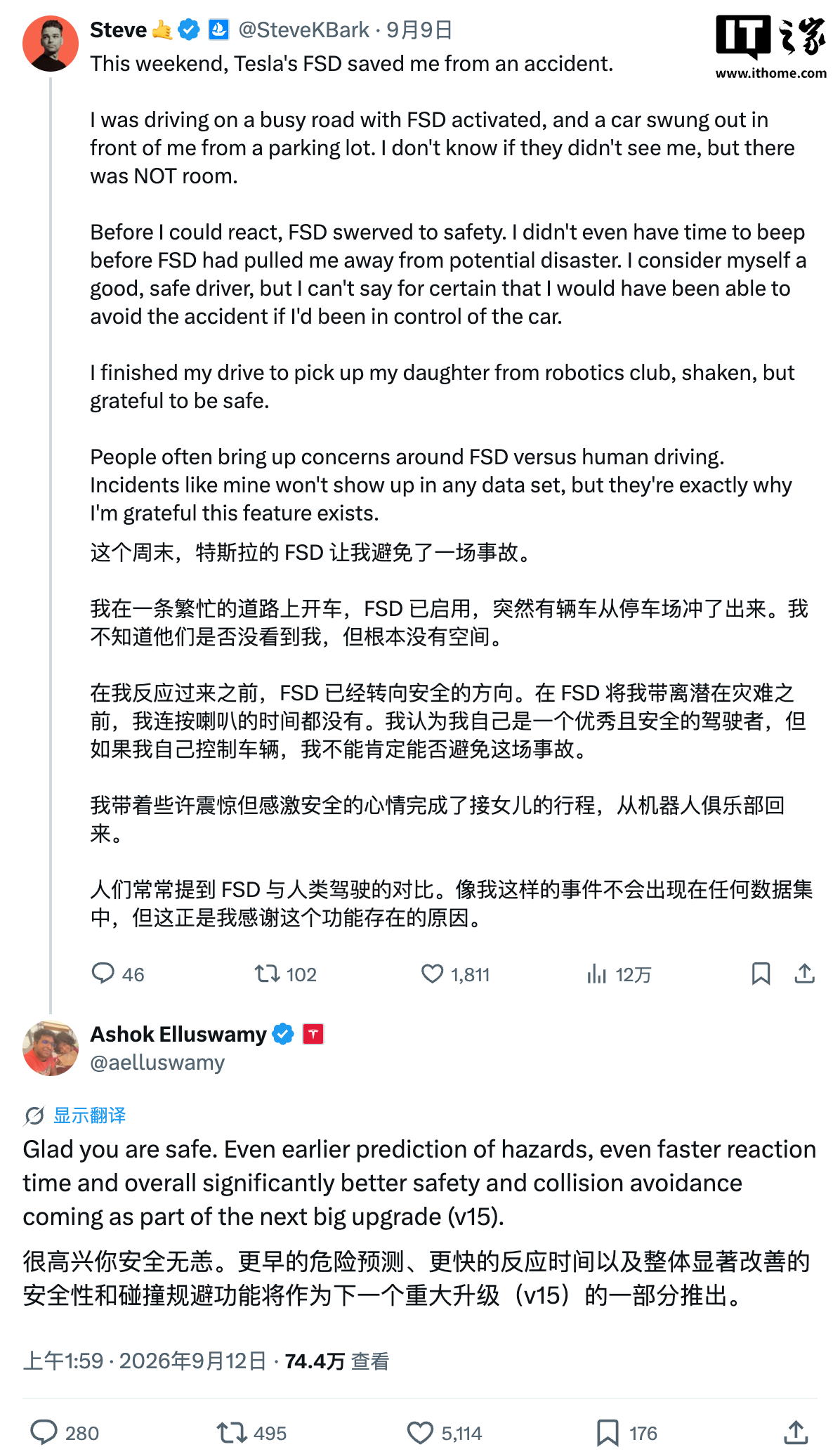
Tesla’s Full Self-Driving (FSD) system is set to receive a significant safety upgrade with the upcoming v15 release. This new iteration promises enhanced active safety and accident avoidance capabilities, building on the company’s commitment to improving autonomous driving technology.
Early Danger Prediction and Faster Reactions
Ashok Elluswamy, Tesla’s head of AI, recently shared insights into the direction of FSD v15’s safety enhancements following a near-miss incident. In this case, a driver’s vehicle maneuvered to avoid another car exiting a parking lot. Elluswamy expressed relief for the driver’s safety and stated that FSD v15 will feature:
- Earlier prediction of hazards.
- Quicker reaction times.
- Overall substantial improvements in safety and collision avoidance.
This focus on proactive safety measures aims to prevent accidents before they happen, a key goal for autonomous driving systems.
Architectural Overhaul and Tighter Integration
Internally, FSD v15 is considered a more substantial architectural upgrade. It involves a significant expansion of the neural network’s scale. Furthermore, the connection between the system’s predictive capabilities and its control mechanisms will be more closely integrated. This tighter coupling is expected to result in more seamless and effective decision-making under complex driving conditions.
Testing and Rollout of Safety Features
Tesla is actively testing early versions of v15 software within its Robotaxi operations. Simultaneously, the company is deploying safety features like Automatic Collision Evasion to existing customer vehicles. This feature is designed to intervene proactively, even when the driver is in manual control, offering an additional layer of security.
Ambitions for Human-Level and Beyond Safety
The development of FSD v15 aligns with Tesla CEO Elon Musk’s ambitious pronouncements regarding the system’s safety benchmarks. As early as April, Musk declared that FSD v15 would surpass human-level safety, even in unsupervised and intricate driving scenarios. He has previously projected that FSD v14 would outperform human drivers, with v15 potentially achieving performance ten times better than human drivers.
During the company’s second-quarter earnings call in July, Tesla revealed that modified Model Y vehicles operating in its Robotaxi network were already equipped with early test versions of FSD v15. This suggests a methodical approach to testing and validation before a wider release.
The continuous development and phased rollout of features like those in FSD v15 underscore Tesla’s ongoing efforts to refine its autonomous driving technology and enhance vehicle safety for its customers.