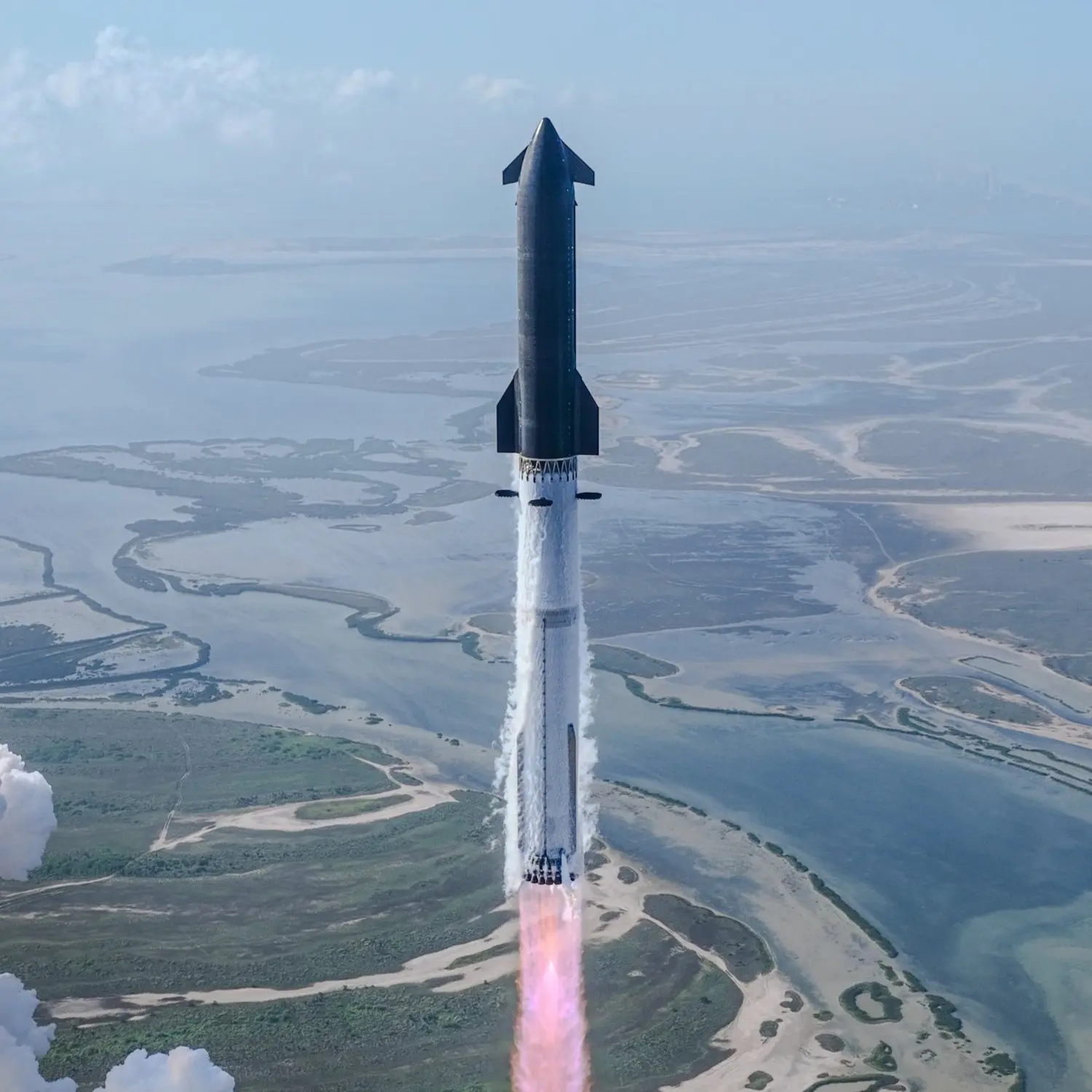
SpaceX conducted its 15th test flight of the Starship super heavy-lift rocket on November 13, 2026, launching from its Starbase facility in Texas. The mission was highly ambitious, aiming for a 22-hour flight of the Starship upper stage and the first-ever attempt to catch the Super Heavy booster using the launch tower’s mechanical ‘chopsticks.’ However, the booster catch was aborted, and the booster was safely ditched in the Gulf of Mexico.
Smooth Launch and Stage Separation
The launch occurred at 5:47 PM Eastern Time (10:47 PM GMT, 4:47 PM local time). The formidable rocket, comprising the Super Heavy booster and the Starship spacecraft, cleared the launch tower successfully, generating over 18 million pounds of thrust from its 33 Raptor 3 engines. The initial ascent phase proceeded nominally, with the Super Heavy engines shutting down and a successful ‘hot-staging’ separation occurring, where the Starship engines ignited before full detachment from the booster. This milestone was achieved approximately 2.5 minutes after liftoff.
Failed ‘Catch’ and Orbital Insertion
Following stage separation, the Super Heavy booster began its return maneuver towards Starbase, while Starship continued its trajectory towards low Earth orbit (LEO). SpaceX had planned to capture the Super Heavy with the launch tower’s giant mechanical ‘chopsticks.’ However, the company called off this attempt, and the booster executed a controlled splashdown in the Gulf of Mexico about 6.5 minutes after launch. The exact reasons for aborting the catch attempt are not yet public.
A successful catch would have represented a significant step for SpaceX in its quest for a fully and rapidly reusable Starship system. It would have marked the first successful landing of a V3 Super Heavy version. Meanwhile, the Starship upper stage pressed on. After its first engine burn, which concluded around 8 minutes post-launch, Starship successfully reached LEO approximately 26 minutes and 10 seconds after liftoff, attaining an altitude of about 275 kilometers. ‘We have nominal orbital insertion, so Starship is now on its second lap around the Earth. This is a great moment,’ commented SpaceX representative Dan Huot during the flight broadcast.
During its mission, Starship deployed 26 Starlink V3 satellites into orbit. These upgraded communication satellites are substantially more powerful than previous Starlink V2 versions. Three of the deployed satellites are equipped with cameras pointed at Starship itself to analyze its heat shield tiles and other components post-spaceflight. This data is intended to help SpaceX assess the spacecraft’s readiness for a potential return to Earth. Starship was slated to complete 14 orbits around Earth, spending over 21 hours in space before attempting a return to the launch site.
Source: space.com