Astronomers have been observing an object for 15 years that misleadingly appeared to be a supernova. However, recent research using NASA’s Chandra X-ray Observatory has revealed that behind this phenomenon is not the explosive death of a star, but a hidden black hole (or neutron star) that was “dining” on an unstable giant star.
A False Supernova: A 15-Year Enigma
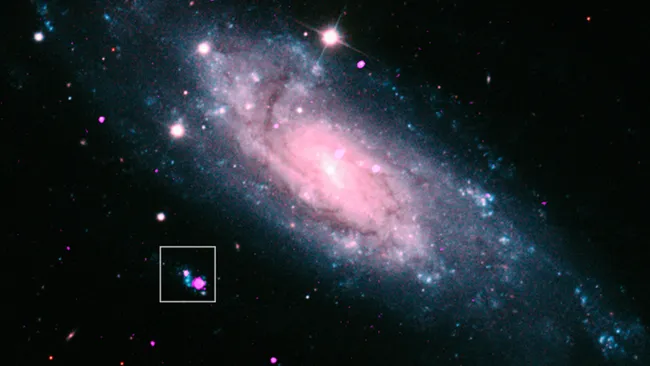
The event, known as AT 2016blu, was first detected on January 11, 2012, on the outskirts of the spiral galaxy NGC 4559, located approximately 25 million light-years from Earth. Initially, astronomers assumed it was a supernova – a grand cosmic event marking the death of massive stars. However, as the “explosion” faded, the star remained in place, continuing to flare up every 113 days. This regular “return” of brightness baffled scientists, as such behavior is not characteristic of true supernovae.

Unraveling the Mystery: The ‘Vampire’ Black Hole
“For 15 years, astronomers observed this star regularly becoming very bright and then dimming again,” noted Mojgan Aghalouloo from the University of Virginia. It was her team, using the “eyesight” of the Chandra X-ray Observatory, that managed to solve this puzzle. It turned out that AT 2016blu is an extremely massive and bright, but unstable, Luminous Blue Variable (LBV) star. Its main characteristic is periodic ejections of material. But even this did not explain the “supernova”.
Astronomers hypothesized that X-ray data taken precisely during one of these ejections would be needed to uncover the cause of these flares. The team had the opportunity to direct Chandra at AT 2016blu in March 2026. The telescope, which had incidentally observed this region of the galaxy in 2001-2002, captured a powerful burst of X-ray radiation that coincided with another “false” explosion.
This data allowed scientists to piece together the events: AT 2016blu has an invisible companion – a compact object with immense gravity (a neutron star or black hole) orbiting it in an elliptical path with a period of 113 days. When this compact object approaches the unstable star, its gravity “rips away” some of its material. This material forms a superheated disk around the black hole or neutron star, emitting X-rays and creating the illusion of a supernova explosion.