November 12, 2014, marked a pivotal moment in space exploration: the European Space Agency’s Philae lander achieved the first-ever soft landing on a comet. However, what was intended to be a stable scientific operation turned into a series of unexpected “hops” and a period of lost contact, with the module disappearing from view for nearly two years.
An Unconventional Landing and ‘Jumps’
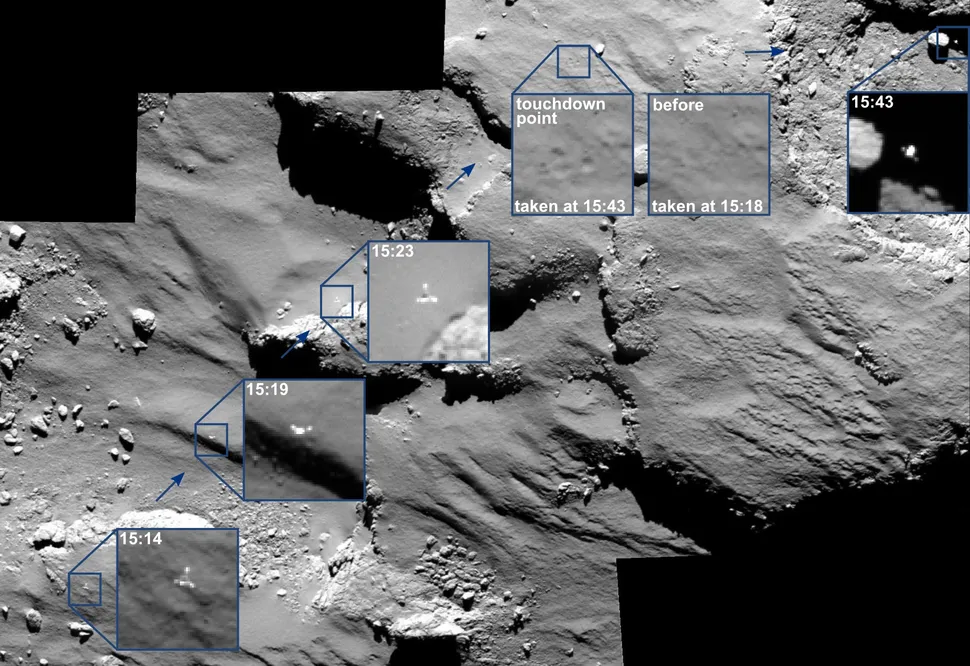
Launched by the European Space Agency (ESA) as part of the Rosetta mission, Philae was designed to anchor itself to the surface of Comet 67P/Churyumov-Gerasimenko using harpoons. The harpoon deployment mechanism, however, failed to function as intended. Upon touching the surface, Philae bounced, ascending up to 800 meters. Over the next two hours, the lander executed at least one more jump before losing contact with the Rosetta orbiter. The comet’s surface, described as resembling a rubber duck, proved more challenging than anticipated.
Lost and Found: Scientific Achievements Despite Setbacks
Following its initial bumpy landing, Philae ricocheted off the comet’s surface, traveling approximately one kilometer. It then made a second brief contact before detaching again due to the lack of secure anchoring. Its final resting place remained a mystery for almost two years. Later, images from the Rosetta orbiter revealed that Philae had landed in a dark crevice on the comet, an area devoid of the sunlight necessary to power its solar panels.
Despite these significant challenges, Philae managed to conduct vital scientific research using its 10 onboard instruments, powered by batteries for over two days. Its most significant discovery was the identification of organic molecules, previously unobserved on comets. The Rosetta mission continued until September 2016, and it was shortly before its end that the spacecraft finally located Philae, resting on its side within a rocky gorge.