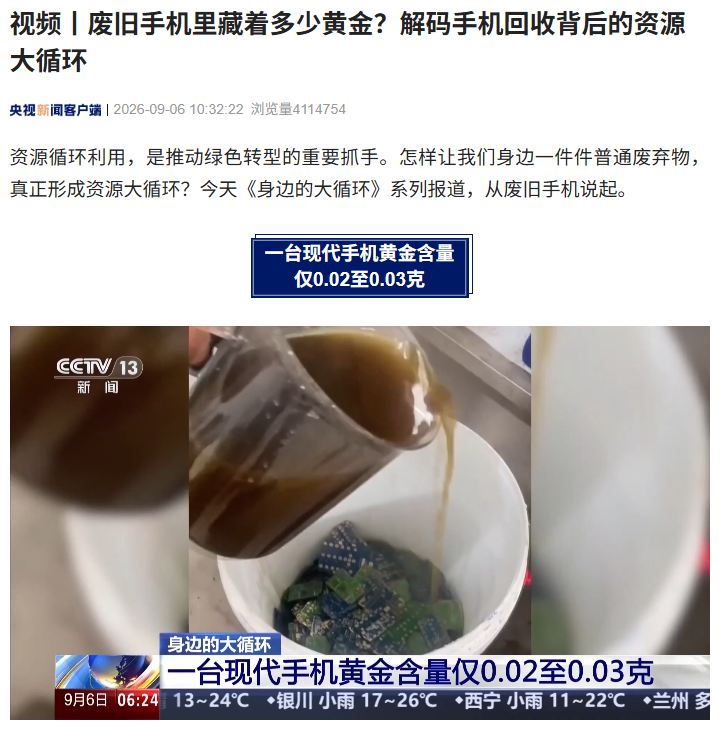
A recent report by China Central Television (CCTV) has delved into the world of smartphone recycling, aiming to clarify common misconceptions about the precious metals contained within our discarded devices. The investigation specifically addressed the widely circulated claim that one ton of old mobile phones can yield 200 grams of gold.
Debunking the ‘Mobile Gold Rush’
According to experts interviewed in the CCTV report, the popular claim is misleading as it conflates different stages of the recycling process. The figure of 200 grams of gold is not achievable from one ton of intact, used mobile phones. Instead, it refers to one ton of highly processed electronic waste – specifically, pure circuit board material after components like casings, screens, and batteries have been removed and sorted.
The presence of these other components significantly dilutes the overall concentration of valuable metals in a complete, discarded phone. Furthermore, a notable trend has emerged in recent years: since 2010, smartphone manufacturers have progressively thinned the gold plating on components. This means a modern smartphone typically contains a mere 0.02 to 0.03 grams of gold.
The Industrial Process of Metal Recovery
The CCTV report shed light on the sophisticated industrial processes involved in extracting valuable metals from recycled electronics. Processed circuit boards from discarded phones are fed into a smelting furnace operating at a scorching 1300℃.
Inside this high-temperature environment, valuable metals such as copper, gold, silver, and palladium are separated from hazardous substances like lead and mercury. The facility described utilizes a three-tier processing system, achieving an impressive comprehensive metal recovery rate exceeding 98%. This operation has the capacity to process approximately 12,000 tons of waste circuit boards annually.
Huang Wen, the head of a major electronic recycling and utilization base in China, explained the output from the smelting process. The resulting copper ingots are about 90% copper, with gold content around 100 grams per ton and silver at 1,000 grams per ton. Significantly, one ton of circuit boards can yield roughly 300 kilograms of copper.
Gold as a Byproduct, Not the Main Prize
The report emphasized that the gold extracted is not independently refined from phones. Instead, it is found as a trace byproduct within the copper ingots, solidifying in metal containers. The notion of ‘mining gold from phones’ is essentially a mischaracterization of a complex industrial process focused on the comprehensive recovery of multiple metals. Gold is just one of several valuable byproducts obtained.
The Scale of E-Waste in China
Data from the China Circular Economy Association highlights the immense scale of the e-waste challenge. Over the past five years, China has generated approximately 400 million old mobile phones annually. A significant portion, around 250 million units each year, remains unused in homes, while only about 150 million units enter the official recycling market. When considering the historical accumulation, the current estimated cumulative number of disused mobile phones across China is a staggering 4 billion.
National Goals for a Circular Economy
This focus on recycling and resource recovery aligns with China’s national ambitions outlined in the ‘Circular Economy Development Plan for the 15th Five-Year Plan’ (2026-2030). By 2030, the plan aims for a more mature circular economy system encompassing production, consumption, recycling, and utilization. Key targets include a roughly 16% increase in major resource productivity compared to 2025 levels, an annual comprehensive utilization of solid waste reaching about 4.5 billion tons, and a yearly recycling of primary renewable resources hitting 510 million tons. The resource recycling industry is projected to reach a total output value of 8 trillion yuan.
Looking further ahead to 2035, China envisions a basic establishment of a high-quality circular economy development system, with major resource utilization efficiency reaching internationally advanced levels.
Expanding Urban Mining and New Energy Waste
The national strategy emphasizes accelerating standardized collection and refined dismantling in traditional ‘urban mining’ sectors. This includes enhancing the high-value utilization of end-of-life vehicles, waste electrical and electronic products, scrap steel, non-ferrous metals, plastics, and textiles.
Additionally, the plan addresses the growing challenge of waste from ‘new three’ green energy products. Specific measures are being developed for discarded power batteries, wind power equipment, and photovoltaic equipment. These measures involve improving disposal management, clarifying responsibility, and strengthening recycling networks to boost standardized recycling and utilization rates.