A team of Chinese scientists, led by Yu Xuejia from the Ningbo Institute of Technology, in collaboration with researchers from Hunan University and Zhejiang University, has announced a significant theoretical breakthrough in the field of quantum phase transitions and critical phenomena. Their research, published in the prestigious journal Physical Review Letters, reveals a novel dynamical behavior driven by topological edge states at critical points, which challenges the long-standing Kibble-Zurek (KZ) mechanism.
Challenging the Conventional Wisdom
The Kibble-Zurek (KZ) mechanism is a theoretical framework that describes the non-equilibrium dynamics of systems undergoing continuous phase transitions. It was initially developed to explain the formation of topological defects in the early universe. A core concept in understanding phase transitions is the critical point, where a system can exhibit universal properties. Traditionally, it was believed that topological edge states, which describe unique stable states of matter, could not exist at gapless quantum critical points.
For years, physicists have primarily relied on the Landau theory of symmetry breaking to describe phase transitions, which posits that transitions occur due to changes in symmetry. However, starting in 2021, Yu Xuejia’s team and others began to observe rich topological physics even at gapless quantum critical points, phenomena that extend beyond the descriptive capabilities of the Landau theory.
A New Mechanism for Dynamics
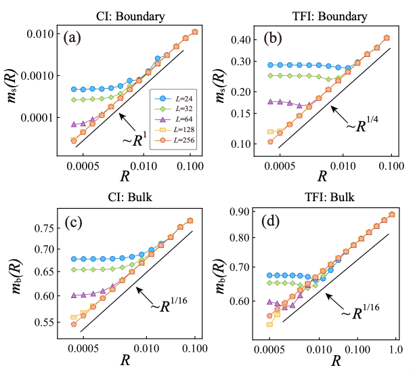
This latest research focuses on the problem of non-equilibrium dynamics. The team investigated the dynamical scaling behavior of topologically inequivalent quantum critical points under driving processes. They discovered that non-trivial topological edge states at these quantum critical points can induce anomalous scaling behaviors that go beyond the traditional KZ framework.
In their study, the researchers examined the driving dynamics of quantum critical points in the transverse-field Ising model and the cluster Ising model. While the bulk dynamics of both models adhered to standard KZ scaling, their boundary dynamics exhibited distinct behaviors. The transverse-field Ising model showed conventional KZ behavior, whereas the cluster Ising model displayed a modified power-law scaling that deviated from traditional theoretical predictions.
This anomalous scaling was further validated through tensor network numerical simulations in the exactly solvable quantum Potts chain. To explore the universal origin of this phenomenon, the team also studied the driving dynamics of topologically inequivalent critical points in a free fermion model. They observed similar anomalous edge excitation scaling behaviors in topologically non-trivial critical points.
Implications for Future Research
The findings indicate that stable topological edge states at critical points are the key drivers of anomalous universal dynamical behavior. This establishes a completely new mechanism for observing dynamical phenomena that surpass the predictions of the KZ framework. This breakthrough opens new avenues for understanding the complex dynamics of quantum systems and could have implications for fields ranging from condensed matter physics to cosmology.
The research was supported by the National Natural Science Foundation of China and other funding agencies.