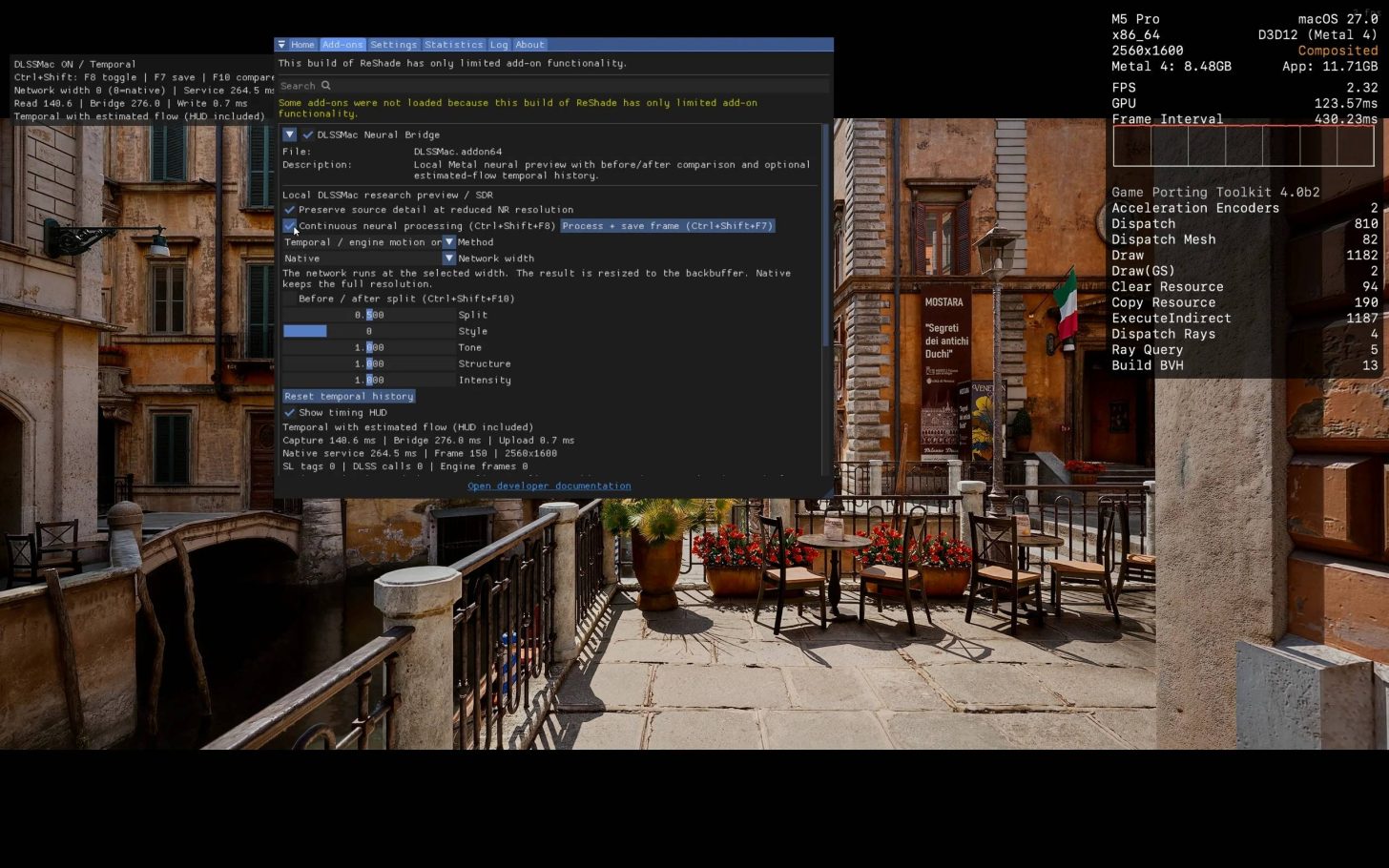
In a remarkable feat of cross-platform ingenuity, developers have successfully ported NVIDIA’s cutting-edge DLSS 5 technology to Apple Silicon, including the M5 Pro chip. While this is an unofficial, community-driven effort, it showcases the growing potential for advanced graphics features on Apple’s own hardware.
DLSS 5 Comes to Apple Silicon via Community Effort
The breakthrough was reported by Wccftech, highlighting the work of developers @iamwavecut and @Mappsnet7. @iamwavecut managed to port the DLSS 5 neural rendering model to Apple Silicon, while @Mappsnet7 integrated it into Windows games running on macOS using the Game Porting Toolkit 4.0b2 and ReShade with a Metal backend.
This unofficial port allows for a glimpse into how NVIDIA’s latest AI-powered graphics enhancement could perform on Apple’s powerful, yet architecturally different, M-series chips.
Performance Gains and Significant Trade-offs
Testing on an M5 Pro chip with a 16-core GPU revealed notable improvements in visual fidelity. Enabling DLSS 5 enhanced surface lighting, ambient occlusion, and the sense of depth in the tested scenes. However, these visual upgrades came at a considerable performance cost.
The frame rate plummeted to a mere 2.32 FPS at 1440p resolution, and input latency soared to a staggering 240ms. This suggests that while the visual enhancements are present, the current implementation struggles to deliver a playable experience on Apple Silicon due to underlying hardware and software limitations.
Hardware Limitations and Future Potential
One of the primary reasons cited for the performance bottleneck is the insufficient support for FP8 precision. DLSS 5 relies on FP8 calculations for a portion of its neural network inference. The M5 Pro, lacking dedicated hardware units for FP8, must instead process these calculations using the less efficient FP16 path. This mismatch significantly hampers the technology’s performance.
To put this into perspective, the M5 Pro’s 16-core GPU offers a peak FP8 compute power of 26TOPS. In contrast, a desktop NVIDIA RTX 4050 (a comparable entry-level gaming GPU) boasts approximately 105TOPS in FP8, roughly four times the theoretical power of the M5 Pro’s implementation in this specific scenario.
What is DLSS 5?
NVIDIA’s DLSS 5 (Deep Learning Super Sampling 5) was officially unveiled at the GTC conference in March 2026 and launched later that year with titles like ‘NBA 2K27’. Unlike previous iterations of DLSS, which primarily focused on boosting frame rates, DLSS 5 introduces a revolutionary real-time neural rendering model.
This generative AI approach aims to “add detail” to game visuals, pushing the boundaries of realism. The goal is to achieve Hollywood-level photorealism in elements such as lighting, textures, and character skin, offering an unprecedented level of visual immersion.
The Road Ahead
While this unofficial port of DLSS 5 to Apple Silicon is far from production-ready for gaming, it’s an exciting development. It demonstrates the capabilities of Apple’s silicon and the dedication of the developer community to push technological boundaries. As both Apple and NVIDIA continue to innovate, future possibilities for advanced graphics technologies on Mac hardware look increasingly promising.