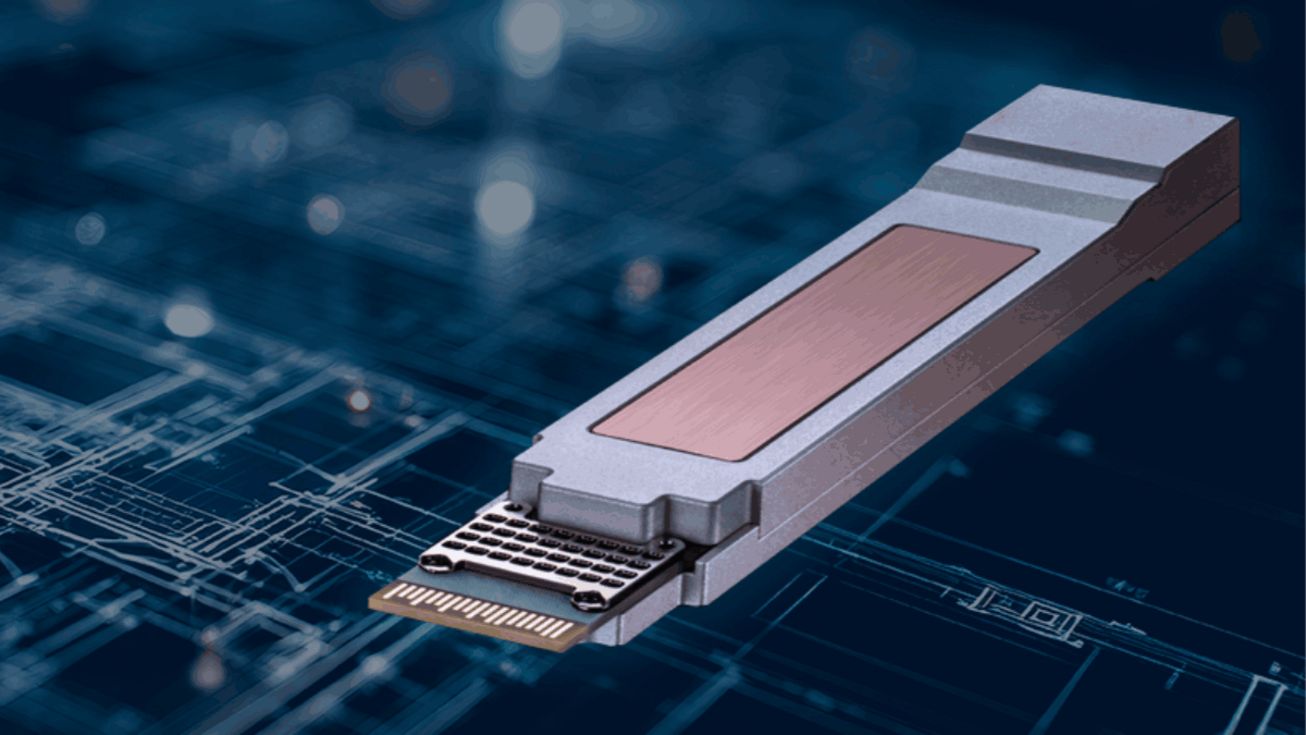
NVIDIA and Cisco have announced a new development, the Ultra-Dense Small Form Factor Pluggable (USFP) module, designed for next-generation optical transceivers to enable the scaling of AI factories. This innovation aims to address the growing demands of artificial intelligence infrastructure.
An Innovative Module for the AI Industry
The USFP module is engineered as the first to support 400 Gigabit Ethernet (GbE) electrical signals per lane, paving the way for aggregate bandwidths of up to 12.8 Terabits per second (Tbps). This advanced module is set to empower creators of AI factories to scale their Ethernet AI networks while maintaining the familiar deployment model that has been a staple across many generations of data center networking.
This new form factor offers four times the bandwidth density and a 30% improvement in power efficiency compared to existing 200 GbE optical modules. This means AI factories can connect more compute systems without adding new network layers, simultaneously reducing the energy consumption for transmitting each bit of data.
“Building the world’s largest AI factories begins with reimagining the smallest connections,” said Gillard Shainer, Senior Vice President of NVIDIA. “With USFP, NVIDIA and Cisco are creating an ecosystem to reimagine pluggable optics, enabling more efficient connectivity of compute power to fuel the next generation of AI factories.”
Bill Gartner, Senior Vice President and General Manager of Cisco’s Optical Systems and Optics business, added, “AI developers need a connectivity architecture that can scale performance without tying them to a more complex operational model. Cisco and NVIDIA realized that scaling pluggable optics to 400GbE per lane would require more than just another incremental update to current module designs. Through our collaboration, USFP is designed to deliver a new level of bandwidth density while maintaining the serviceability, deployment flexibility, and operational simplicity of pluggable optics. By taking a full-stack approach—from silicon and systems to optics and the network operating system—we can optimize every layer to deliver the performance and scale required for next-generation networks.”
The USFP supports up to 100 watts of power consumption without requiring separate onboard cooling, which simplifies switch designs and enhances reliability. This advancement allows for the creation of higher bandwidth networks while retaining the pluggable transceiver form factors that are standard for deployment, service, and manufacturing.
Forging a Hardware Ecosystem
NVIDIA and Cisco are collaborating with TE Connectivity and Amphenol to develop USFP cages, connectors, and modules. The involvement of other partners is anticipated. This common form factor provides vendors with a unified foundation for developing high-density, pluggable infrastructure for 400 GbE per lane networks, thereby fostering a robust ecosystem for AI factory developers.
This collaboration builds upon existing work between NVIDIA and Cisco, which ensures seamless interoperability between NVIDIA Spectrum-X Ethernet and Cisco Silicon One Ethernet networks, simplifying AI infrastructure deployment for enterprises, cloud providers, and sovereign clouds.
NVIDIA and Cisco plan to establish an open industry specification for USFP through a future multi-vendor collaboration initiative.