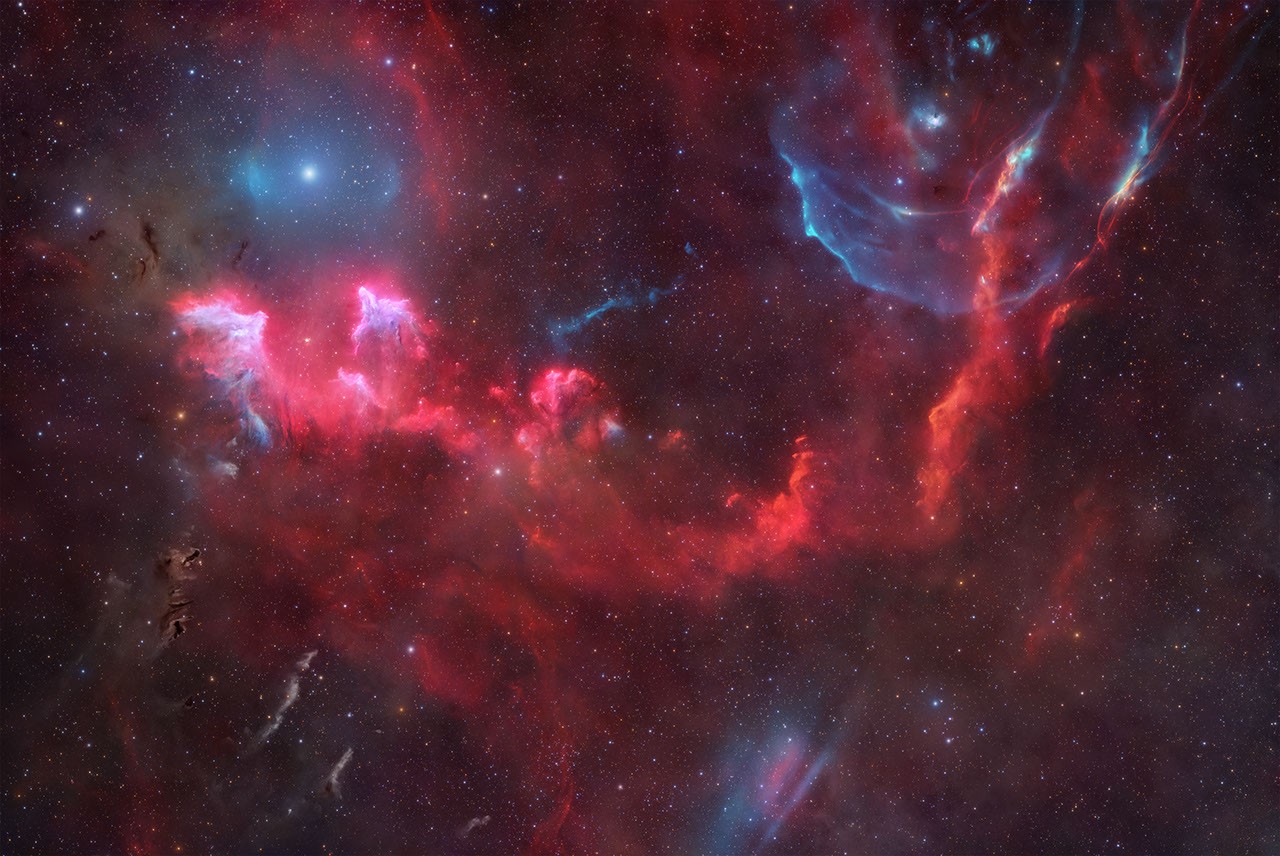
Astronomers, employing advanced filters and thousands of hours of observation, have identified three previously unknown cosmic nebulae within the constellation Cassiopeia. These newly discovered objects, dubbed ‘new ghosts,’ emit light characteristic of ionized oxygen, presenting scientists with intriguing questions about their origins.
Cassiopeia’s ‘Ghosts’: A New Cosmic Discovery
The original ‘Ghosts of Cassiopeia,’ nebulae IC 59 and IC 63, are recognized for their proximity to the multi-star system γ (Gamma) Cassiopeiae. The energetic light from this star causes hydrogen in the nebulae to glow red, while dust reflects bluish-white starlight. However, the recently detected objects, designated Object 1, 2, and 3, appear as blue phantoms, indicating the presence of ionized oxygen.
The Mystery of Ionized Oxygen
The origin of this ionized oxygen remains a significant enigma. One hypothesis suggests that the γ Cassiopeiae system, as it moves through interstellar gas and dust, might be generating a shock wave. Specifically, Object 3 could be compressed and heated oxygen from such a shock wave. Regarding Object 1, it is speculated to be a planetary nebula, contingent on the identification of a central white dwarf star. Further research is anticipated to unravel these cosmic mysteries.