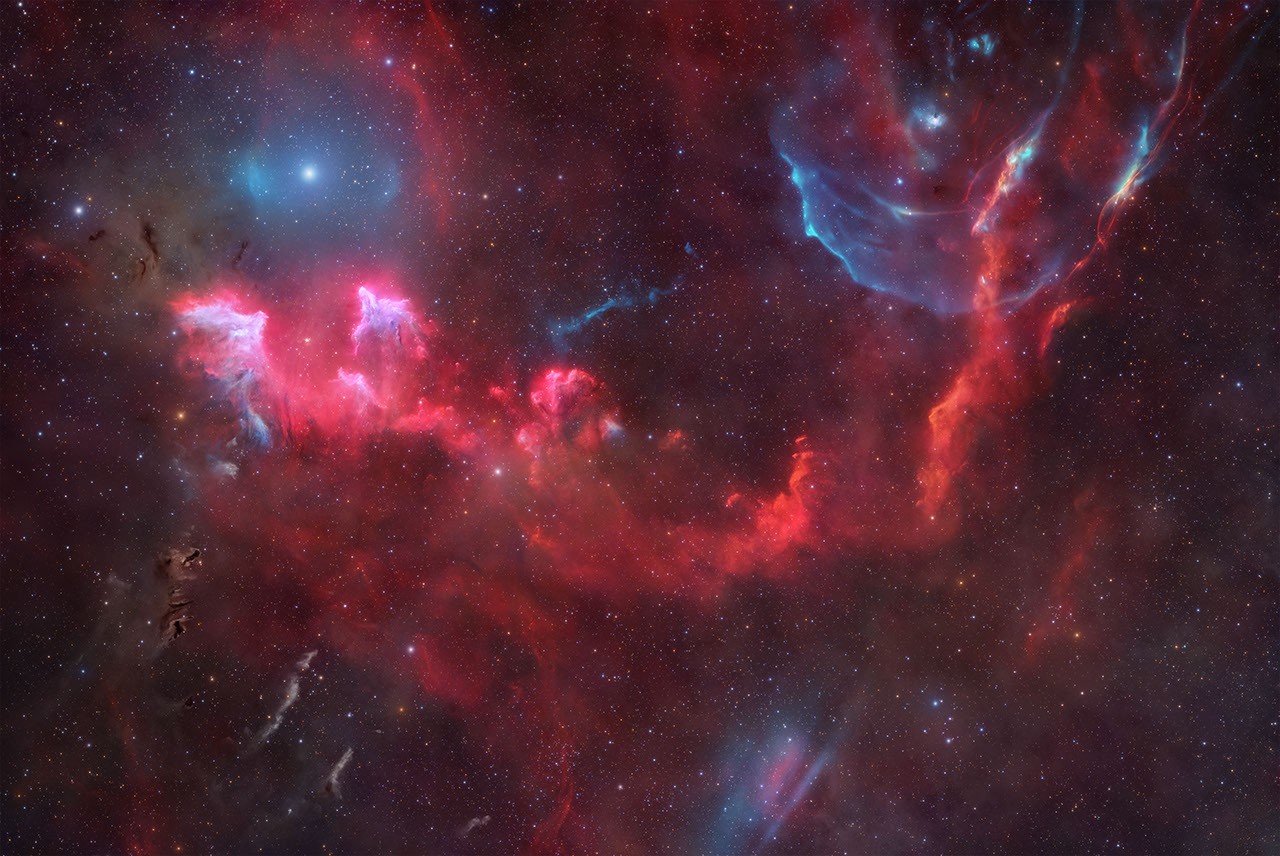
Astronomers have uncovered previously unknown celestial entities, dubbed ‘new ghosts,’ lurking in the constellation Cassiopeia. These faint nebulae, revealed through extensive observation and the use of a specialized oxygen filter, offer a tantalizing glimpse into the dynamic processes occurring in interstellar space. The discovery adds a new layer to our understanding of cosmic nurseries and the interactions between stars and their surrounding gas and dust.
The Haunting of Cassiopeia
The constellation Cassiopeia, a familiar sight in the night sky, is now home to newly identified astronomical apparitions. These ‘ghosts’ were captured over 100 hours of dedicated observation, utilizing a special oxygen filter that allowed for the detection of faint gaseous structures. The original ‘Ghosts of Cassiopeia,’ IC 59 and IC 63, are well-known nebulae located near the multi-star system γ Cassiopeia. The energetic light from this star system causes the hydrogen gas within IC 59 and 63 to emit a red glow, while their dust reflects and scatters blue-ish white starlight. The newly discovered objects, designated Objects 1, 2, and 3, present themselves as eerie blue phantoms, indicating the presence of ionized oxygen.
Unraveling the Mystery of Ionized Oxygen
The presence of ionized oxygen in these newly discovered nebulae raises intriguing questions about their origins. Scientists hypothesize that γ Cassiopeia, as it moves at high speed through the interstellar medium, might be compressing material much like the bow wave of a speeding boat. Object 3, in particular, could represent the compressed and heated oxygen within such a bow shock. The origin of Object 1 remains a captivating mystery, with possibilities including a planetary nebula if a central white dwarf star can be identified. Further research is ongoing to unravel the precise mechanisms behind the ionization and the formation of these celestial specters.
Source: NASA