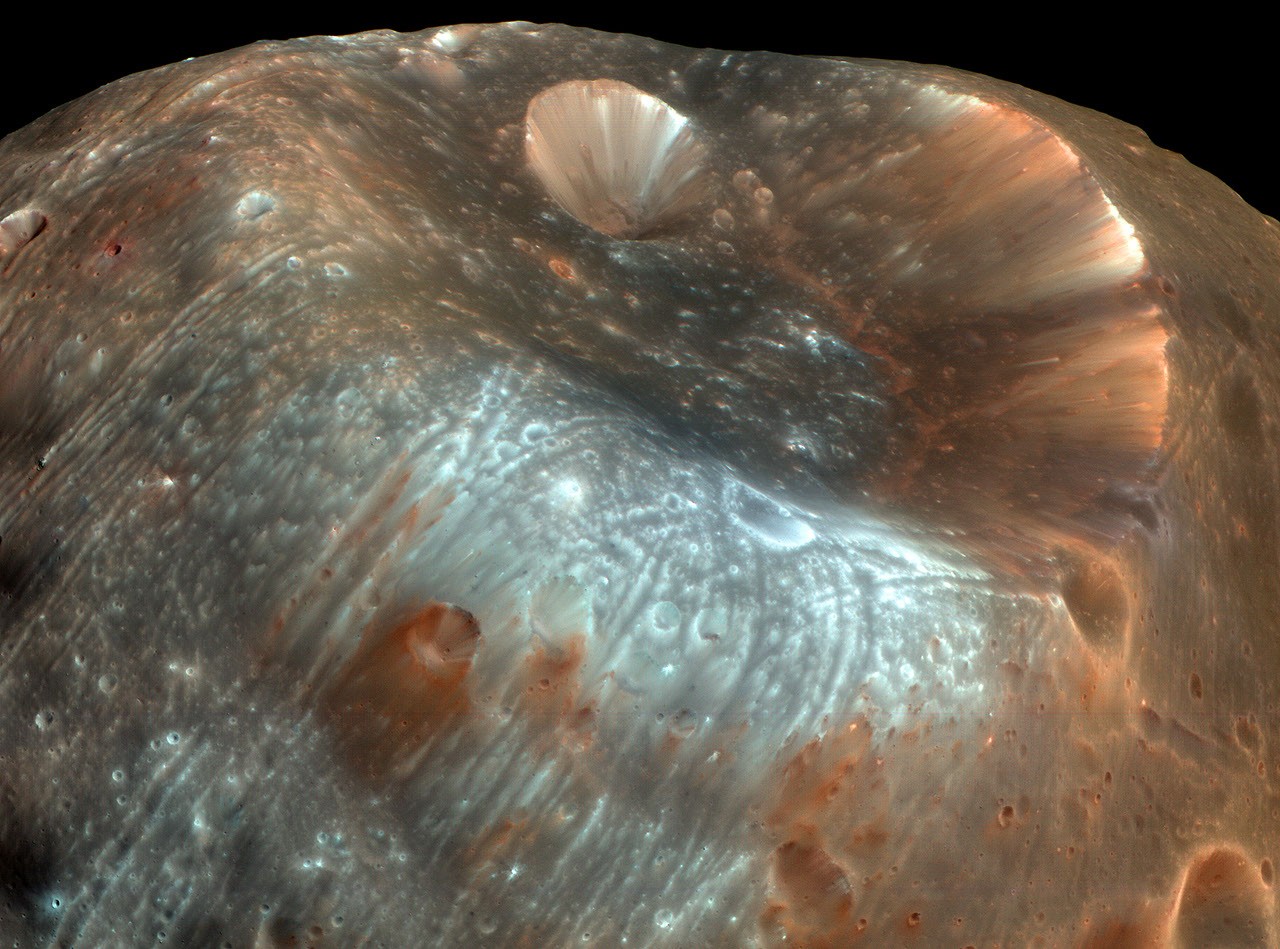
New imagery from NASA’s Mars Reconnaissance Orbiter (MRO) has provided a stunning, enhanced-color view of Stickney Crater, the largest impact feature on Phobos, Mars’ larger moon. This colossal crater, stretching over 9 kilometers (about 5.6 miles) in diameter, is so vast that the asteroid impact that formed it nearly tore the small, potato-shaped moon apart. The image, captured in March 2008, highlights the dramatic scale of this Martian landmark and offers clues to the moon’s violent past and ongoing geological processes.
A Monumental Scar on a Tiny Moon
Stickney Crater’s immense size is particularly striking when considering the overall dimensions of Phobos. The crater’s diameter is nearly half that of the moon itself, underscoring the cataclysmic nature of the event that created it. Named after Chloe Angeline Stickney Hall, wife of astronomer Asaph Hall who discovered Mars’ two moons in 1877, the crater stands as a testament to the raw power of cosmic collisions. The enhanced-color processing by the HiRISE camera reveals subtle details about the crater’s surface and its surroundings, offering scientists a closer look at this ancient scar.
Clues to Phobos’s Dynamic Surface
Despite Phobos’s extremely low surface gravity – less than 1/1000th of Earth’s – the crater walls show evidence of material sliding down, forming streaks that suggest geological activity over time. Intriguingly, light bluish regions near the crater’s rim could indicate recently exposed material, hinting that Stickney Crater is not merely a static geological feature but may still be experiencing subtle changes. The origin of the mysterious grooves crisscrossing Phobos’s surface, including those near Stickney, remains a subject of scientific intrigue, with theories pointing towards tidal stresses from Mars or the very impact that formed the crater.
Source: NASA