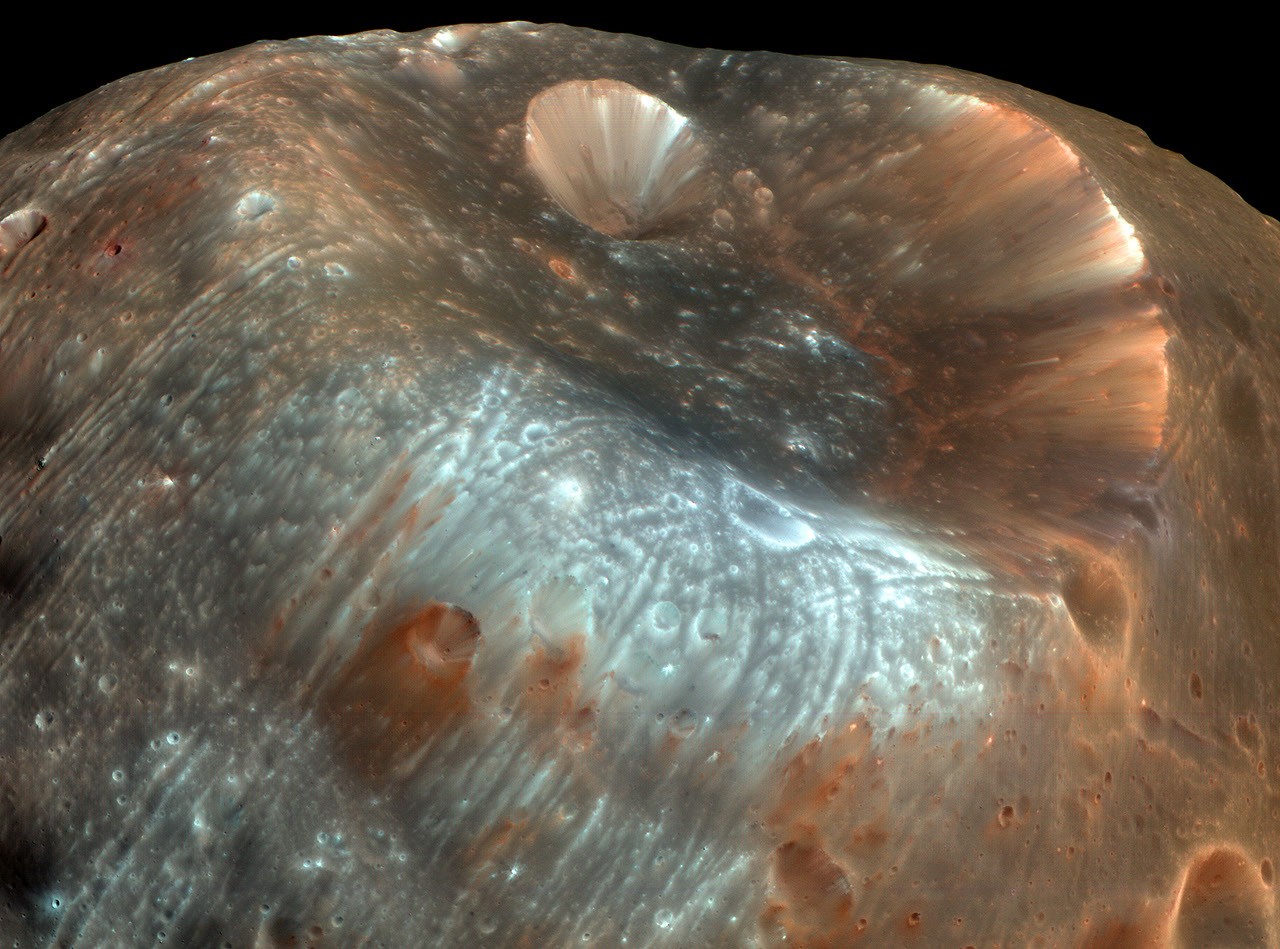
NASA has unveiled a stunning image of Stickney Crater, the largest impact basin on Phobos, one of Mars’ two tiny moons. This immense impact structure, named after Angeline Stickney, the mathematician wife of astronomer Asaph Hall, is nearly twice the size of Phobos itself, underscoring the incredible force of a collision that could have fractured the celestial body.
Monumental Scale of the Impact Event
Stickney Crater, with a diameter exceeding 9 kilometers (approximately 5.6 miles), covers nearly half the surface area of Phobos. Scientists believe the impact that formed it was so powerful it could have severely damaged or nearly shattered the small Martian moon. This striking geological feature serves as a testament to the turbulent past of the Solar System and the intensity of cosmic collisions.
Enigmatic Geological Features
The image, captured by the HiRISE camera aboard the Mars Reconnaissance Orbiter (MRO), reveals not only the crater itself but also the distinctive geological features surrounding it. Despite Phobos’ extremely low gravity—less than one-thousandth of Earth’s—the crater walls show evidence of material slumping, indicating the movement of fine debris. Furthermore, lighter areas near the crater rim may point to relatively fresh, exposed surfaces. Of particular interest are the mysterious grooved lines that stretch across Phobos’ surface. Their origin remains unexplained, but scientists theorize they could be the result of tidal forces acting on the moon due to its close orbit around Mars, or perhaps linked to the very impact event that created Stickney Crater.
Source: NASA