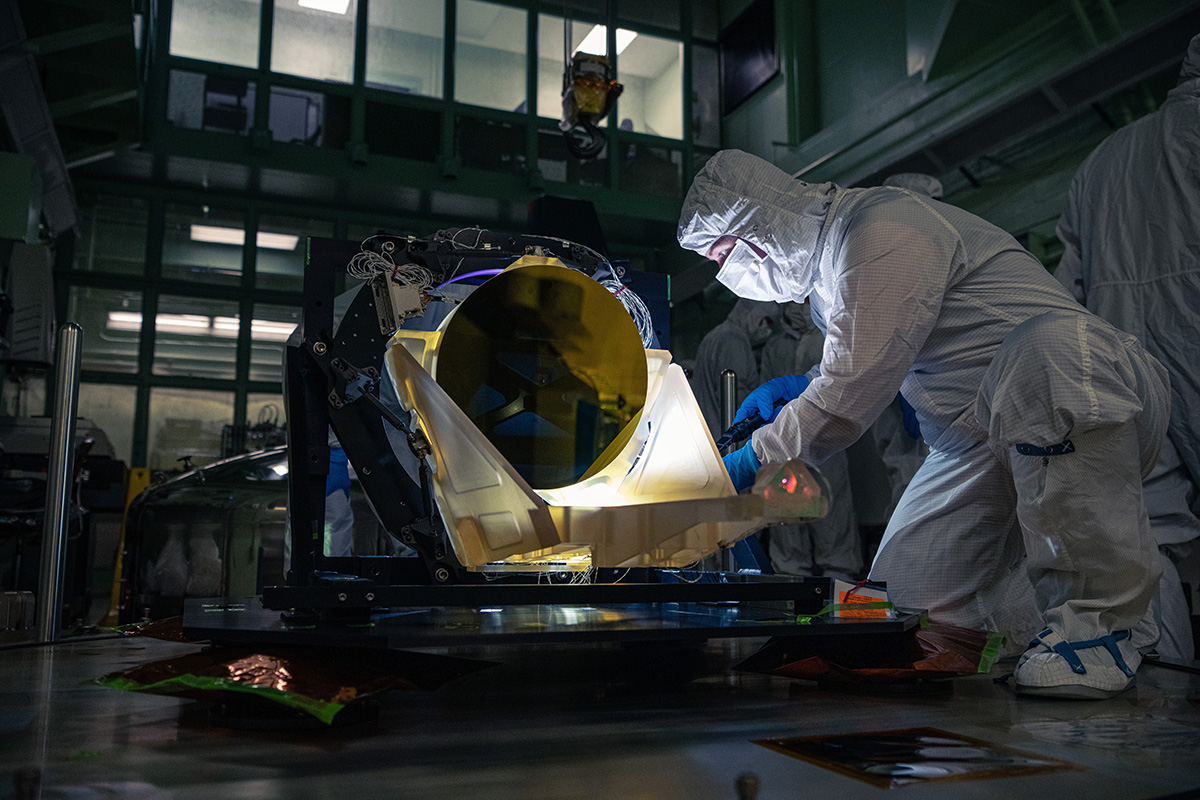
NASA has taken a significant step forward in the development of its ambitious Laser Interferometer Space Antenna (LISA) mission, designed to detect gravitational waves. L3Harris Technologies is set to build, assemble, and integrate a new test telescope, marking a crucial final phase before flight hardware production. This development represents a key contribution from the United States to the mission, which is spearheaded by the European Space Agency (ESA).
LISA: The Gravitational Wave Hunter
Scheduled for launch in the mid-2030s, LISA is a groundbreaking project that will deploy three spacecraft in Earth orbit, forming a vast triangular formation with sides measuring 2.5 million kilometers (1.55 million miles). Each spacecraft will be equipped with two telescopes that will use infrared laser beams to transmit and receive signals between adjacent craft. By measuring microscopic changes in their relative distances, LISA will be able to register the passage of gravitational waves.
“These changes are incredibly small – smaller than the width of a helium atom – but thanks to them, LISA will be able to detect a wealth of low-frequency gravitational waves that we cannot currently observe from ground-based observatories,” explained Ira Thorpe, LISA’s lead scientist at NASA. “LISA will be able to detect the mergers of supermassive black holes billions of light-years away, map compact pairs of white dwarfs, neutron stars, and stellar-mass black holes in our cosmic ‘backyard,’ and possibly provide new insights into gravity itself.”
The Test Telescope: Heart of the Future Observatory
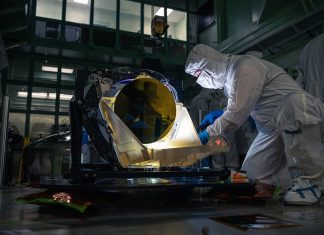
Each telescope will be constructed from a single piece of amber-colored glass-ceramic composite called Zerodur. This material is widely used in high-precision applications due to its stability and resistance to deformation across a broad range of temperatures. L3Harris previously delivered a prototype telescope to NASA last year, which served as an engineering development for this next stage. The new test telescope, known as the Engineering Test Unit, will be the final pre-production unit before flight hardware is manufactured, and it will be the first optical telescope NASA transfers to ESA.
“We conducted extensive testing on the prototype, and we are applying all the lessons learned to this new telescope,” said Ritva Keski-Kuha, LISA telescope program manager at NASA’s Goddard Space Flight Center. Earlier this year, the team had already delivered a structural model of the telescope, made of metal rather than glass.
Gravitational waves, first predicted by Albert Einstein’s general theory of relativity in 1916, were first directly detected by ground-based observatories in 2015. They are generated whenever massive objects accelerate, such as two stars orbiting each other. These waves propagate through spacetime at the speed of light and remain undisturbed on their journey. These properties make them an invaluable tool for exploring the universe.
NASA’s additional contributions to the LISA mission include its laser system, devices to manage the build-up of electric charge on so-called “proof masses” (free-floating cubes influenced only by gravity), data analysis for identifying and classifying individual gravitational wave sources, and further scientific and engineering expertise.