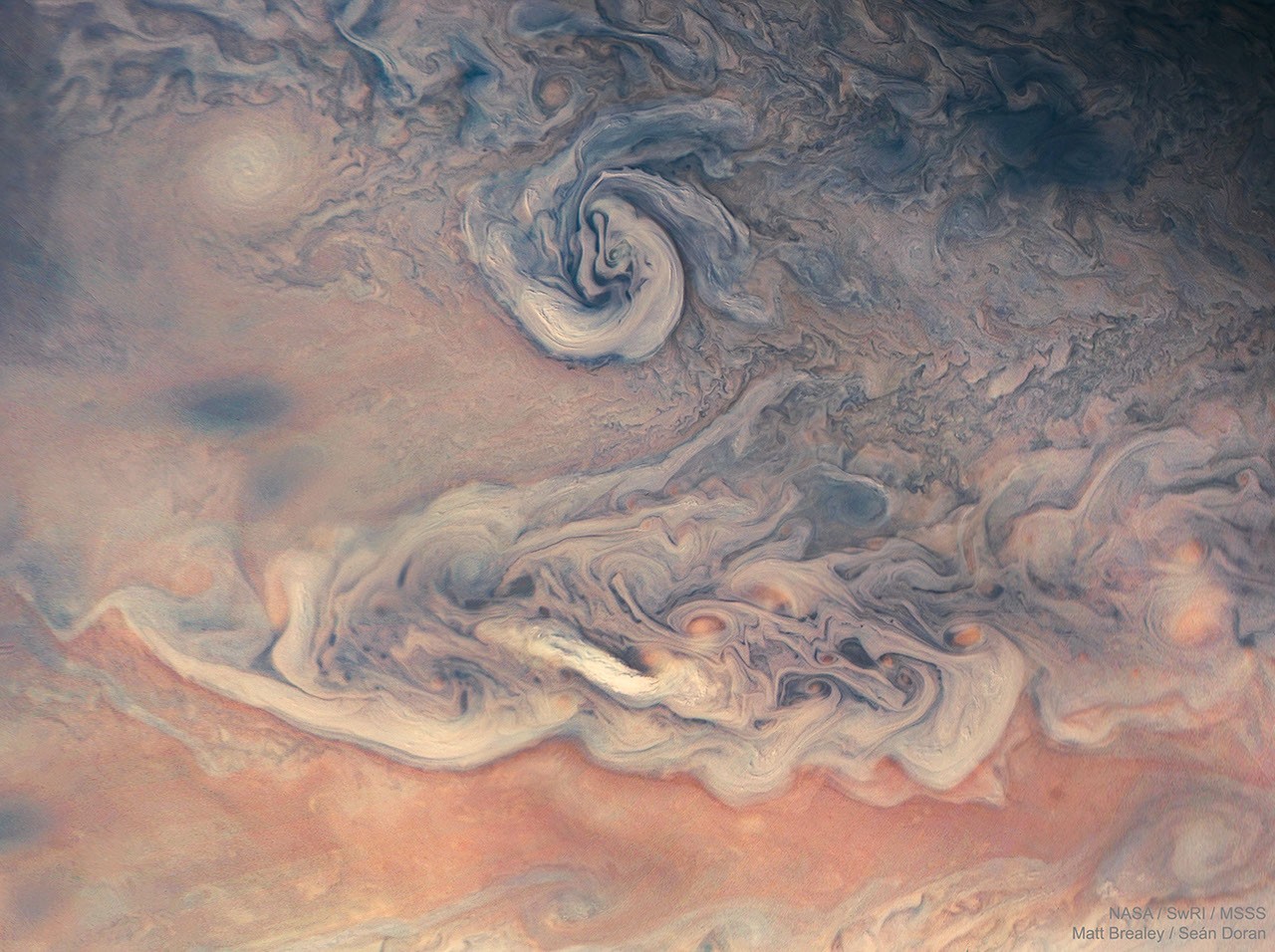
NASA’s Juno spacecraft has delivered a stunning new image showcasing the vibrant and dynamic cloud tops of Jupiter. The photograph, enhanced to highlight its rich colors, reveals swirling patterns and distinct hues, offering a glimpse into the complex atmospheric processes of the gas giant. While the exact causes of these colorful features remain a scientific mystery, researchers are actively investigating the trace molecules that might be responsible for painting Jupiter’s skies.
Unraveling Jupiter’s Colorful Clouds
The dominant elements in Jupiter’s atmosphere, hydrogen and helium, are colorless at the frigid temperatures found at its cloud tops. This means that the mesmerizing colors observed, from vibrant reds to lighter shades, are likely due to the presence of trace chemical compounds. Ammonium hydrosulfide is considered a leading candidate, but the precise mix and distribution of these substances are still a subject of intense scientific research. The image clearly illustrates a key observation: lighter-colored clouds tend to be situated at higher altitudes than their darker counterparts. This visual cue helps scientists piece together the vertical structure and dynamics of Jupiter’s deep atmosphere.
Juno’s Ongoing Exploration of the Giant Planet
This breathtaking vista was captured by Juno in 2018 during its 14th close pass over Jupiter. The robotic explorer continues its mission, orbiting the colossal planet in a looping, elliptical path. Every 33 days, Juno swoops near Jupiter, venturing into a slightly different sector of the planet’s atmosphere with each pass. This continuous exploration allows scientists to gather unprecedented data and imagery, deepening our understanding of Jupiter’s weather, magnetic field, and internal structure. The mission’s ongoing observations promise to unlock more secrets of this fascinating world.
Source: NASA