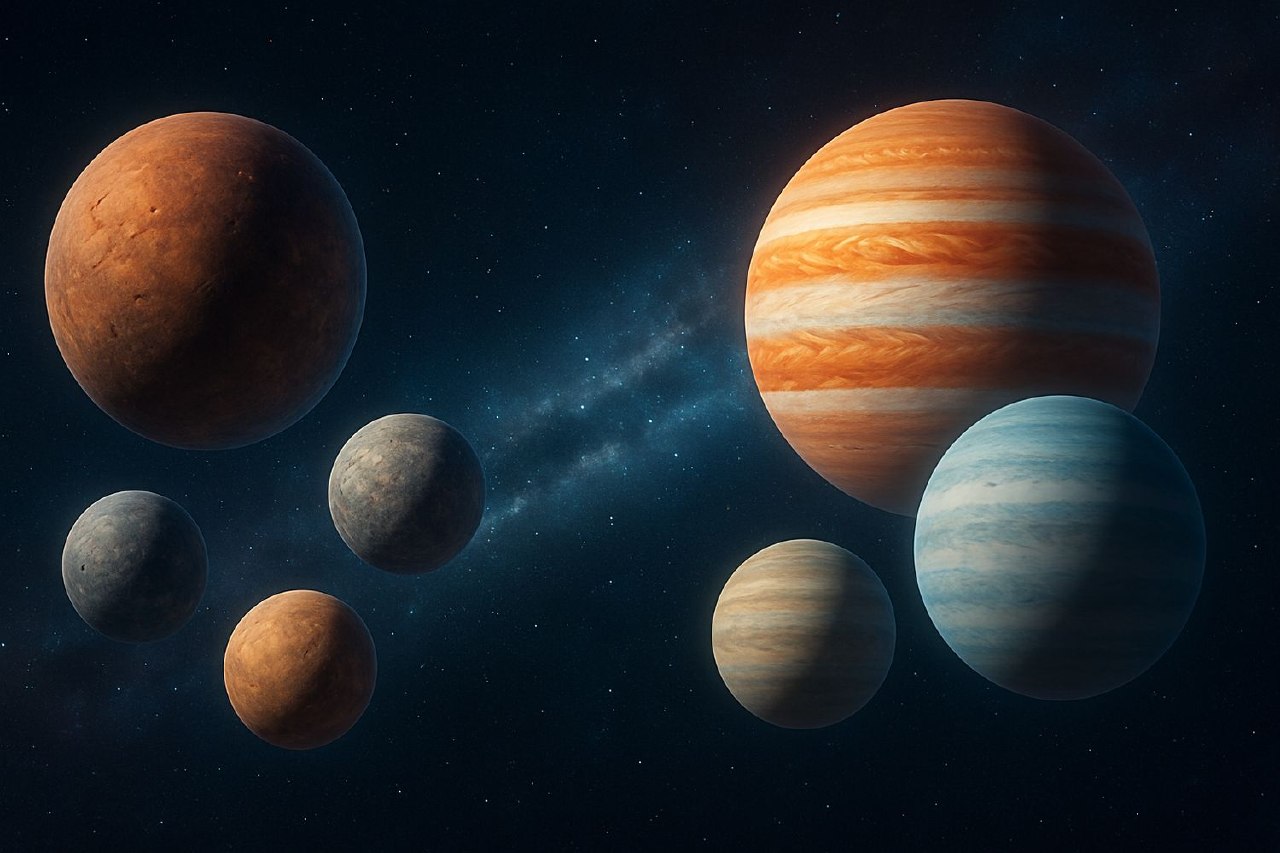
Astronomers have revealed that planetary systems within the Milky Way can be divided into two main ‘families,’ distinguished by the characteristics of their host stars. This discovery offers crucial insights into how planets form and evolve, potentially guiding the search for worlds that could harbor life.
Two ‘Genetic Lines’ of Planetary Systems
A team of researchers, led by the Italian National Institute for Astrophysics (INAF), analyzed data from 300 of the most well-studied multi-planetary systems in our galaxy. They found a ‘genetic link’ between planets and their stars, which dictates not only the initial configuration of a system but also its subsequent evolutionary path.
The first ‘family’ comprises wide, massive systems whose total mass is 2 to 10 times that of our own Solar System. Planets within these systems orbit stars that are more massive than our Sun and have a lower concentration of heavy elements, which astronomers refer to as ‘metals.’
The second ‘family’ consists of more compact and less massive systems. Planets in these systems often exhibit comparable masses and sizes, forming a configuration likened to ‘peas in a pod.’ They orbit stars similar to or smaller than our Sun, with orbits situated significantly closer to their star than Mercury is to ours.
Divergent Evolutionary Paths
One of the key ‘genes’ that helped differentiate these families is the deviation of planetary orbits from a single plane. This suggests a tumultuous gravitational history, marked by collisions and planetary ejections. Such events were found to be more prevalent in the first ‘family’ of systems, while being considerably rarer in the second.
Researchers attribute these differences to the properties of the parent star. Variations in stellar characteristics influence planetary formation and determine whether a system will remain stable or undergo phases of instability and collisions. This understanding will be invaluable in identifying which exoplanetary systems hold higher potential for the development of life in the future.
The identified discrepancies between these systems are not merely artifacts of current observational limitations but reflect fundamental structural differences. Simulations indicate that massive systems are likely born unstable due to an excess of material, leading to the formation of overly large planets and destabilizing the entire system.
Source: space.com