Meta has rolled out a significant system update for its Quest 3 virtual reality headset, boosting the maximum refresh rate to an impressive 240Hz (at a reduced resolution) or 207Hz (native resolution) with the Horizon OS 2.7 update. This move potentially unlocks a smoother, more responsive VR experience for compatible applications.
Unlocking Hidden Potential
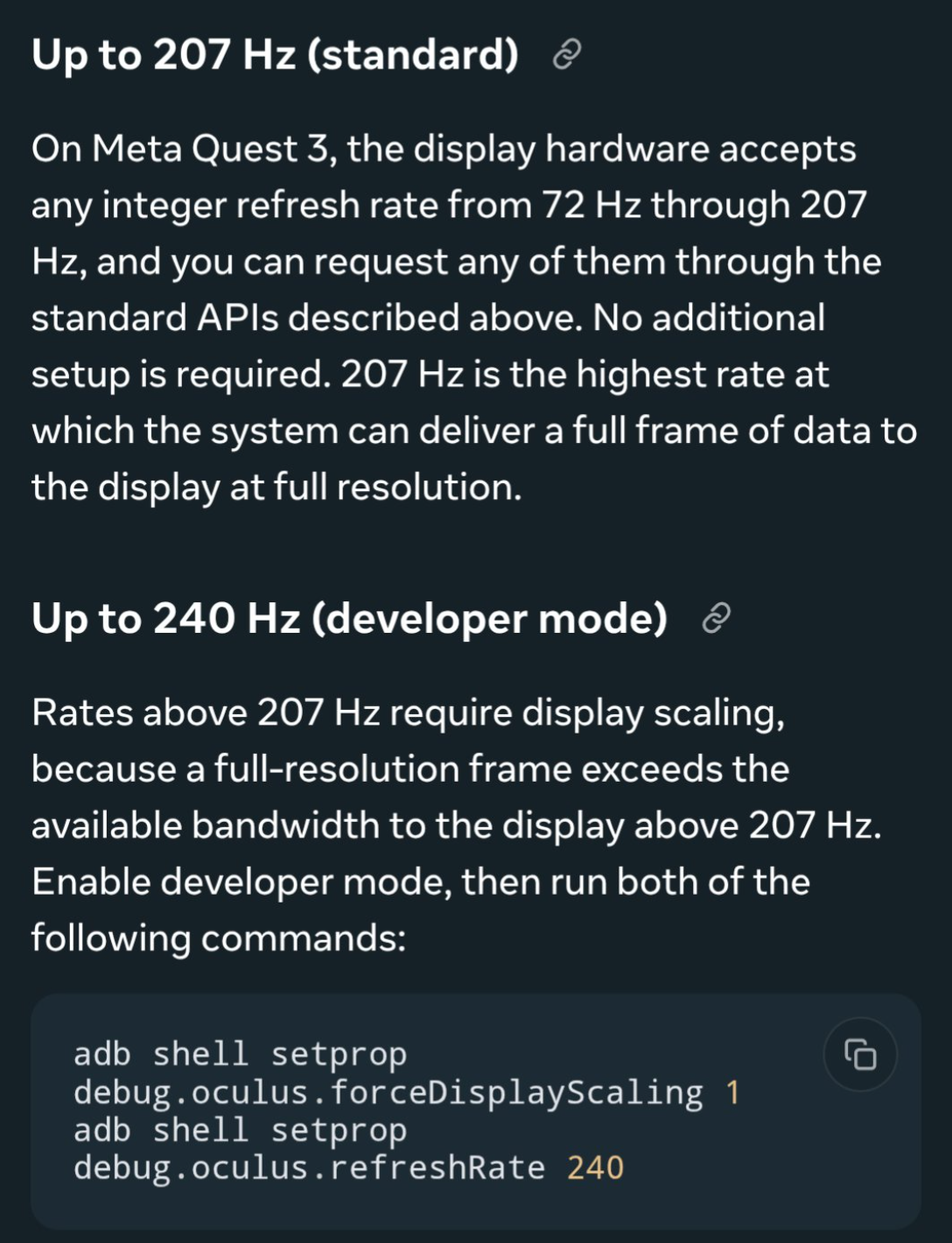
The update specifically targets the Quest 3, while its predecessor, the Quest 3S, remains capped at a 120Hz refresh rate. To take advantage of the new 240Hz capability, developers will need to enable developer mode and activate display scaling. This feature works by lowering the resolution of the image sent to the display panel before upscaling it to restore the original dimensions.
While a 240Hz refresh rate sounds exciting, it’s important to note that existing games and applications won’t automatically benefit. Most native Quest titles were not optimized for such high frame rates, meaning content that can truly leverage this performance boost may be scarce initially. However, some developers are already exploring higher refresh rates. For instance, the Virtual Desktop streaming application has added support for 144 FPS (144Hz).
Developer Godin pointed out that the Quest 3’s hardware video decoder struggles with frame rates exceeding 144 FPS, leading to the current 144Hz limit in their application.
This update suggests that the Quest 3’s hardware might have always possessed more power than was previously accessible through the system software. It’s not uncommon for manufacturers to unlock hidden capabilities later in a product’s lifecycle, a strategy that can enhance appeal and help clear existing inventory.
Strategic Move Amidst Competition
The timing of this update is particularly interesting, especially with Valve reportedly preparing to launch its own VR hardware, the Steam Frame. Meta and Valve appear to be entering a new phase of competition in the VR hardware market.
Until now, Meta has primarily focused on building its native Quest content ecosystem, where most games struggle to fully utilize the existing 120Hz refresh rate. Therefore, a further increase in refresh rate might have seemed less critical for native experiences.
However, with the Steam Frame on the horizon, the landscape could change. Meta has a clear incentive to showcase the Quest 3’s untapped potential. If the Steam Frame is indeed priced at over $1,000, the Quest 3’s high refresh rate capability, topping out at 240Hz, could become a significant selling point for comparative marketing efforts.
By enabling consumers to directly compare the two products, Meta can potentially bolster the Quest 3’s market competitiveness. This strategic refresh rate increase positions the Quest 3 as a more compelling option, especially as it faces new competition in the rapidly evolving VR space.