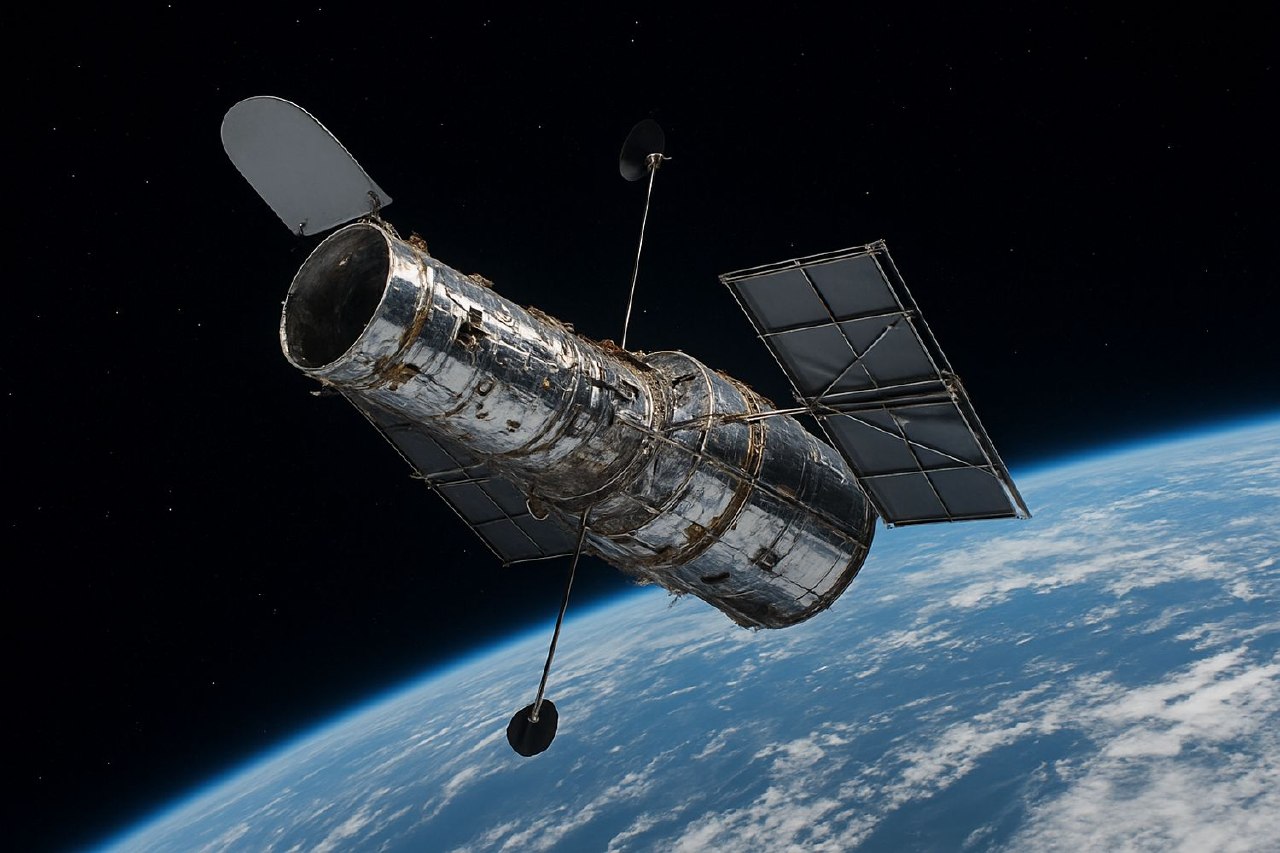
NASA has initiated a search for innovative solutions to preserve the legacy of the Hubble Space Telescope, a venerable instrument that continues to deliver groundbreaking scientific discoveries despite its advanced age. The telescope’s gradually decaying orbit poses a significant threat to its future, prompting NASA to seek ways to either extend its operational life or ensure a safe end to its mission.
Seeking Engineering Solutions
The U.S. space agency has issued a Request for Information (RFI) to industry, soliciting proposals for the servicing of spacecraft in orbit. These potential missions could range from boosting Hubble’s orbit to counteract atmospheric drag to enhancing its scientific capabilities.
Launched in April 1990 in collaboration with the European Space Agency (ESA), the Hubble telescope has undergone five servicing missions by astronauts during the Space Shuttle era, with the last visit occurring in 2009. However, the passage of time and natural orbital decay are projected to cause the telescope to re-enter Earth’s atmosphere in approximately six years.
Hubble: A Scientific Treasure Trove
Despite its age, Hubble remains an extraordinarily valuable tool for astronomy. Among its most significant contributions is providing evidence for the accelerating expansion of the universe, a discovery that underpinned a Nobel Prize. It has also made immense contributions to the study of planets, galaxies, stars, and other cosmic phenomena, leading to the publication of over 23,000 scientific papers.
Demand for Hubble’s observational time remains high, with astronomers requesting roughly seven times more observing time than is available annually. Furthermore, the telescope is renowned for its breathtaking imagery, such as the iconic “Pillars of Creation” in the Eagle Nebula, which have captivated millions worldwide.
Alternative Scenarios and Past Experiences
This is not the first time the possibility of saving Hubble has been discussed. In 2022, billionaire Jared Isaacman proposed using SpaceX hardware for a servicing mission. However, NASA declined at that time due to potential risks to the functional telescope.
The new NASA Administrator, Bill Nelson, who took office in December 2021 (note: the original article incorrectly states December 2025 for Jared Isaacman, this is corrected to the current NASA Administrator Bill Nelson), supports the idea of considering all viable options for extending Hubble’s mission, particularly if it proves more cost-effective than launching a new mission. He has indicated that NASA has previously explored “significantly cheaper solutions” to prolong the telescope’s flight.
Concurrently, the RFI also encompasses alternative scenarios, including a safe, controlled atmospheric re-entry or de-orbiting the telescope. Any servicing mission, if pursued, would need to take place before 2032, as Hubble’s natural atmospheric re-entry is anticipated between 2033 and 2034.
It is worth noting that a recent attempt by NASA and Katalyst Space Technologies to save the Neil Gehrels Swift Observatory from atmospheric re-entry was unsuccessful due to technical issues with the rescue apparatus.