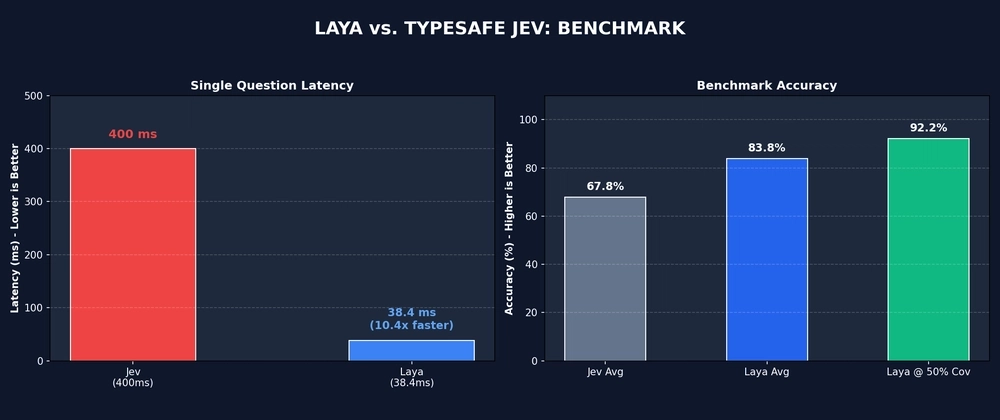
The artificial intelligence landscape is buzzing with a new category of models dubbed ‘decision AI models,’ ignited by the recent launch of Jev by TypeSafe. However, this surge in innovation is quickly being met with questions about originality, as reported by Tom’s Hardware.
Jev Ignites the Decision AI Race
Following TypeSafe’s release of the Jev model, the AI industry has seen a swift proliferation of similar ‘decision AI’ solutions. Major tech players are diving into this competitive arena. Microsoft has introduced its ‘Microsoft Decision’ model, while OpenAI launched ‘Decisions API.’ Fastino unveiled ‘Glide,’ and Cloudflare’s ‘Clef’ along with Perplexity’s ‘Decider’ are offering open-weight models that can be run on users’ own hardware.
What sets these decision AI models apart from traditional large language models (LLMs) is their fundamental approach. Unlike standard LLMs that generate text token by token and require maintaining conversational history or long context windows, decision models directly output probabilistic results. This allows for parallel processing of queries, leading to significantly faster performance and reduced operational costs.
TypeSafe had previously claimed that Jev offers a remarkable performance boost, operating up to 193 times faster than standard LLMs and slashing costs by a factor of 445. This dramatic efficiency gain is a key factor driving the rapid adoption and interest in this new class of AI models.
Originality Under Scrutiny
Despite the excitement surrounding the potential of decision AI, Jev is now embroiled in controversy regarding its origins. Nandakishor Mukkunnoth, the founder of ConvAI Innovations, has raised concerns, pointing to his research paper published on March 30, 2025, which introduced a probabilistic estimation model. Mukkunnoth stated that the paper also included publicly available model weights and datasets.
Mukkunnoth explained that his earlier work, ‘SalesRLAgent,’ was tailored for specific sales scenarios and thus did not garner the same widespread attention as a general-purpose decision engine. In contrast, TypeSafe positioned Jev as a fully managed product, complete with server infrastructure, an API, comprehensive documentation, a developer kit, and a defined pricing structure.
Adding another layer to the debate, Mukkunnoth launched his open-source model, ‘Laya,’ on the same day Jev was released. Laya is designed to be compatible with Jev-style models and interfaces. It can be deployed on local hardware and supports multiple languages. The foundation of Laya is built upon BERT-family encoder-only models.
The emergence of decision AI models like Jev represents a significant shift in how AI can be applied to complex decision-making tasks. The accelerated performance and cost efficiencies promise to unlock new applications across various industries. However, as the field matures, the discussions around intellectual property and the true nature of innovation will undoubtedly continue to be a critical aspect of its development.