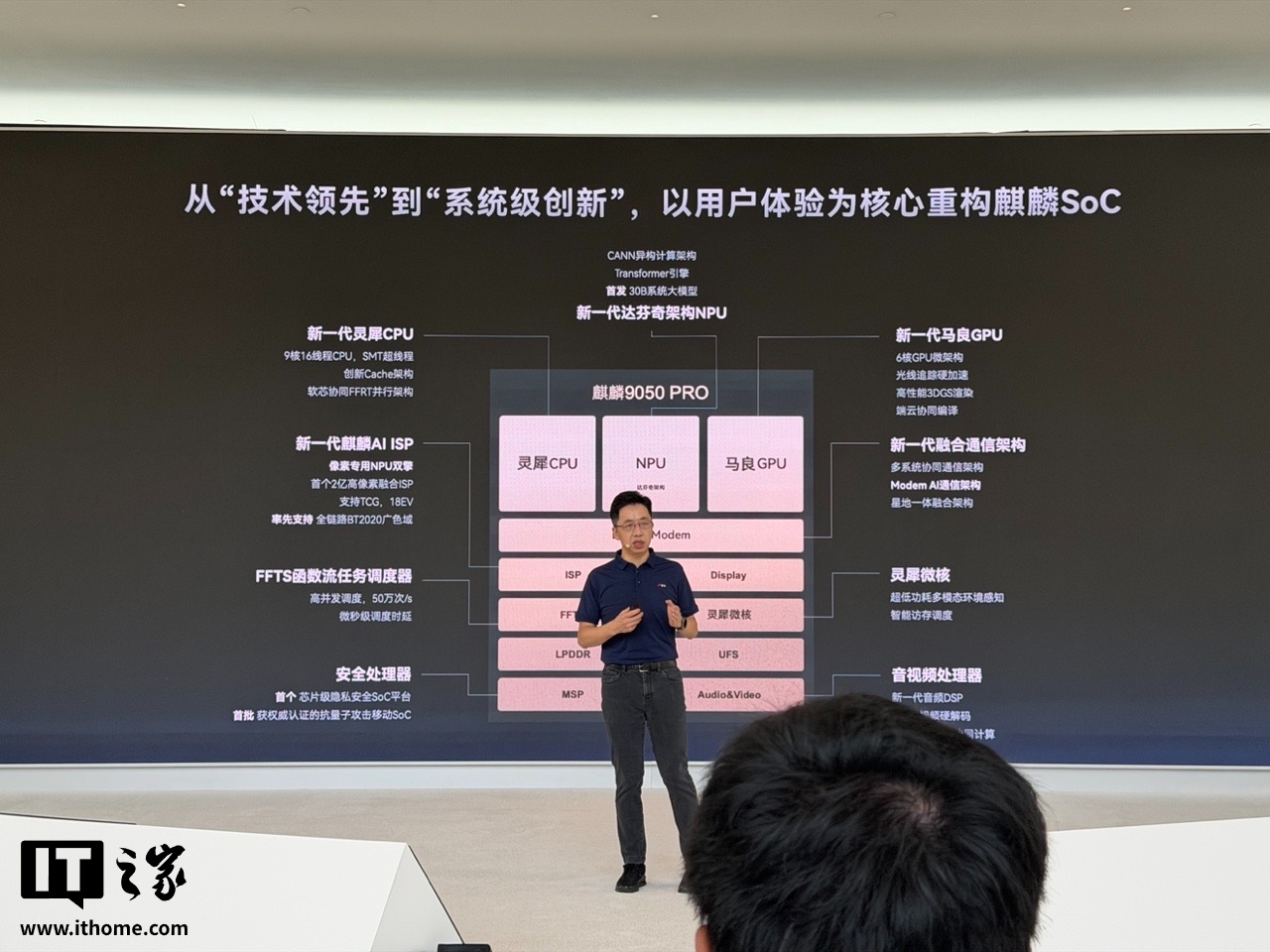
Huawei recently hosted the 2026 Kirin Media Communication Conference in Shanghai, where Xu Songyu, Minister of Huawei’s Semiconductor Business Wireless Terminal Chip Product Management Department, unveiled key details about the Kirin 9050 series. Notably, Huawei shared the first detailed architectural diagram of the Kirin 9050 Pro chip, a significant move supported by the Chinese semiconductor industry, enabling its successful mass production.
Kirin 9050 Pro: A Glimpse Inside
During the conference, Xu Songyu elaborated on the performance specifications of the Kirin 9050 series. The newly released architecture diagram for the Kirin 9050 Pro highlights several advanced components:
- New generation Lingxi CPU
- New generation Maliang GPU
- New generation DaVinci architecture NPU
- New generation Kirin AI ISP
- Lingxi Microcore
- FFTS Function Task Scheduling
- Security Processor
These components suggest a significant leap in processing power, graphics capabilities, AI performance, and image processing for Huawei’s future devices.
Mass Production and Future Challenges
Xu Songyu emphasized that the Kirin 9050 series, described as the first logic folding chip, has achieved mass production thanks to the robust support from the Chinese semiconductor industry. However, he also candidly addressed the numerous challenges that lie ahead for this technology path.
The future belongs to open cooperation. No single company can answer all the questions alone.
These challenges include developing the necessary toolchains and methodologies, compensating for process variations, optimizing inter-layer interconnection overhead, managing power consumption effectively, and establishing standardized benchmark testing methods.
A Call for Collaboration
Huawei’s proactive approach in sharing the Kirin 9050 Pro architecture and discussing future hurdles underscores its commitment to innovation. Xu Songyu extended an open invitation to the semiconductor industry and academia, calling for enhanced cooperation and support.
The company believes that the path forward requires a collective effort. By fostering an environment of open collaboration, Huawei aims to accelerate technological advancements and overcome the complex issues associated with cutting-edge chip development. This collaborative spirit is seen as crucial for navigating the evolving landscape of semiconductor technology and ensuring continued progress.