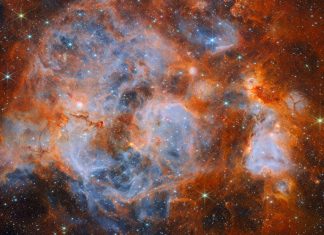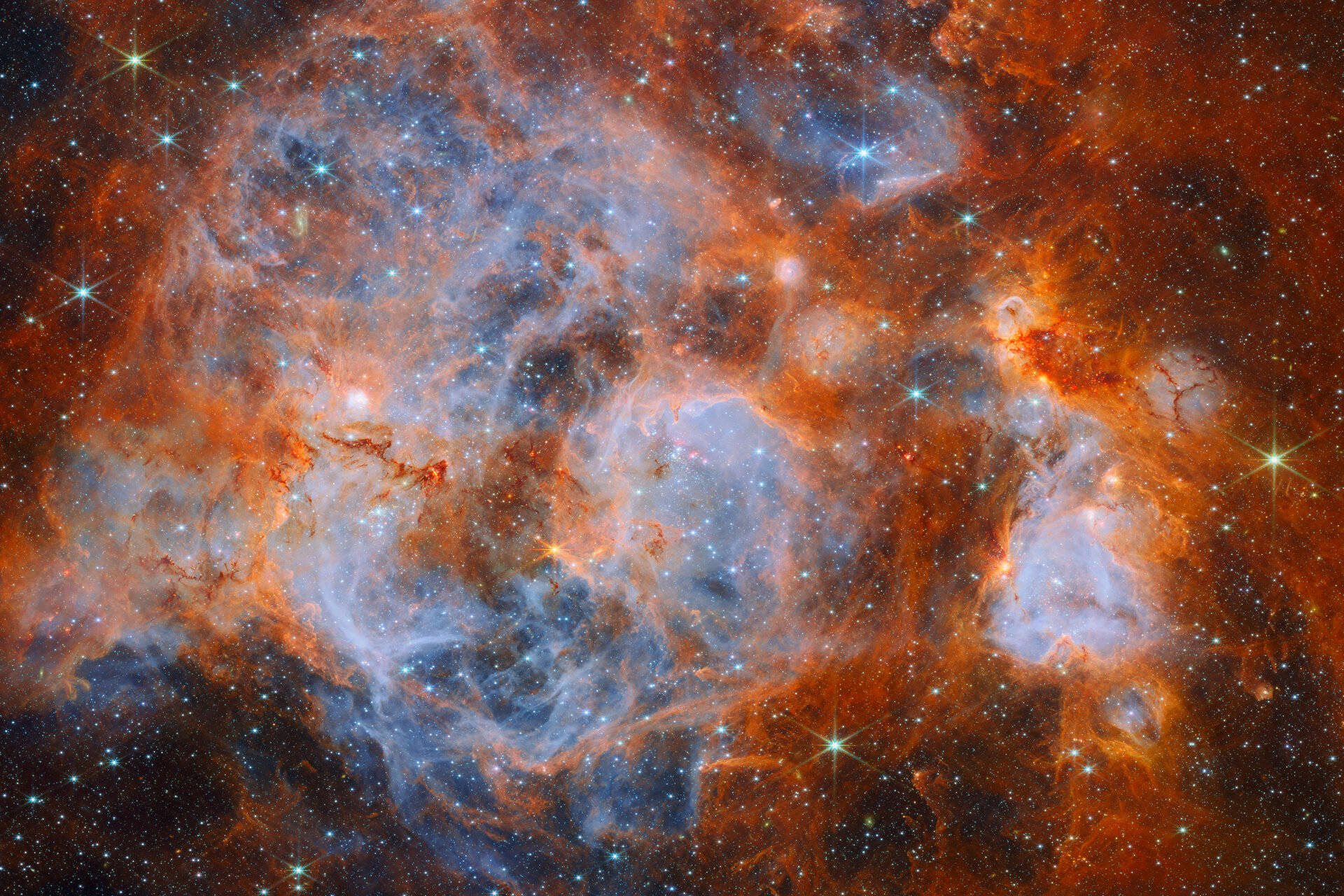
The NASA/ESA James Webb Space Telescope has peered into a vibrant stellar nursery, revealing the dynamic and turbulent process of star formation in unprecedented detail. The image showcases the LHA 120-N 159 region, also known as N159, a stellar forge located 161,000 light-years away in the Large Magellanic Cloud. This vast celestial cloud, spanning approximately 230 light-years, is a prime example of an H II region, an area where massive stars are actively being born and profoundly shaping their surroundings.
A Turbulent Blend of Gas and Dust
N159 is a swirling cosmic cauldron where gravity pulls together cold hydrogen gas, initiating the birth of new stars. Many of these newly formed stars are colossal, intensely hot, and bathe their environment in powerful ultraviolet radiation. This radiation ionizes the surrounding hydrogen gas, causing it to glow brightly and revealing N159 as a spectacular emission nebula. The raw power of these young stars is evident as their stellar winds sculpt dense ridges and carve out vast cavities within the gas, all captured with exquisite clarity by Webb’s Near-Infrared Camera (NIRCam).
The nebula itself is a stunning display of cosmic elements. Thick, smoky orange clouds, a signature of polycyclic aromatic hydrocarbons—essential carbon-based molecules—billow across the image. Interspersed are pools of pale blue gas, marking areas of ionized hydrogen illuminated by the intense stellar radiation. Crossing the center, particularly above the blue regions, are dark red filaments. These are the densest areas, composed of cool molecular hydrogen, acting as cosmic cocoons that shield nascent stars from the harsh radiation and stellar winds. Zooming in reveals tiny points of light—newly born stars—nestled within these filaments and small, pillar-like structures of orange gas that reach into the glowing blue bubbles, a testament to the ongoing, energetic process of creation.
A Window into Early Universe Conditions
The Large Magellanic Cloud (LMC) is an ideal location for studying star formation, boasting numerous H II regions like N159, including other famous sites like the Tarantula Nebula. Crucially, the LMC has a significantly lower proportion of elements heavier than hydrogen and helium (what astronomers call ‘metals’) compared to our own Milky Way. This lower metallicity offers researchers a unique opportunity to observe star formation under conditions that closely resemble those present in the early Universe, providing invaluable insights into how stars formed billions of years ago.
N159, at less than three million years old, is a remarkably young star-forming region, teeming with thousands of stars in their earliest developmental stages. Astronomers have long studied its stellar populations, with the Papillon Nebula—a bright knot of ionized hydrogen believed to be linked to massive star formation—first resolved by the Hubble Space Telescope in 1999. Webb’s latest observations, from a program designed to compare stars across different evolutionary stages, have allowed astronomers to detect incredibly dim stars and differentiate between young stellar objects still enshrouded in gas and more evolved, hotter stars. The data reveal that the western part of N159 is a more concentrated area of young stellar objects, indicating it’s in a more nascent stage of star formation. N159’s dynamic display of star formation makes it an extraordinary natural laboratory for understanding the evolution of collapsing molecular clouds.