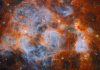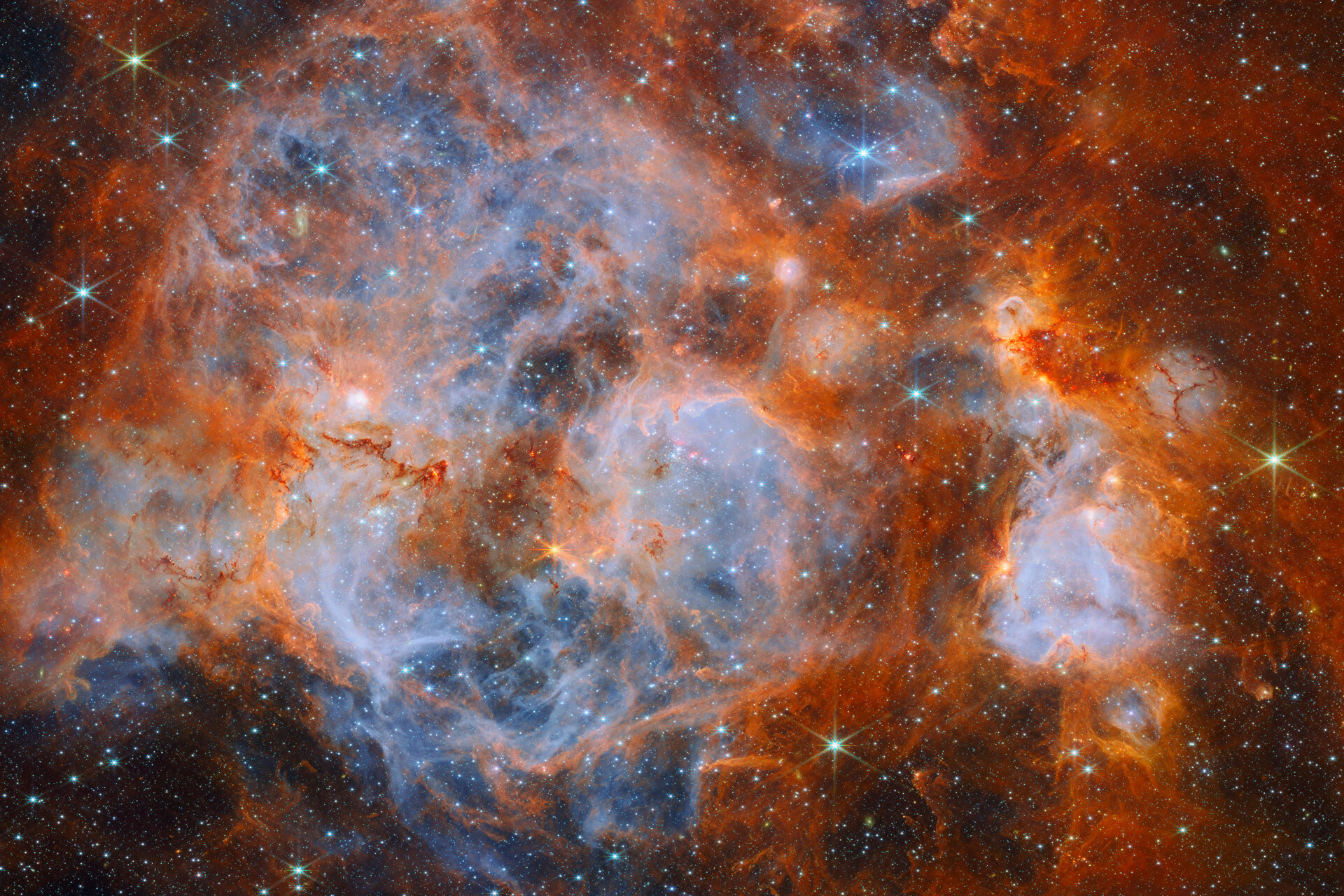
The James Webb Space Telescope (JWST) has peered into the turbulent cosmic cauldron of gas and dust where new stars are born, unveiling an awe-inspiring image of the star-forming region LHA 120-N 159, known as N159. Located 161,000 light-years away in the Large Magellanic Cloud, this detailed view illuminates the intricate processes of star formation on an unimaginable scale.
A Stellar Infancy in a Cosmic Cradle
N159 is an H II region, a vast expanse filled with ionized hydrogen. It is within these immense clouds of cold gas that gravity initiates the birth of new stars, many of which are destined to be exceptionally massive and hot. The intense ultraviolet radiation emitted by these nascent stars ionizes the surrounding gas, transforming these regions into brilliant emission nebulae, much like the one captured in this image. Powerful stellar winds from these young stars sculpt dense ridges and carve out cavities within the gas – details that the James Webb Telescope has recorded with remarkable clarity using its Near-Infrared Camera (NIRCam).
The dynamic mix of star formation in N159 is enveloped by thick, smoky orange clouds that also blanket the center of the image. The light orange hue signifies the emission of polycyclic aromatic hydrocarbons, crucial carbon-based molecules. Patches of pale blue gas represent clouds of ionized hydrogen (H II) glowing under the influence of intense ultraviolet radiation from massive stars. Dark red filaments, particularly noticeable above the blue region on the right, traverse the center of the image and are composed of cold molecular hydrogen. These are the densest parts of the nebula, currently shielding new stars from harsh radiation and stellar winds. Magnified views reveal stars as pinpricks of light embedded within these filaments and small pillars of orange gas protruding into the blue bubbles. Eventually, these structures will dissipate, leaving behind fully formed stars.
A Unique Laboratory for Studying the Early Universe
The Large Magellanic Cloud, home to N159, is often referred to as a “laboratory” for studying star formation. The abundance of H II regions like N159 (alongside larger ones like N79 and the famed Tarantula Nebula) makes it an ideal location for research. These regions differ from those found in our own Milky Way, notably due to their lower proportion of elements heavier than hydrogen and helium, known as “metals.” This composition allows scientists to study H II regions under conditions more closely resembling those of the early universe, providing valuable insights into star formation processes from that era.
N159, estimated to be less than three million years old, is one of the youngest star-forming regions in the Large Magellanic Cloud, housing thousands of stars in their early stages of development. The Hubble Space Telescope first provided detailed observations of the bright light in the left portion of the image in 1999 – the Papillon Nebula, an exceptionally compact cloud of ionized hydrogen likely associated with the formation of massive stars. The James Webb Telescope has now taken up the mantle, studying N159 as part of a program aimed at examining and comparing stars at various evolutionary stages. These new data have enabled the detection of extremely faint stars, with masses less than one-tenth that of our Sun, and have differentiated between large, hot, fully formed stars and young stellar objects still enshrouded in the clouds of their birth. The results indicate that the western part of N159 contains a higher concentration of young stellar objects within a smaller area, suggesting a more advanced stage of collapse.