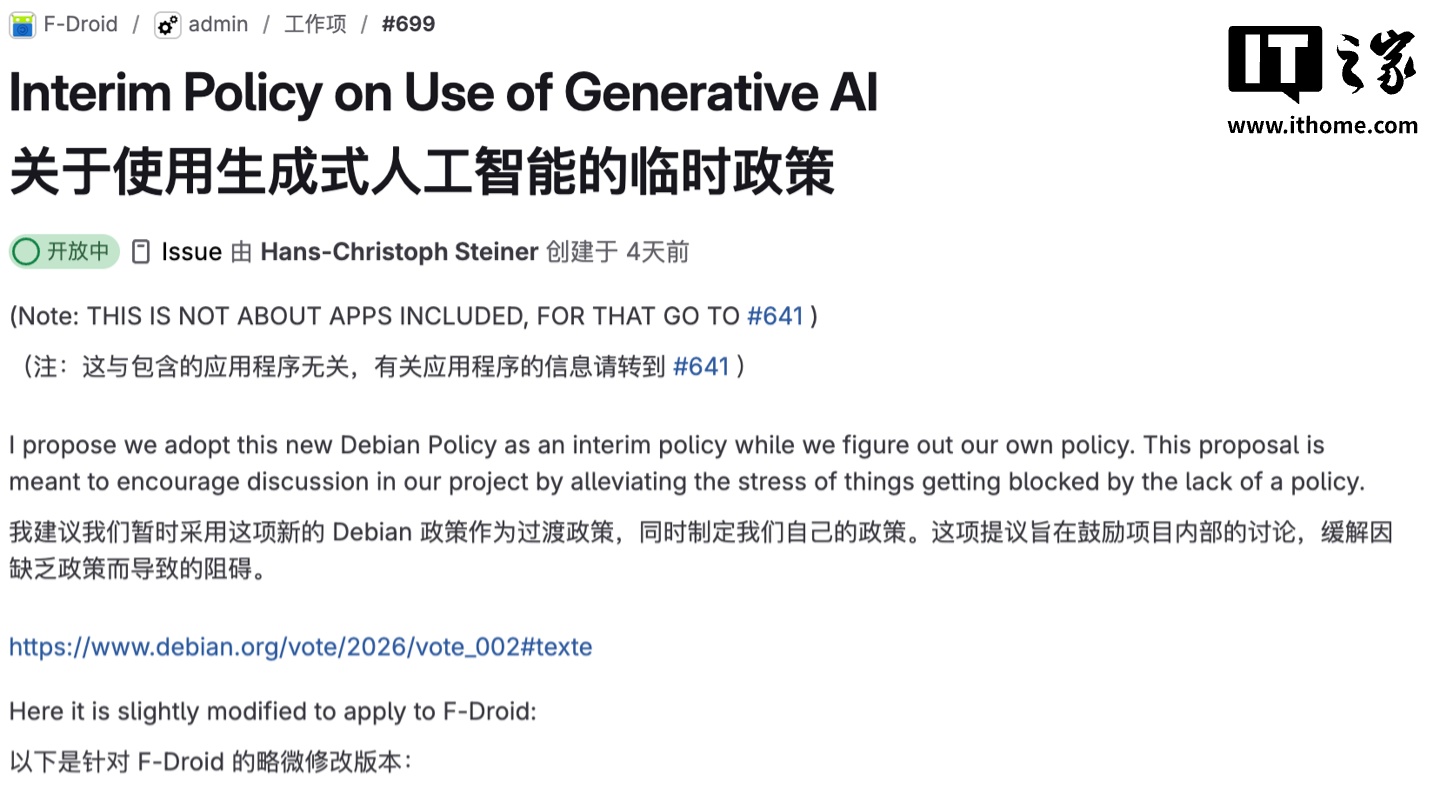
The open-source Android app store F-Droid is considering adopting an AI policy similar to the one recently approved by the Debian community. This move reflects a growing trend among open-source projects to define guidelines for the responsible use of generative AI in development.
Debian Paves the Way with AI Policy
Last week, the Debian community concluded a vote on a proposal regarding the use of large language models (LLMs) in their development processes. The outcome favored a nuanced approach, with the option “Responsible use of generative AI” securing the majority of votes. This decision will shape how Debian developers integrate AI tools into their workflows and address the evolving landscape of AI in software creation.
The new Debian policy does not outright ban the use of generative AI in software development, documentation writing, or other tasks. Instead, it emphasizes that all AI-generated code and documentation must meet stringent quality and legal compliance standards. Crucially, the ultimate responsibility for the work lies with the human developer. While Debian encourages contributors to disclose their use of AI, it is not a mandatory requirement.
F-Droid Explores Similar AI Guidelines
Following Debian’s lead, the F-Droid community is now evaluating a similar AI policy. The current proposal within F-Droid closely mirrors Debian’s framework, with the core text adapted by simply replacing references to Debian with F-Droid. The proposed policy outlines that AI can be utilized across various aspects of software development, including development, maintenance, packaging, and documentation.
However, the overarching principle remains the same: AI must be employed responsibly. As with Debian’s policy, the ultimate accountability for any AI-assisted work will rest with the human contributors. This approach aims to harness the potential benefits of AI while ensuring that the integrity, quality, and legal compliance of open-source projects are maintained.
The debate around AI in open-source development is multifaceted. While AI tools offer significant potential to accelerate development cycles, improve code quality, and assist with complex tasks, concerns about code licensing, potential biases, and the dilution of human oversight persist. Projects like Debian and F-Droid are navigating these challenges by establishing clear, albeit flexible, guidelines that prioritize developer responsibility and adherence to existing project standards.
The adoption of such policies by prominent open-source initiatives signals a pragmatic approach to integrating cutting-edge technology. By allowing AI while maintaining human accountability, F-Droid and Debian are attempting to strike a balance that could serve as a model for other open-source communities grappling with the implications of artificial intelligence.