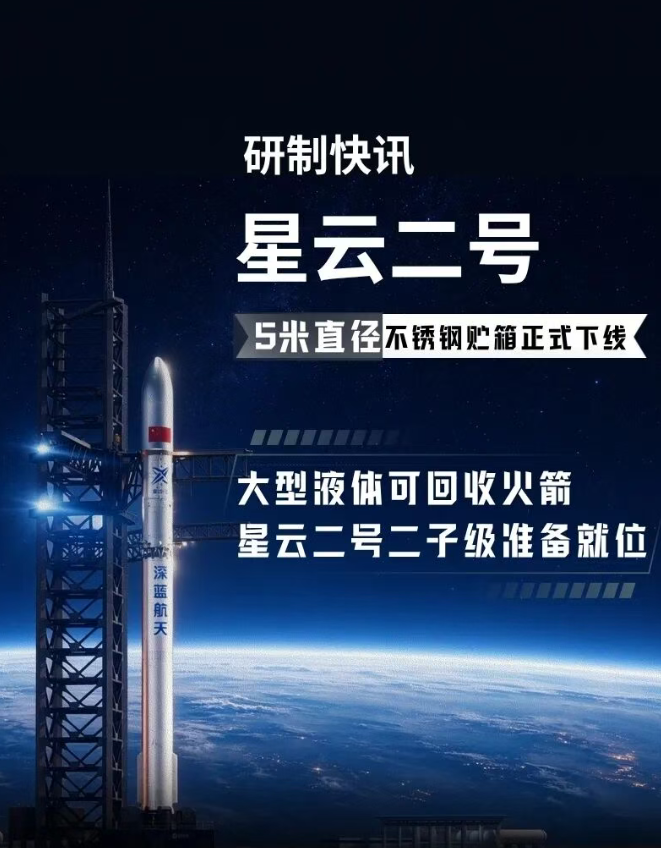
Deep Blue Aerospace has announced a significant milestone in China’s commercial space sector with the recent completion of its 5-meter diameter stainless steel integrated fuel tank. This critical component is set to be the heart of the Nebula-2 (Xingyun-2), a large liquid-recoverable rocket. The successful delivery of this tank propels the Nebula-2, which boasts the highest payload capacity among privately developed liquid-recoverable rockets in China, into an intensive engineering development phase.
A Pillar of Rocketry and a Leap in Manufacturing
Rocket fuel tanks are often described as the ‘backbone’ of a launch vehicle and represent a bottleneck in the mass production of rockets. In response to the burgeoning demand for high-density satellite internet launches, Deep Blue Aerospace adopted a rapid iterative development model. By synchronizing design, process, and production efforts closely, the company successfully navigated the entire process from design to manufacturing for the 5-meter diameter stainless steel integrated fuel tank. This achievement sets a new record for the development and production of large-diameter stainless steel rocket fuel tanks within China’s commercial space industry.
The successful development of this tank not only enhances Deep Blue Aerospace’s in-house manufacturing capabilities for core rocket components but also lays a crucial foundation for the planned testing of the second stage’s propulsion system by the end of the year. This endeavor is particularly noteworthy as it signifies a move towards greater self-sufficiency and technological advancement in a field crucial for national space ambitions.
Nebula-2: Pushing Payload Capacity Boundaries
As the liquid-recoverable rocket with the largest payload capacity in China’s commercial space sector, the Nebula-2 is engineered for impressive performance. It offers a payload capacity of 18 tons to a 500 km SSO (Sun-Synchronous Orbit) and 25 tons to LEO (Low Earth Orbit), placing its performance metrics among the top tier of domestic commercial rockets.
Coinciding with the fuel tank’s rollout, the final external design of the Nebula-2 was also revealed. The rocket will feature a striking silver-grey metallic finish, preserving the natural texture of the stainless steel, departing from the traditional white coating. This aesthetic choice is not merely superficial; the use of stainless steel offers a compelling combination of high-temperature and low-temperature resistance, robust strength, and cost-effectiveness. Compared to conventional materials, stainless steel provides enhanced structural stability in extreme temperature fluctuations, significantly simplifying thermal protection designs and considerably shortening material and manufacturing lead times.
Propulsion and Reusability: Powering the Future
The first stage of the Nebula-2 will be powered by 11 ‘Super Thunder’ engines, collectively generating a staggering 12,446 kN of liftoff thrust. The second stage will utilize a single vacuum-optimized ‘Super Thunder’ engine. The ‘Super Thunder’ engine is recognized as the most powerful open-cycle liquid oxygen kerosene engine with a needle-plug nozzle currently developed in China. It has successfully undergone multiple long-duration hot-fire tests under nominal conditions, with test durations covering the entire operational timeline of a typical first-stage flight mission. The engine is already entering mass production and undergoing reliability verification.
Innovative Recovery Technology
In terms of recovery and reusability, the Nebula-2 is designed for exceptional performance, capable of over 20 reuse cycles. A standout feature is its ‘chopsticks’ style in-situ capture recovery technology. This innovative system aims to transition rocket recovery from ‘remote landing’ to ‘in-situ capture,’ a method where the rocket is caught mid-air shortly after stage separation. This approach promises to dramatically enhance launch and recovery efficiency, further reducing the cost and increasing the accessibility of spaceflight.