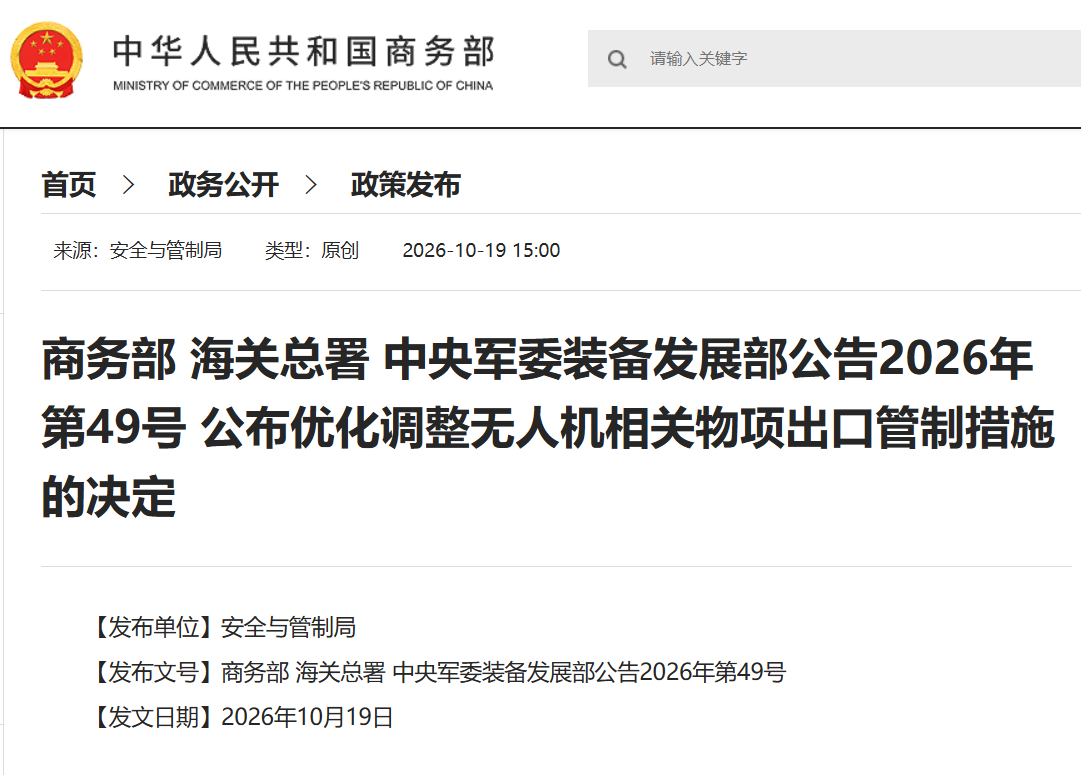
China has announced significant updates to its export control measures concerning specific drone-related items. The Ministry of Commerce, General Administration of Customs, and the Central Military Commission’s Equipment Development Department jointly issued a notice detailing these adjustments, which are set to take effect on November 18.
New Regulations Target Advanced Drone Technologies
The revised regulations, enacted under China’s Export Control Law, aim to bolster national security and international non-proliferation efforts. The Ministry of Commerce stated that these measures are designed to prevent drones from being misused for non-peaceful purposes. While implementing stricter controls, China also reaffirmed its commitment to maintaining the security and stability of global supply chains and will continue to review export license applications, approving those that comply with regulations.
A spokesperson for the Ministry of Commerce emphasized that the dynamic adjustment of export controls is a common international practice. As drone technology rapidly evolves, with previously advanced products becoming widely available, China has been actively listening to industry feedback. This optimization reflects the latest advancements and industry insights, underscoring China’s dual commitment: firmly opposing the malicious use of drones and steadfastly supporting legitimate international trade and cooperation in the civilian drone sector.
Key Items Under Enhanced Control
The updated measures specifically target a range of drone components and technologies. These include:
- Autopilots specifically designed for unmanned aircraft (Customs Code 90142010.10).
- Technologies related to autopilot stabilization and mission payload for drones.
- Unmanned aircraft and airships capable of controlled flight beyond ‘visual line of sight’, with specific endurance and wind resistance capabilities (Customs Codes including 88010090.10, 8806 series). This includes systems with a maximum endurance of 30 minutes to 3 hours or those capable of sustained flight over 3 hours, and those with takeoff and stable flight capabilities in gusty winds up to 46.3 km/h.
- Engines specifically designed for unmanned aircraft, including those for high-altitude flight (above 15,420 meters), engines with a maximum continuous power exceeding 16 kW, and turbojet engines with thrust of 400 N or more (Customs Codes including 84071010.10, 8411 series).
- Radio communication equipment for drones, such as airborne systems with an equivalent isotropic radiated power (EIRP) of 30 dBmW or more, or systems capable of controlling more than 10 aircraft from a single ground station.
- Unmanned aircraft with specific capabilities, including those with a range of 300 km or more, autonomous flight control and navigation, or the capacity to carry or be fitted with aerosol dispersal systems exceeding 80 liters.
- Propulsion and control components for drones, such as brushless motors with specific power and voltage ratings, electronic speed controllers, and carbon fiber propeller blades with specific dimensions and pitch control features.
- Software and technologies specifically designed for the research, development, production, or use of the controlled drone items, including flight control, autonomous navigation, sense-and-avoid technology, and system design.
- Specialized design and manufacturing technologies for polar-lightweight unmanned aircraft capable of operating in harsh maritime or ice conditions, with high wind resistance, low operating temperatures, significant endurance, and payload capacity.
- Human-machine mixed control technology for complex unmanned ground platforms in weak communication environments, focusing on high compression rates, low latency, and reliable task execution.
- Counter-drone technologies related to specific controlled items.
Export Procedures and Compliance
Exporters dealing with these controlled items must apply for licenses from the relevant authorities. They are responsible for accurately declaring the nature of the goods to customs, including specific characteristic indicators. For items that do not precisely match the listed specifications but are similar, or those with non-listed uses but matching specifications, exporters must still declare their characteristics and indicate whether they are subject to export controls.
The announcement also outlines facilitative measures for compliant exporters. These include simplified procedures for certain drone items used in exhibitions (excluding defense and police expos), provided they are returned to their origin. Companies with robust internal compliance systems, a history of compliant exports, and stable customer channels may also benefit from general licenses.
Violations of these regulations, including illegal exports or diversions, will be pursued rigorously, with relevant parties held accountable under the law. The updated export control list for dual-use items will be synchronized with this announcement.
China remains committed to engaging in bilateral dialogues on export control policies and practices, seeking to foster communication and gather feedback to better fulfill its international non-proliferation obligations while promoting compliant trade.