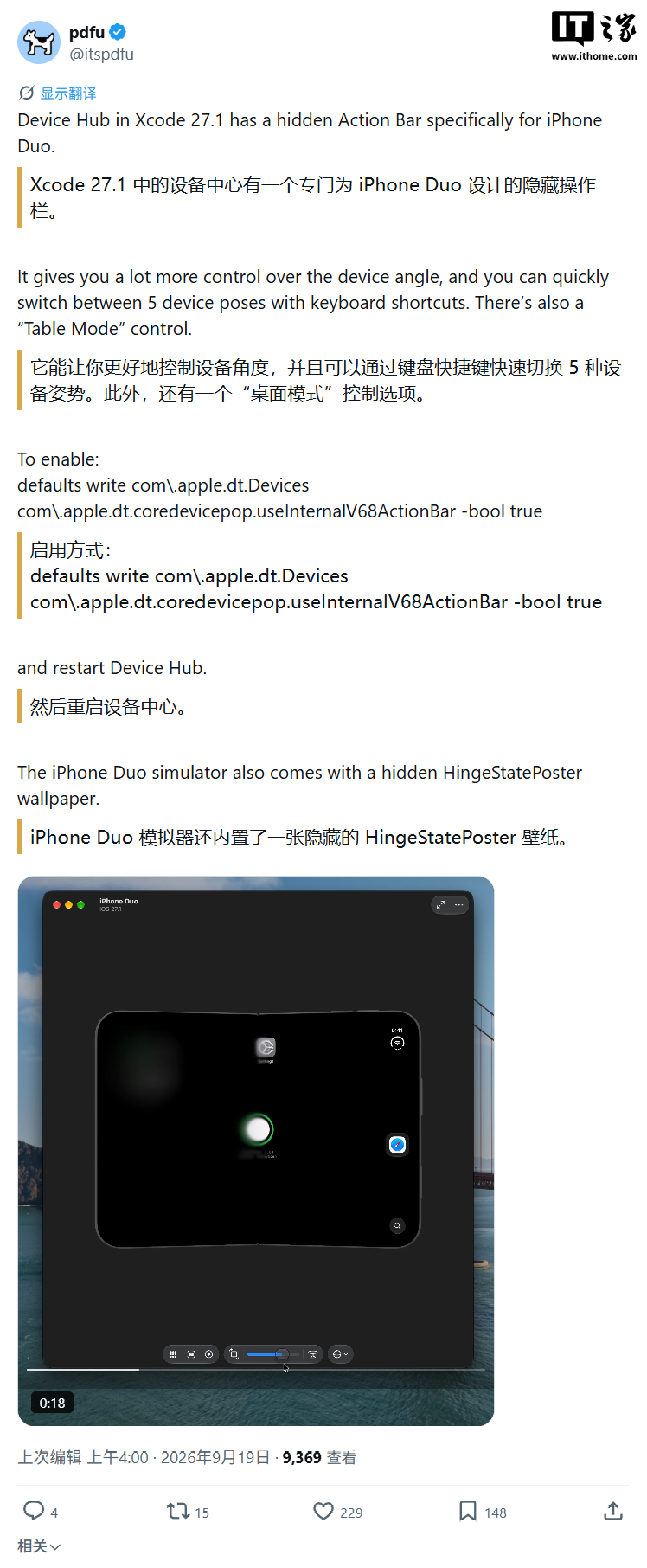
Whispers about Apple’s first foldable iPhone, codenamed ‘Duo’, are getting louder, with new details emerging from Xcode 27.1. Developers are now getting a peek into how the device might manage its form factor and power consumption, thanks to a specialized simulator in Xcode’s Device Hub.
Dynamic Hinge and Screen Management
According to a recent post on X by source @itspdfu, the latest Xcode beta includes a dedicated interface for the iPhone Duo simulator. This feature allows developers to precisely adjust the device’s folding angle, enabling them to test various screen configurations and user interactions. It’s reported that developers can utilize keyboard shortcuts to cycle through five distinct device postures.
This level of control is crucial for simulating real-world usage scenarios. For instance, the ‘Table Mode’ (or ‘桌面模式’ in the source text) allows for a half-folded device to be placed on a surface. In this mode, the upper half of the screen could be used for video calls or media playback, while the lower half displays controls, input fields, or other relevant information. This split-screen functionality is a hallmark of many foldable devices, and Apple appears to be focusing on optimizing this experience.
Power and Thermal Strategy Tied to Hinge Angle
A particularly intriguing detail suggests that the iPhone Duo might employ different power consumption and thermal management strategies based on its open/closed state, potentially using a 30-degree angle as a threshold. The source indicates that if the device is unfolded beyond approximately 30 degrees, a different set of ‘sustainable power’ targets might be activated.
This implies that beyond this critical angle, the iPhone Duo could become more aggressive in limiting high-power tasks. This is likely a proactive measure to prevent overheating, especially when the inner display, dual-screen components, or high brightness levels are in use. Such a strategy would be vital for ensuring the longevity and performance of the device, especially considering the complexities of cooling components within a foldable chassis.
Implications for Developers and Users
The introduction of these detailed simulator features in Xcode points towards Apple’s commitment to refining the foldable user experience. Developers will be able to meticulously test how their applications adapt to different folding angles and postures, ensuring a seamless transition between single-screen and dual-screen modes. This focus on developer tools suggests that Apple is aiming for a polished software experience right from launch.
For users, this nuanced approach to power and thermal management could translate into a more reliable and consistent performance. By dynamically adjusting performance based on the device’s physical state, Apple aims to balance the desire for powerful features with the practical limitations of battery life and heat dissipation in a foldable form factor.
While these are early insights based on simulator capabilities, they offer a compelling glimpse into Apple’s potential strategy for its first foray into the foldable market. The emphasis on fine-grained control over the device’s physical state and its impact on performance suggests a thoughtful approach to a challenging new product category.