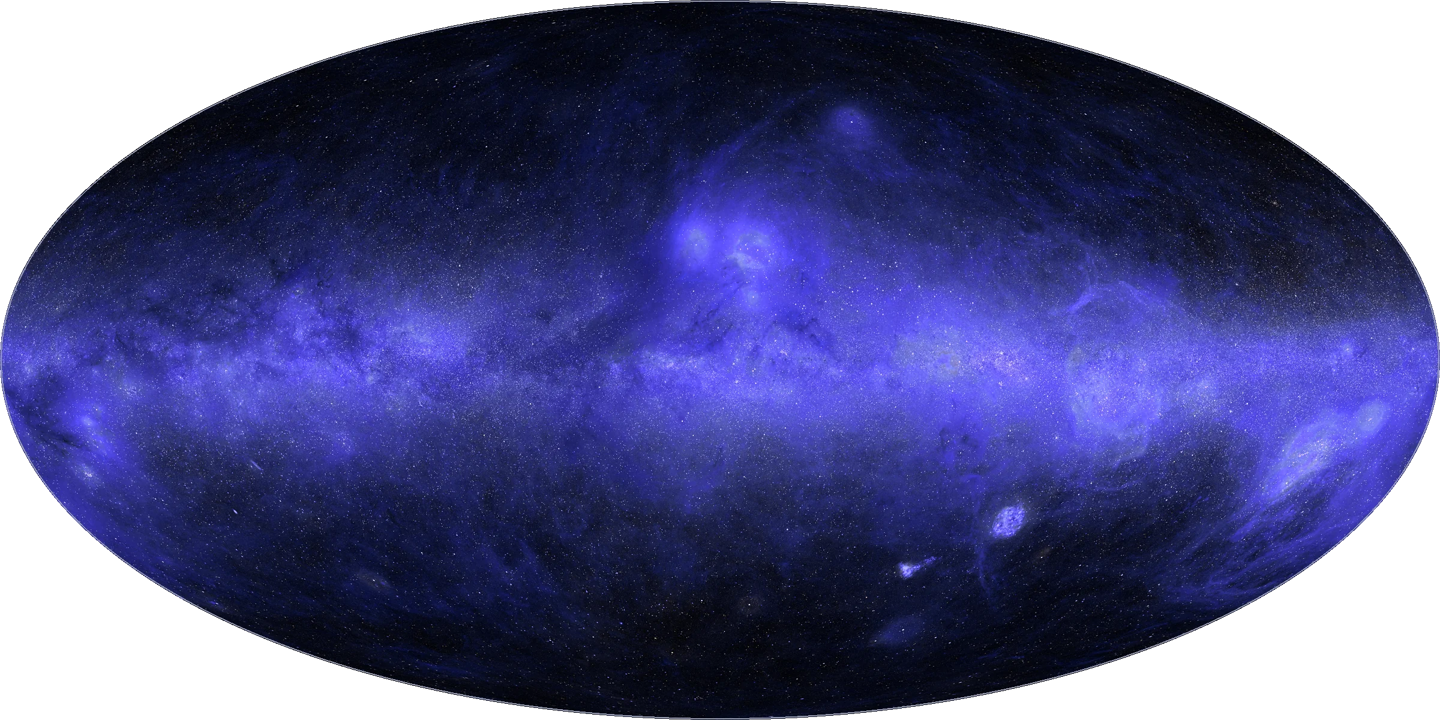
Artificial intelligence is expanding the frontiers of astronomy, with Anthropic’s AI model, Claude Science, playing a pivotal role in creating the first comprehensive map of the entire sky in ultraviolet (UV) radiation. Approximately one-third of this groundbreaking cartographic effort was powered by the AI’s calculations.
The newly compiled UV sky map is a composite image of UV emissions from across the celestial sphere, centered on the galactic core. It incorporates data capturing both far (154 nm) and near (232 nm) ultraviolet wavelengths.
Observational Hurdles
Due to Earth’s ozone layer absorbing UV radiation, astronomers rely on space-based telescopes for these observations. The largest dataset for this map originates from NASA’s GALEX mission, which conducted roughly 38,000 observations between 2003 and 2013, covering approximately two-thirds of the sky. However, due to the need to protect instruments from bright light and avoid regions with high star concentrations, a portion of the sky remained unexplored in the UV spectrum.
A Novel Mapping Methodology
The research team integrated data from multiple missions, including NASA’s GALEX and Swift, as well as Korea’s FIMS/SPEAR. They meticulously calibrated observations from different instruments, unifying their resolution and coordinates.
For areas of the sky lacking direct UV observations, Claude Science leveraged existing data. The AI analyzed the correlations between UV brightness and data from visible, infrared, and radio wavelengths to estimate the missing portions of the map.
The Result: A Combined Map
This new sky map is not solely a product of direct measurements. About a third of it, particularly large areas within the plane of the Milky Way, was generated through Claude Science’s modeling and calculations. Each point on the map is marked to indicate whether it represents a ‘direct measurement’ or a ‘prediction,’ along with an estimate of the uncertainty associated with these calculations.
This project highlights how advanced AI technologies can augment and extend the capabilities of traditional scientific research, enabling us to view the universe in unprecedented detail.