NASA Science’s daily “Astronomy Picture of the Day” (APOD) has highlighted a remarkable celestial object: WD J1330+6435. This white dwarf, through interaction with its accretion disk, has exhibited unexpected colors, notably green. This discovery offers new insights into stellar evolution and the spectral characteristics of stars.
The Mystery of White Dwarf Colors
Distant stars typically appear as bright points of light, with colors ranging from white to red or blue. This color is directly linked to the star’s temperature; hotter stars emit more blue light, while cooler stars radiate in the red spectrum. However, recent research has revealed that some white dwarfs, despite their name, can display hues of yellow, green, blue, pink, or even violet. This phenomenon is attributed to the presence of impurities in their atmospheres, which interact with the star’s radiation, altering its spectrum.
WD J1330+6435: A Glimpse of Stellar Evolution’s Green Phase
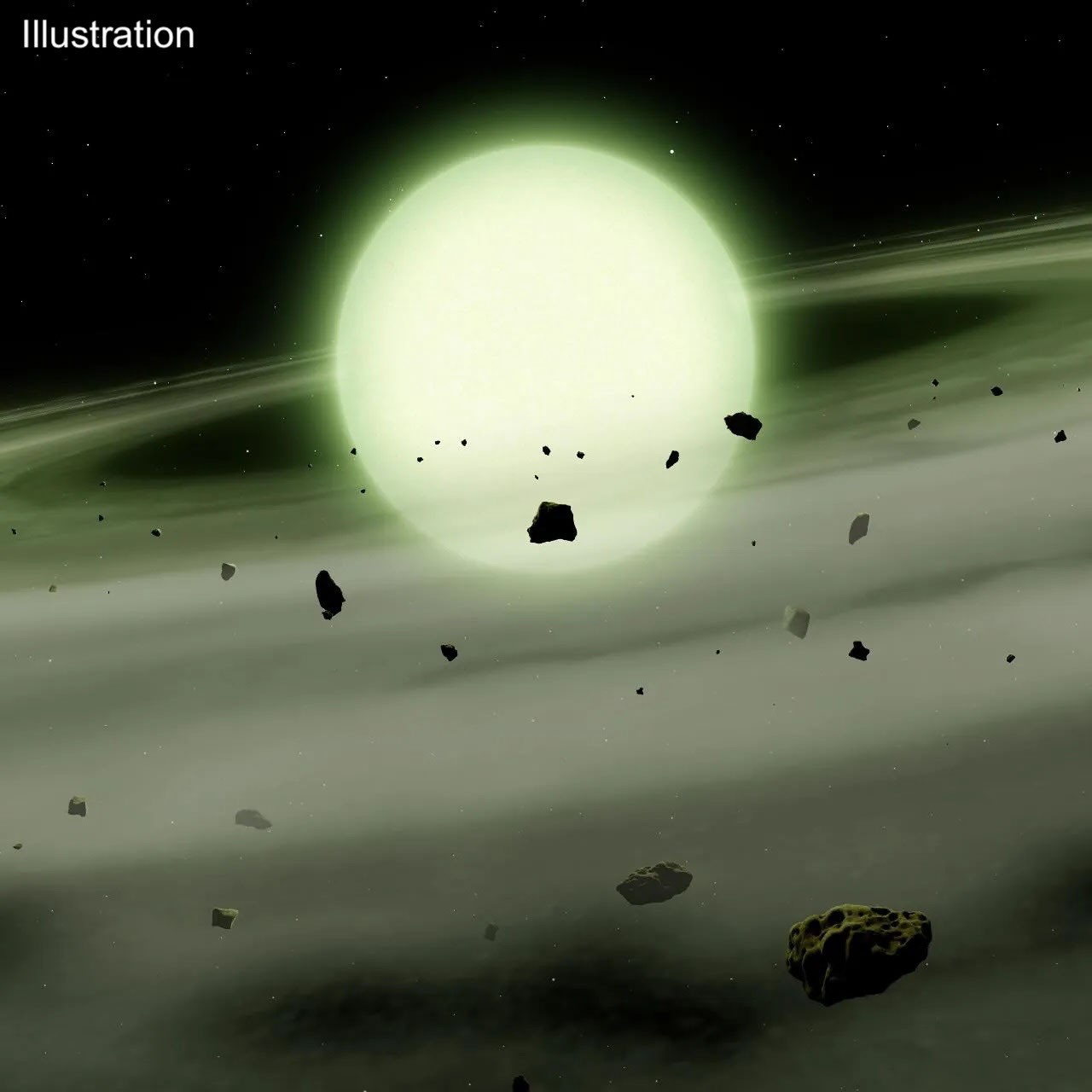
The illustration showcases the white dwarf WD J1330+6435, surrounded by an accretion disk composed of gas and rocky debris. White dwarfs are the remnants of stars similar to our Sun that have exhausted their nuclear fuel. Once massive stars, they are now compact and dim objects. Scientists have recently found that stars like WD J1330+6435 can exhibit unusual colors. Although these green stars are too faint to be seen with the naked eye, they provide valuable data on the processes occurring in the later stages of stellar evolution.
Source: NASA