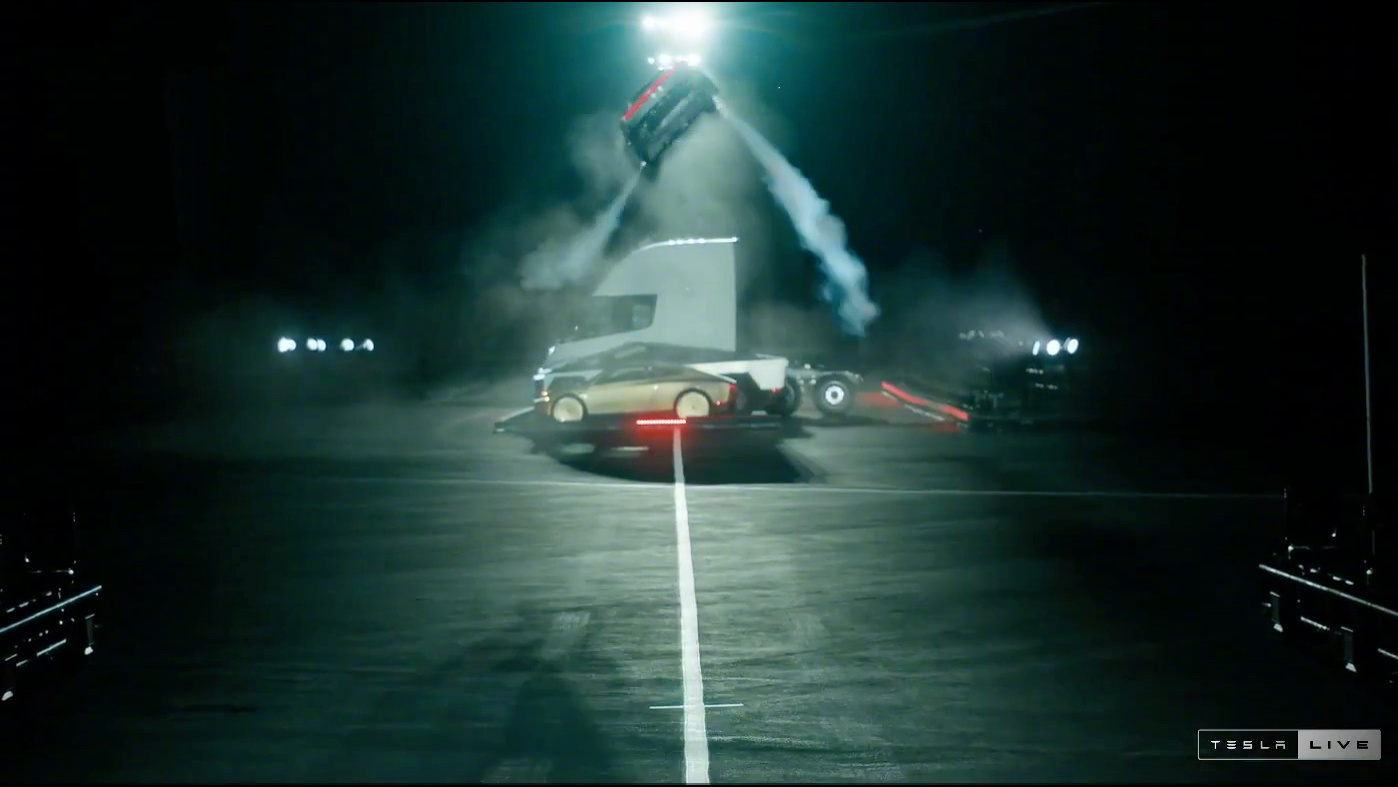
Tesla’s updated Roadster, recently revealed with SpaceX-inspired thruster technology capable of stunts like leaping, has faced skepticism regarding its feasibility. However, a top Tesla executive has directly addressed these doubts, asserting the company’s commitment to showcasing only production-ready innovations.
Addressing the Doubts
Following the unveiling of the redesigned Roadster and its planned 2028 production, some observers on X (formerly Twitter) questioned the car’s ability to perform aerial maneuvers, citing perceived physical impossibilities for a vehicle of its weight to brake and rotate in the air.
Lars Moravy, Tesla’s Vice President of Vehicle Engineering, responded directly to these criticisms in a comment, stating, “We won’t show something that we can’t achieve in production.” He elaborated on the technical aspects, explaining that the cold gas thruster system can generate over 80 kN of thrust. Moravy highlighted that even with a total vehicle weight of 2500 kg, which includes the gas tanks and propulsion system, the thrusters provide more than three times the necessary lift to get the car off the ground. “When your lift is greater than your weight, you can leave the ground, and when that advantage is so large for a period of time, you have the room to flip and maneuver – it’s just simple math,” he explained.
Roadster’s Advanced Propulsion Systems
In a separate interview with Hagerty, Moravy provided further details on the new Roadster’s innovative flight capabilities, outlining three distinct versions: Performance, Thrust, and Rocket.
- Thrust Version: This variant features a 200-liter carbon-fiber-wrapped pressure vessel located behind the driver’s seat. When activated, it releases compressed gas through four rear-facing nozzles, providing approximately 5 seconds of boost. This enables the car to achieve a 0-60 mph acceleration time of under one second.
- Rocket Version: Described as even more extreme, the Rocket version involves removing the front passenger seat to accommodate an additional 400-liter pressure vessel. This brings the total gas capacity to 600 liters and adds six thrusters: two at the front for attitude control and one at each corner of the vehicle.
Refueling Challenges and Solutions
Moravy acknowledged that the current process for fully refilling the 600-liter nitrogen tanks takes between 6 to 7 hours. However, Tesla is actively developing a rapid refueling system aimed at significantly reducing this time to approximately 30 minutes. This addresses a crucial logistical challenge for potential users of the more advanced versions of the Roadster.
The company’s proactive response and detailed explanations aim to reassure the public and automotive enthusiasts about the technological advancements incorporated into the next-generation Tesla Roadster, emphasizing that the showcased capabilities are grounded in achievable engineering principles.