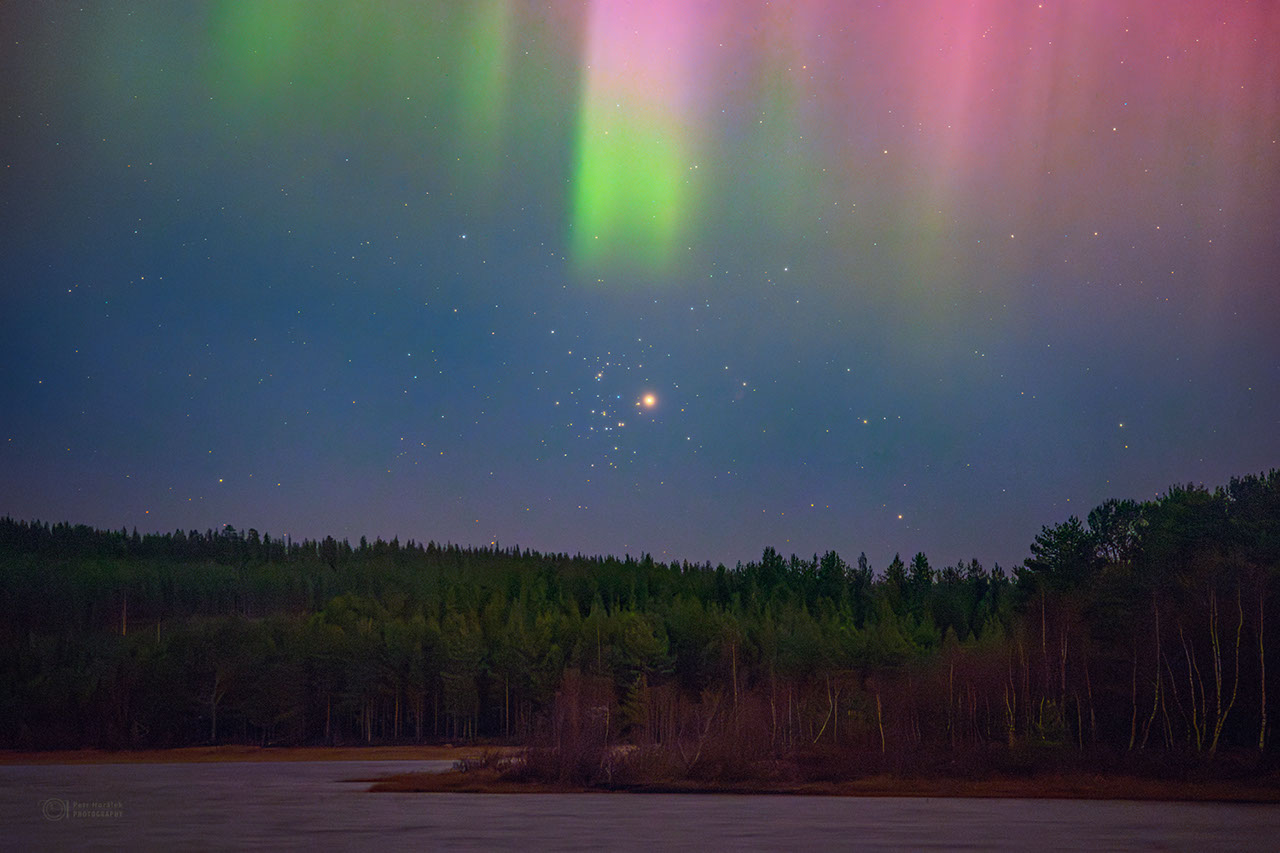
Cosmic photographer Petr Horálek has captured a rare celestial spectacle: the planet Mars positioned near the famed Beehive Cluster (M44), illuminated by a powerful aurora borealis. This remarkable convergence of cosmic and atmospheric phenomena was observed over Långaryd, Sweden, on October 14, 2026, a breathtaking display made possible by a potent solar storm impacting Earth.
Solar Storm Ignites the Heavens
On October 10, 2026, Earth experienced a significant geomagnetic storm triggered by a powerful solar flare. This event caused considerable disturbances in the planet’s magnetic field, leading to intense aurora displays. Energetic particles ejected from the Sun interact with molecules in Earth’s atmosphere, exciting them to emit light. The result is the vibrant auroral glow, historically revered by indigenous Sami peoples as “guovssahasat.”
A Celestial Encounter: Mars and the Star Cluster
Coinciding with this atmospheric light show, the planet Mars made a close approach to the center of the Beehive Cluster (also known as Messier 44 or Praesepe). While real bees have yet to venture into space, the “Beehive” is not an insect swarm but a stunning collection of young stars. Studying the rotation of these stars has provided scientists with insights into how stars gradually slow their spin over time, shedding mass through stellar winds.
Source: NASA