NASA scientists are investigating unexpected phenomena in engineering structures, particularly within the demanding environment of spaceflight, where lightly damped systems can exhibit complex vibrational behaviors. This phenomenon, detailed in a new study, occurs when two structural modes, close in frequency, interact through indirect damping. Understanding this process is crucial for ensuring the safety and reliability of spacecraft and their components.
The Problem: Unexpected Complexity
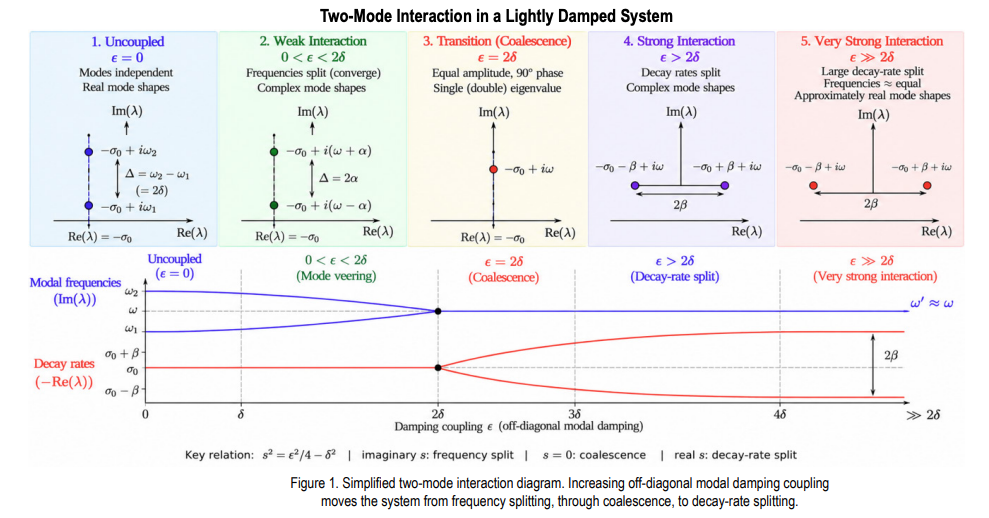
The classical approach to analyzing lightly damped structures often assumes that vibrational modes are simple and possess real shapes. However, when two structural modes (ways in which a structure can vibrate) are close in frequency and interact via indirect damping, a phenomenon known as ‘complex modes’ emerges. This means vibrations can become significantly more intricate than anticipated, potentially having serious consequences for structural integrity. Even a slight interaction between these modes can lead to complex vibration patterns. The stronger the interaction, the closer the modal frequencies become, and their shapes grow more convoluted. At a critical point, frequencies can nearly merge before diverging again, with different damping rates while frequencies remain similar. With very strong interaction, the mode shapes eventually return to being approximately real, but as a new combination of the initial modes.
Engineering Interpretation and Practical Implications
This research offers a straightforward physical interpretation for phenomena such as ‘mode veering,’ the formation of complex modes, ‘eigenvalue coalescence,’ and ‘decay-rate splitting.’ Importantly, the detection of complexity in vibration shapes does not always indicate strong damping, nonlinearity, or data deficiencies. For pairs of closely spaced modes, analyzing complex poles alongside the phase of the vibration shapes is critical. Approaching frequencies accompanied by components near quadrature (90 degrees) point to one situation (the imaginary direction of pole separation), while nearly equal frequencies with decaying rates suggest another (the real direction of pole separation). This concept also bridges analysis and practical testing. The parameter 2 = (λ1 – λ2)/2 can be derived from identified poles, while δ can be estimated from the calculated or measured analytical mode separation. These values allow for an assessment of the interaction strength and determination of how close the system is to a transition boundary, which is vital for preventing potential catastrophic failures.
Source: NASA