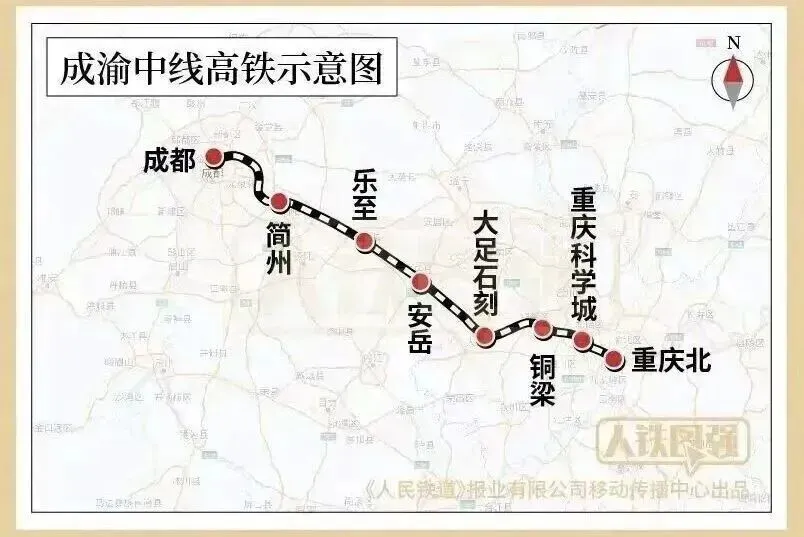
The construction of the Chengdu-Chongqing high-speed railway (also known as the Chengyu Zhongxian High-Speed Railway) has reached a significant milestone. On September 14th, the final section of the ballastless track slab was poured at the Jingkou Jialing River Grand Bridge construction site in Chongqing. This completion marks the end of all ballastless track construction for the entire line, laying a solid foundation for its timely opening.
Key Details of the Chengyu Zhongxian High-Speed Railway
Once operational, the Chengyu Zhongxian High-Speed Railway is set to drastically cut travel time between Chengdu and Chongqing to just 50 minutes. This advancement is expected to further optimize the regional transportation network and bolster the development of the Chengdu-Chongqing economic circle.
The Chengyu Zhongxian High-Speed Railway is a crucial component of China’s “Eight Vertical and Eight Horizontal” high-speed rail network, specifically the Yangtze River corridor. The line stretches approximately 292 kilometers, with a design speed of 350 kilometers per hour. It originates from Chongqing North Station in the Chongqing hub, heads west through various districts of Chongqing including Liangjiang New Area, Shapingba District, Bishan District, Tongliang District, and Dazu District, and then enters Sichuan Province, passing through Ziyang City before finally arriving at Chengdu Station in the Chengdu hub.
Enhancing Regional Connectivity
Upon completion, the Chengyu Zhongxian High-Speed Railway will connect seamlessly with other existing and under-construction lines. These include the operational Xi’an-Chengdu High-Speed Railway, the Zhengzhou-Chongqing High-Speed Railway, the under-construction Xining-Chengdu High-Speed Railway, and the Chengdu-Dazhou-Wanzhou High-Speed Railway. This integrated network will significantly improve the railway structure in the Chengdu-Chongqing region.
The enhanced connectivity will not only dramatically reduce travel times between Chengdu and Chongqing but also greatly facilitate convenient travel for residents along the entire route. This development is a testament to China’s ongoing investment in high-speed rail infrastructure, aiming to connect major economic centers and improve quality of life through efficient transportation.