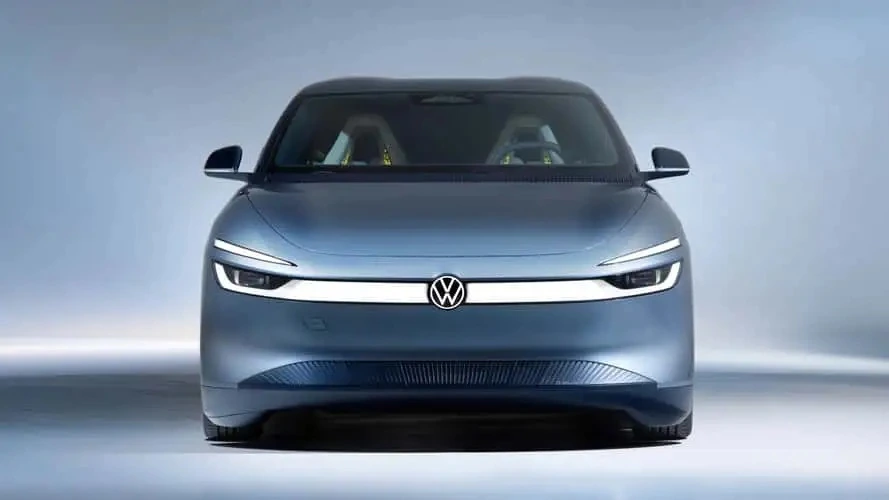
Volkswagen has unveiled its “Mission Efficiency” concept electric vehicle, a car that looks like it just emerged from a wind tunnel, and its impressive performance data validates its distinctive design. Built on the MEB+ platform with front-wheel drive, this new concept car shares its motor and battery with the ID. Polo compact car. Volkswagen has focused heavily on aerodynamics, weight reduction, and minimizing energy loss rather than relying on exotic powertrains to achieve its remarkable efficiency figures.
Aerodynamics Prowess and a Record-Breaking Drag Coefficient
The first record is directly related to its aerodynamic capabilities. The vehicle boasts a drag coefficient of 0.158, which Volkswagen claims makes the “Mission Efficiency” the most aerodynamic, road-legal car ever. Its frontal projection area is also exceptionally small, measuring just 2.08 square meters (22.4 sq ft), contributing significantly to the car’s extremely low air resistance.
Unprecedented Low Energy Consumption
The second record was set in an “ideal condition test”: driving at a constant speed of 68 km/h (42 mph) on a level surface with the air conditioning and all auxiliary systems turned off. Under these conditions, the “Mission Efficiency” consumed a mere 6.48 kWh per 100 kilometers. However, the most astonishing figures come from a longer, real-world test journey. Volkswagen drove the car from its Wolfsburg research center, passing through Poznań, Poland, and Olomouc, Czech Republic, finally arriving in Vienna.
The official recorded distance for the entire trip was 1278.36 km (794 miles), with an average speed of 67.72 km/h (42 mph) and a maximum speed of 138 km/h (86 mph). Including charging losses, the car consumed 7.51 kWh per 100 kilometers. Excluding charging losses, the consumption was an even lower 6.89 kWh per 100 kilometers.
With its 54.9 kWh usable capacity battery, the vehicle only required charging once during the entire journey. Upon arrival in Vienna, the official stated remaining range was 164 km (102 miles). This suggests that under the conditions of this record test, the car’s theoretical total range far exceeds 1400 km (870 miles).
Combining Efficiency Pursuit with Practicality
The third record is for the most energy-efficient near-production electric vehicle. Volkswagen has applied for certification from the German Record Institute (RID) for the “Mission Efficiency” in the category of “near-production, four-seater electric car for everyday use.”
Unlike many prototype vehicles built solely for extreme energy saving, this car retains a degree of practicality in its design. It is a 2+2 coupe with a large hatchback tailgate, offering 481 liters (17 cubic feet) of luggage space and additional storage compartments. The rear seats are suitable for passengers up to approximately 1.60 meters tall, and Volkswagen suggests that, in theory, this concept car could accommodate a family of four.
With the rear seats folded down, the cargo floor can extend up to 1.8 meters (5.9 feet). Storage bins are located under the rear seats, and additional storage space is also available behind the rear wheel arches.
The Electric Era Reimagining of the XL1
The exterior design of the “Mission Efficiency” heavily emphasizes aerodynamics, drawing inspiration from the XL1. This low-slung coupe measures 4775 mm in length, 1744 mm in width, and a mere 1392 mm in height. Its wheelbase is 2700 mm, 100 mm longer than the ID. Polo, while the overall length is an additional 722 mm longer.
The elongated body tapers towards the rear, forming a teardrop shape. The rear wheels are fully enclosed, and the roofline is long and sleek. The Wolfsburg development team calls the rear design a “boat tail,” where the narrowing tail allows airflow to follow the body as smoothly as possible before separating cleanly at the edge.
The front end integrates three active cooling vents that can switch between five operating modes individually or in coordination, allowing air intake only when needed. When all three vents are closed, the car achieves its drag coefficient of 0.158.
The wheels are another area of optimization, as wheel-induced air resistance accounts for approximately 25% to 30% of a vehicle’s total air resistance. Therefore, the “Mission Efficiency” is equipped with specially developed wheel spoilers to prevent airflow from entering the wheel wells and creating turbulence. The rear wheels are largely enclosed, and the front wheel arches fit snugly around the tires. The accompanying Continental special tires, based on the EcoContact 7, are designed to balance low rolling resistance with aerodynamic optimization of the sidewalls.
One surprising design choice is the deliberate retention of traditional exterior mirrors. Test results showed that camera-based mirrors offered limited efficiency gains that did not justify the additional cost and energy consumption.
The underbody of the vehicle is almost completely enclosed. Compared to the ID. Polo, Volkswagen narrowed the rear axle of this car by 170 mm to improve underbody airflow and complement the tapering rear design.
ID. Polo-Derived Hardware
Beneath the highly aerodynamic exterior lies familiar core hardware. The “Mission Efficiency” is powered by the same APP290 permanent magnet synchronous motor found in the ID. Polo, delivering 135 horsepower and 264 Nm of peak torque in this application. The motor itself weighs only 75 kg and is paired with a single-speed transmission.
The power comes from a 54.9 kWh ternary lithium battery. The usable capacity of this battery is slightly higher than that of the production ID. Polo. To achieve its record-breaking figures, Volkswagen temporarily increased the available power by 2.9 kWh through software adjustments. Volkswagen explains that production models intentionally reserve a portion of the battery’s capacity to ensure long-term battery life. The DC fast charging capacity is up to 105 kW, and AC charging supports 11 kW.
Engineers have also integrated photovoltaic panels into the glass roof and tailgate. This 370-watt solar system powers the vehicle’s low-voltage electrical systems rather than the main drive battery. Under ideal conditions, depending on the season, location, and weather, this solar system can add up to 30 km of range per day.
Integrated Devices Serve as Infotainment System
The extreme focus on efficiency extends to the interior. Instead of a traditional infotainment screen, Volkswagen has adopted a minimalist and practical approach reminiscent of the up! city car. Drivers can secure their Android or Apple smartphones or tablets on a rail, which then wirelessly connect to the vehicle, allowing the mobile device to handle multimedia functions.
Fixed speakers are also unnecessary. The “Mission Efficiency” uses portable Bluetooth speakers to save weight and reduce electrical components. The concept car also features lightweight seats and door panels, with some components designed for complete recyclability. Even the floor uses a lightweight composite material with a rubber anti-slip structure, eliminating the need for additional floor mats.
A Spiritual Successor to the XL1
Volkswagen previously took a similar approach with the XL1, and the “Mission Efficiency” can be seen as its spiritual successor in the electric era. The plug-in hybrid model from 2013 was essentially a mobile experiment exploring the lowest possible energy consumption for a car, featuring a lightweight body and a teardrop-shaped, ultra-low drag exterior, prioritizing efficiency above almost all other factors.
The “Mission Efficiency” continues this philosophy, applying it to a pure electric powertrain. Volkswagen has openly acknowledged the XL1 as its primary inspiration. While only 250 units of the XL1 were produced, Volkswagen has not yet revealed any production plans for this de facto successor.