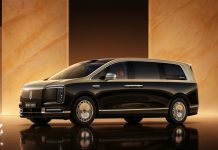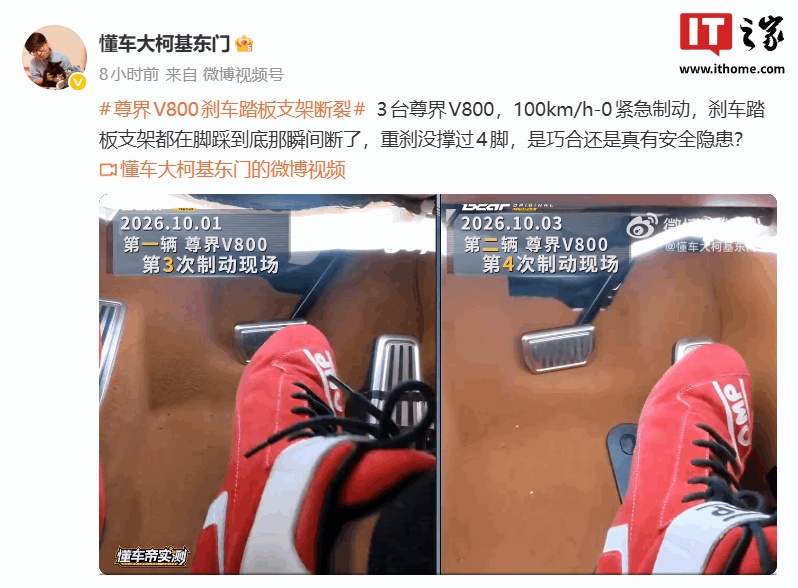
A recent test by Dongchedi involving three Jizhi V800 vehicles revealed a critical safety concern: the brake pedal bracket reportedly fractured during emergency braking from 100 km/h to 0. This incident has sparked widespread discussion online, prompting comments from notable figures, including Weibo CEO Wang Gaofei.
Initially reported by IT Home, the test results quickly became a hot topic. In response to the situation, a blogger named @Xiaoteshushu remarked on the complexities of car manufacturing, suggesting that a small oversight could lead to dire consequences. Wang Gaofei shared this post, adding his perspective on the matter.
It’s not necessarily a catastrophic abyss. Many manufacturers have had brake recalls. The core issue is whether there are any records of accidents caused by brake problems. If there aren’t, then the issue is a risk, not a fatal danger. Another point is how quickly the manufacturer can identify the problem and announce a recall… User trust in a brand’s safety isn’t about the brand having no safety issues, but about how outstandingly the brand handles safety issues.
Wang Gaofei elaborated on his views in the comments section, engaging with netizens. When a user questioned whether Huawei would recall the vehicles, citing a lack of prior recall history for Huawei-involved cars, Wang clarified the situation. He stated, “This is JAC. Is Huawei’s empowerment extending to how the brake pedal is manufactured?” This pointed to the fact that the V800 is a JAC vehicle, with Huawei providing technology empowerment.
Further addressing the distinction between a risk and a fatal danger, another user expressed confusion regarding the original statement. Wang explained, “It seems there was a previous case where a certain manufacturer recalled a component, but there were no accidents. This indicates that the issue, at the time of the recall, had not caused any accidents.” This implies that while the potential for failure exists, the critical factor for immediate severity is whether it has led to actual incidents.
The incident involving the Jizhi V800 has put a spotlight on vehicle safety and the response protocols of manufacturers. While the fracture of a brake pedal bracket is undeniably a serious concern, Wang Gaofei’s comments highlight a specific framework for assessing the immediacy of the threat: the presence or absence of accident records directly linked to the defect. He emphasizes that a manufacturer’s transparency and efficiency in addressing such issues are key to maintaining user trust, even when problems arise.
This situation also draws attention to the broader automotive industry, where recalls are not uncommon. The key differentiator, according to Wang’s perspective, lies in how effectively and transparently a company addresses safety concerns, rather than the complete absence of such issues. The focus remains on whether the identified problem has translated into real-world accidents and how swiftly the manufacturer acts to mitigate potential future risks.
Related reports indicate that JAC Motors’ stock price experienced a decline, with their investor relations department stating that quality control procedures are in place before vehicles leave the factory. JAC Motors personnel also acknowledged awareness of the situation and are monitoring the brake pedal bracket issue.